Written by Peter Morales-Brown — Fact checked by Jill Seladi-Schulman, Ph.D.
Semaglutide is a glucagon-like peptide 1 (GLP-1) receptor agonist that mimics a hormone to increase insulin secretion, slow gastric emptying, and reduce appetite.
The medication has Food and Drug Administration (FDA) approval for helping with long-term weight management and treating type 2 diabetes.
For many people, semaglutide is better known as the injectable drug Ozempic. However, many may not be aware that semaglutide has been available in oral form since it was approved by the FDA in 2019.

After previously announcing a rebrand and reformulation to Rybelsus in February 2026 to make the treatment more easily recognizable and bioavailable, Novo Nordisk announced that the “Ozempic pill” will be available for adults with type 2 diabetes in the United States starting Monday, May 4, 2026.
Highlighting that the oral pill can help improve blood glucose control alongside diet and exercise, while also reducing major cardiovascular events in adults with type 2 diabetes at increased risk, the pharmaceutical company adds that the pill will be available through 70,000+ U.S. pharmacies nationwide and select telehealth providers.
Rebrand and reformulation
Novo Nordisk’s Rybelsus was the first oral GLP-1 receptor agonist product approved by the FDA for the treatment of type 2 diabetes. It was available in 3 milligram (mg), 7 mg, and 14 mg tablets.
The oral pill was designed to help improve blood glucose control alongside diet and exercise, while also offering additional cardiometabolic benefits in certain high risk patients.
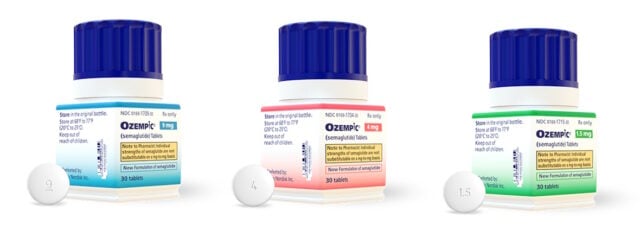
Now rebranded as the Ozempic pill, the updated formulation is available in different strengths of 1.5 mg, 4 mg, and 9 mg. In the press release, Novo Nordisk states that the Ozempic pill formulation is more bioavailable and works similarly to the Rybelsus tablets, offering the same efficacy and safety profile as the original formulation, but in a smaller pill.
The pharmaceutical company adds that people should take the new formulation the same way as before, so that people who were taking 3 mg should now take 1.5 mg, and so on.
While both injectable Ozempic and oral Rybelsus contain semaglutide and have approval for type 2 diabetes, Novo Nordisk suggest the brand name Ozempic is more synonymous with GLP-1 medications, hence the rename.
“While the oral form of semaglutide has been available for years as Rybelsus, the Ozempic branding is more widely recognized, which may lead to increased patient requests,” Mir Ali, MD, bariatric surgeon and medical director of MemorialCare Surgical Weight Loss Center at Orange Coast Medical Center in Fountain Valley, CA, told Medical News Today.
“Additionally, because the oral form has a longer shelf life, it may offer logistical advantages for certain prescribing patterns,” Ali explained.
Oral or injectable?
The choice between oral and injectable formulations is typically down to individual factors and preferences. It is advisable for a person to discuss options with their healthcare professional.
Generally, research suggests that injectable semaglutide achieves significantly greater HbA1c reductions compared to oral forms in those with type 2 diabetes.
Additionally, while the daily oral form may be preferable to weekly injections, research suggests that adverse events occur more frequently with oral semaglutide.
Speaking to MNT, Ali noted the potential advantages and disadvantages of oral GLP-1 medications:
“The primary advantages of oral GLP-1 medications are that they are easier to take, transport, and store. They are also typically less expensive to manufacture, which could lead to lower costs for patients. The disadvantages are that they are slightly less effective than injections and require daily instead of weekly administration.”
Novo Nordisk also outlined pricing arrangements they suggest will improve access to the Ozempic pill. For insured individuals, the medication may be available for $25 for up to a 3-month supply.
Self-pay options, available through Novo Nordisk’s pharmacy and select telehealth providers, are expected to range from approximately $149 to $299 per month, depending on dose strength, defining a month’s supply as one bottle of 30 pills.
This may offer a cheaper alternative to injectable Ozempic, as while a 3-month supply may also be available for $25, self-pay patients can expect to pay $349 per month for doses up to 1 mg and $499 for the 2 mg dose.
“Pricing and insurance coverage are significant factors in medication adherence,” Ali told MNT.
“High out-of-pocket expenses make patients less likely to seek or maintain treatment. Consequently, if costs remain high, individuals in lower socioeconomic areas with limited health coverage will face significant barriers to accessing these medications,” he added.
A shift toward oral GLP-1 treatments?
The rebrand of the Ozempic pill may reflect a broader shift in diabetes care toward GLP-1–based therapies, with the FDA approving Foundayo, an oral GLP-1 receptor agonist from Eli Lily, in April 2026.
While GLP-1-based therapies have traditionally been administered via injection, the oral formulations aim to provide a more convenient alternative for those who prefer not to use injectable medications.
Novo Nordisk adds that the pill is manufactured end-to-end in the U.S. and will be widely distributed through established pharmacy networks. They also note that this is the first time oral semaglutide for type 2 diabetes is being offered through their direct-to-patient service.
“Accessibility is critical, especially as these medications are in high demand and have faced shortages,” Ali highlights. “Lack of access often leads patients to switch to less effective alternatives or discontinue treatment entirely.”
Beyond blood sugar control, Novo Nordisk also states that the Ozempic pill is also approved for reducing the risk of major cardiovascular events, including heart attack, stroke, or death, in adults with type 2 diabetes who are at elevated risk.
“Real-world cardiovascular benefits are linked to weight loss, improved blood pressure, and reduced inflammation,” Ali notes. “Some studies have shown a reduction in major adverse cardiovascular events by 18-20%. Patients with diabetes, obesity, and existing atherosclerotic cardiovascular disease stand to benefit the most.”
Disclaimer
Artificial Intelligence Disclosure & Legal Disclaimer
AI Content Policy.
To provide our readers with timely and comprehensive coverage, South Florida Reporter uses artificial intelligence (AI) to assist in producing certain articles and visual content.
Articles: AI may be used to assist in research, structural drafting, or data analysis. All AI-assisted text is reviewed and edited by our team to ensure accuracy and adherence to our editorial standards.
Images: Any imagery generated or significantly altered by AI is clearly marked with a disclaimer or watermark to distinguish it from traditional photography or editorial illustrations.
General Disclaimer
The information contained in South Florida Reporter is for general information purposes only.
South Florida Reporter assumes no responsibility for errors or omissions in the contents of the Service. In no event shall South Florida Reporter be liable for any special, direct, indirect, consequential, or incidental damages or any damages whatsoever, whether in an action of contract, negligence or other tort, arising out of or in connection with the use of the Service or the contents of the Service.
The Company reserves the right to make additions, deletions, or modifications to the contents of the Service at any time without prior notice. The Company does not warrant that the Service is free of viruses or other harmful components.