The Syllable That Shook the World
On the evening of May 10, 2026, the world’s financial machinery came to a grinding, shuddering halt—only to restart moments later in a feverish, chaotic sprint. The catalyst was not a missile launch or a formal declaration of war, but a single, characteristically blunt post on Truth Social. President Donald Trump, reviewing the latest counter-proposal from the Iranian regime aimed at ending the months-long maritime blockade and conflict in the Middle East, delivered a verdict that was as brief as it was impactful: “TOTALLY UNACCEPTABLE.”
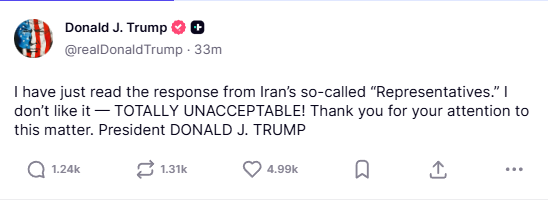
With that one phrase, months of back-channel diplomacy mediated by Pakistani officials evaporated. The “No” heard around the world has immediately recalibrated every major asset class, from the crude oil flowing through the Strait of Hormuz to the precious metals stored in vaults in Zurich and New York. As the sun rises on Monday, May 11, the global economy is grappling with the reality of a “Maximum Pressure 2.0” campaign that has moved from the realm of economic sanctions into active, high-stakes military and energy brinkmanship.

Crude Oil: The $100 Psychological Barrier Shattered

The immediate epicenter of the fallout is the crude oil market. For months, traders had been pricing in a “peace discount,” hoping that the ongoing ceasefire and Pakistani mediation would lead to a reopening of the Strait of Hormuz. Those hopes were doused in cold water on Sunday night.
As markets opened for the Asian trading session, West Texas Intermediate (WTI) crude futures surged nearly 3.3%, quickly testing the $98.50 level. Across the Atlantic, Brent Crude—the international benchmark—breached the psychological $104 per barrel mark. This surge represents more than just a reaction to a social media post; it is a fundamental reassessment of global supply security.
The Strait of Hormuz, a narrow waterway through which 20% of the world’s petroleum liquids pass, remains the world’s most dangerous chokehold. Iran’s proposal, which Trump rejected, had offered a gradual reopening of the Strait in exchange for the lifting of the U.S. naval blockade and the removal of sanctions on Iranian oil sales. By saying “no,” Trump has signaled that the blockade will continue until Tehran agrees to a full, 20-year dismantlement of its nuclear facilities—a demand the Iranian Revolutionary Guard Corps (IRGC) has repeatedly called a “non-starter.”
The “War Premium” is back with a vengeance. Analysts now predict that if the stalemate persists through the end of May, Brent could easily see $120 per barrel, a level not seen since the height of the 2022 energy crisis. For the global economy, this isn’t just about the price of a barrel; it’s about the cost of everything that moves, from groceries to industrial equipment.
The $6 Gasoline Nightmare and the Domestic Response
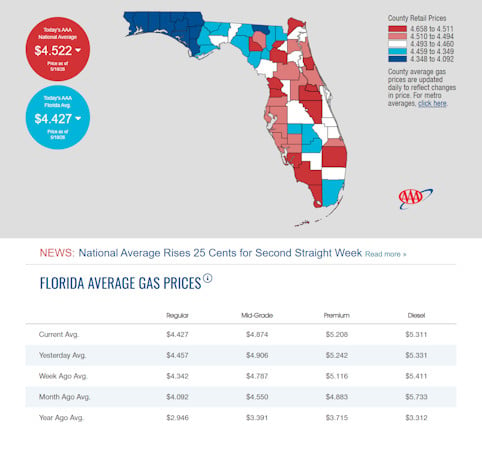
While the oil market is a game for traders in Manhattan and Dubai, the gasoline market is where the American consumer feels the “Trump No” most acutely. Even before this weekend’s rejection, the national average for a gallon of regular gasoline had climbed to $4.55, according to AAA. This represents a staggering $1.40 increase compared to the same time last year.
However, the “national average” hides the true extent of the pain in regional markets. In California and parts of the Pacific Northwest, drivers are already facing $6.00 per gallon at the pump. This “gasoline nightmare” is more than a nuisance; it is a direct threat to consumer sentiment and domestic political stability.
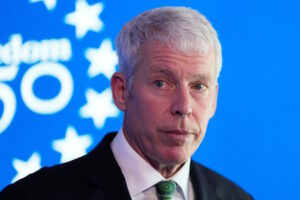
In a move that highlights the administration’s concern over “pump pain,” U.S. Secretary of Energy Chris Wright appeared on Face the Nation earlier today to signal a massive policy pivot. Wright confirmed that the Trump administration is officially considering a temporary suspension of the federal gasoline tax.
“We are looking at every tool in the shed to provide relief to the American family,” Wright stated. “If that means a federal gas tax holiday to offset the costs of standing up to a rogue regime, that is a sacrifice the federal government is willing to make.”
The proposal involves pausing the 18.4 cents-per-gallon federal tax. While some critics argue that 18 cents is a drop in the bucket compared to a $2.00 price increase, the psychological impact of government action cannot be understated. However, this “Gas Tax Gambit” faces hurdles in Congress, where lawmakers are concerned about the long-term impact on the Highway Trust Fund, which relies on that revenue to maintain the nation’s infrastructure.
Stock Futures: Volatility and the $7 Billion Short
 Wall Street’s reaction to the “Trump No” has been a masterclass in volatility. Stock futures for the Dow Jones and S&P 500 initially tumbled as the news of the rejection broke, as investors feared the inflationary impact of sustained high energy prices. High energy costs act as a “stealth tax” on consumers, reducing discretionary spending and increasing the cost of goods for corporations.
However, a secondary story is brewing in the shadows of the trading floor. The Commodity Futures Trading Commission (CFTC) is currently investigating what has been described as “highly suspicious” trading activity. Reports indicate that roughly $7 billion in short positions were placed against global indices just hours before President Trump’s Truth Social post.
The timing has raised eyebrows from Washington to London. “The precision of these trades suggests either incredible foresight or a massive breach of diplomatic confidentiality,” one senior analyst noted. The investigation into these “short-sellers of war” adds a layer of intrigue to an already tense market environment, as the feds look for evidence of insider trading linked to the administration’s internal deliberations on the Iranian proposal.
Precious Metals: The Safe Haven Paradox
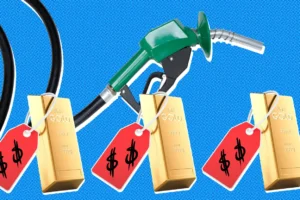 In times of geopolitical chaos, investors traditionally flock to gold and silver. True to form, Gold prices saw a significant uptick following the Sunday night rejection, trading near the $4,730 per ounce mark. Silver also led the complex with a nearly 3% gain, settling around $81.11 per ounce.
The 2026 precious metals market, however, is operating under a unique set of constraints. While safe-haven demand is high, the “Trump No” has also led to a significant strengthening of the U.S. Dollar. Because Trump’s aggressive foreign policy is viewed as a projection of American strength, the USD has become the ultimate “safe-haven currency.” Since gold is denominated in dollars, a stronger greenback actually puts a ceiling on how high gold can rally.
Investors are currently caught in a tug-of-war: the fear of a broader Middle Eastern war is pushing gold up, while the surging value of the dollar is pulling it down. For silver, the story is more industrial. As a key component in military technology and AI hardware, silver is seeing dual demand as both a monetary hedge and a critical strategic resource in the ongoing conflict.
The “Wright” Policy: Chris Wright and the Energy Pivot
Secretary Chris Wright’s role in this crisis cannot be understated. As a former fracking executive and the founder of Liberty Energy, Wright has been a champion of “Energy Dominance.” However, his tenure has been marked by controversy, with organizations like Climate Power highlighting that his former companies have benefited immensely from the price surges triggered by the conflict.
Wright’s suggestion of a federal gas tax holiday is a clear attempt to manage the domestic fallout of the administration’s foreign policy. By pausing the federal tax, the administration hopes to buy enough time for domestic production to ramp up and eventually stabilize the market. But with the Strait of Hormuz effectively a war zone, the question remains: Can American shale make up for a 20 million-barrel-per-day shortfall?
Conclusion: The High Price of a Hard Line
The events of May 10, 2026, have clarified the stakes for the remainder of the year. President Trump has signaled that he is willing to accept—and perhaps even leverage—market volatility to achieve his goal of a totally denuclearized Iran. For the global economy, this means that the “war premium” is no longer a temporary spike, but a structural feature of the 2026 landscape.
As crude oil eyes $110, gasoline hits $6, and stock futures swing on every syllable from the Oval Office, the “Trump No” will be remembered as the moment the 2026 economic trajectory shifted from recovery to resilience. Whether the federal gas tax holiday and safe-haven assets can protect the average citizen remains to be seen.
Sources Used and Links:
- Marine Link: Oil Prices Rise As US-Iran Fighting Continues https://www.marinelink.com/news/oil-prices-rise-usiran-fighting-continues-538986
- LiveNOW from FOX: Some lawmakers call for federal gas tax suspension: What to know https://www.livenowfox.com/news/some-lawmakers-call-federal-gas-tax-suspension-what-know
- YouTube (Times of India): $6 GAS NIGHTMARE Forces Trump Into SHOCK ACTION, Pause On Federal Tax Soon? https://www.youtube.com/watch?v=v3Ap4wrw1mI
- The Guardian: Oil and gas prices fall sharply, driven by hopes of strait of Hormuz reopening https://www.theguardian.com/business/live/2026/may/06/oil-prices-retreat-global-stocks-hit-record-highs-trump-great-progress-iran-deal-live-updates
- Texas Precious Metals: Precious Metals Update: Iran Risk Boosts Metals May 8, 2026 https://texmetals.com/all-news/precious-metals-market-update-5-8-2026
- Investing.com: Trump calls Iran’s response on nuclear dismantlement ’totally unacceptable’ https://www.investing.com/news/economy-news/fragile-ceasefire-holds-in-middle-east-while-us-awaits-iranian-war-response-4674735
- The Business Times: Trump calls Iran’s response to US peace proposal ‘unacceptable’; oil prices jump https://www.businesstimes.com.sg/international/global/trump-calls-irans-response-us-peace-proposal-unacceptable-oil-prices-jump
- AAA Gas Prices: National Average Rises 25 Cents for Second Straight Week https://gasprices.aaa.com/national-average-rises-25-cents-for-second-straight-week/
- Climate Power: Secretary Wright’s Oil Company Paid Zero US Taxes as Americans Pay Billions More at the Pump https://climatepower.us/news/happy-tax-day-secretary-wrights-oil-company-paid-zero-us-taxes-as-americans-pay-billions-more-at-the-pump/
- U.S. Department of Energy: Chris Wright | Department of Energy https://www.energy.gov/person/chris-wright
Disclaimer
Artificial Intelligence Disclosure & Legal Disclaimer
AI Content Policy.
To provide our readers with timely and comprehensive coverage, South Florida Reporter uses artificial intelligence (AI) to assist in producing certain articles and visual content.
Articles: AI may be used to assist in research, structural drafting, or data analysis. All AI-assisted text is reviewed and edited by our team to ensure accuracy and adherence to our editorial standards.
Images: Any imagery generated or significantly altered by AI is clearly marked with a disclaimer or watermark to distinguish it from traditional photography or editorial illustrations.
General Disclaimer
The information contained in South Florida Reporter is for general information purposes only.
South Florida Reporter assumes no responsibility for errors or omissions in the contents of the Service. In no event shall South Florida Reporter be liable for any special, direct, indirect, consequential, or incidental damages or any damages whatsoever, whether in an action of contract, negligence or other tort, arising out of or in connection with the use of the Service or the contents of the Service.
The Company reserves the right to make additions, deletions, or modifications to the contents of the Service at any time without prior notice. The Company does not warrant that the Service is free of viruses or other harmful components.