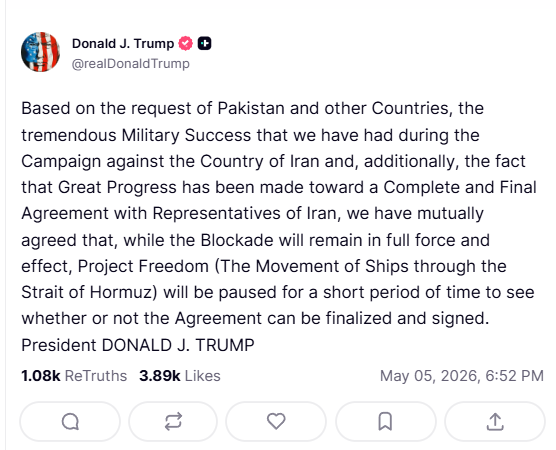
WASHINGTON, D.C. — In a characteristic late-evening maneuver that has sent shockwaves through global energy markets and the halls of the Pentagon, President Donald Trump announced on Tuesday that he is calling a “temporary halt” to Project Freedom. The high-stakes military initiative, launched just days ago to break the Iranian blockade of the Strait of Hormuz, has been suspended to allow for what the President describes as a “complete and final agreement” with Tehran.
The announcement, delivered via the President’s Truth Social platform, marks a dramatic pivot in a month-long standoff that has brought the world’s most critical maritime chokepoint to a grinding halt. While the U.S. naval blockade of Iranian ports remains “in full force and effect,” the active movement of commercial ships under the protective wing of the U.S. Navy has been paused.
The Midnight Pivot: Diplomacy Over Destroyers?
The President’s decision follows a chaotic 48 hours in the Persian Gulf. As recently as Monday, May 4, U.S. Central Command (CENTCOM) reported active hostilities, with American forces destroying six Iranian small boats and intercepting a swarm of drones and cruise missiles directed at commercial traffic.

“Based on the request of Pakistan and other Countries, the tremendous Military Success that we have had during the Campaign against the Country of Iran and, additionally, the fact that Great Progress has been made toward a Complete and Final Agreement with Representatives of Iran, we have mutually agreed that… Project Freedom will be paused for a short period of time,” the President wrote.
The shift from a “defensive dome” strategy to a diplomatic pause suggests that the administration may be seeking an off-ramp for Operation Epic Fury, the broader U.S.-Israeli campaign that has simmered since early 2026.
What is Project Freedom?
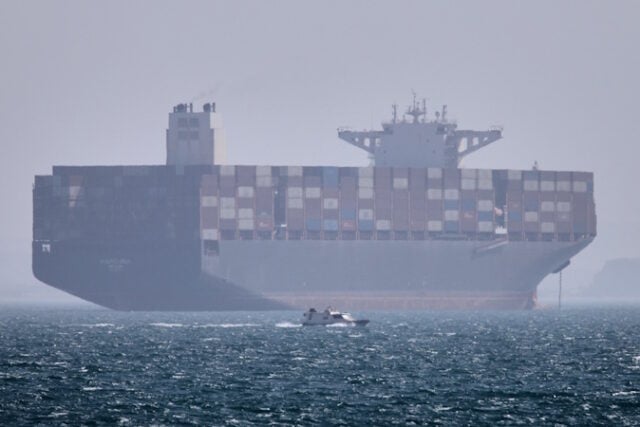
Launched on May 3, 2026, Project Freedom was designed to be the administration’s solution to a global shipping paralysis. Since April, an estimated 1,600 commercial vessels have been trapped on either side of the Strait of Hormuz, unable to transit due to Iranian threats and the prohibitive cost of war-risk insurance.
The “Red, White, and Blue Dome”
Defense Secretary Pete Hegseth described the project as a “maritime security corridor” rather than a traditional escort mission. The strategy utilized a massive concentration of:
- Guided-missile destroyers on station to provide 24/7 overwatch.
- Integrated air defense systems designed to neutralize “asymmetric threats” like drone swarms.
- Intelligence sharing and satellite-guided safe passage routes for “peaceful commercial vessels.”
The goal was to provide a “thick layer of defense” to lower the war-risk premiums that had sent national gas prices soaring to a national average of $4.46 per gallon.
The Economic Brinkmanship of May 2026
The temporary halt comes at a moment of extreme economic sensitivity. Energy experts have warned that if the Hormuz blockade is not resolved by mid-month, a national average of $5.00 per gallon for gasoline is “baked in.” This domestic pressure is compounded by the President’s upcoming diplomatic calendar.
Next week, President Trump is scheduled to arrive in Beijing for a high-profile summit with Chinese leader Xi Jinping. Given that China is the world’s largest importer of crude oil—much of which passes through the very Strait currently being contested—the President’s leverage in trade talks is inextricably tied to his ability to “free the flow” of energy.
Treasury Secretary Scott Bessent noted on Monday that the administration expects China to “step up with some diplomacy” to assist in the de-escalation. By pausing the military escorts now, Trump appears to be clearing the deck for a coordinated international resolution that might involve Beijing and Islamabad as key mediators.
The Role of Pakistan and International Mediators
The President specifically cited a request from Pakistan as a catalyst for the pause. Diplomats in Islamabad have reportedly been working behind the scenes to facilitate a “30-day agreement” that would see Iran lift its blockade in exchange for limited sanctions relief and a cessation of strikes under Operation Epic Fury.
While the “pause” is a humanitarian gesture aimed at countries that are “victims of circumstance,” the administration has been careful to maintain its “Maximum Pressure” posture. The U.S. naval blockade of Iranian oil exports continues, effectively strangling Tehran’s primary source of revenue while the negotiations proceed.
Political Fallout: Hawks vs. Pragmatists
The sudden halt has reignited the debate within the Republican Party regarding the direction of the 2026 conflict.
- The Hawks: Figures like Senator Lindsey Graham have signaled that anything short of a decisive military victory over the Iranian Revolutionary Guard Corps (IRGC) risks projecting weakness.
- The Pragmatists: The “America First” wing of the party remains focused on the domestic economy. For many in this camp, Project Freedom was always a means to an end: lower gas prices and the restoration of global supply chains.
Democrats in Washington have met the news with skepticism, with some questioning whether the “Significant Progress” claimed by the President is a substantial breakthrough or a tactical retreat following the firefight on May 4.
The “Epic Fury” Context
It is impossible to separate Project Freedom from the broader context of Operation Epic Fury. This overarching campaign has seen the U.S. and Israel target Iranian infrastructure in response to regional escalations earlier this year.
Admiral Bradley Cooper, head of CENTCOM, clarified earlier this week that Project Freedom was technically “operationally separate” from the combat missions of Epic Fury. This distinction was intended to signal to Tehran that the U.S. was willing to protect shipping without necessarily expanding the war—a “red, white, and blue dome” that shielded commerce but did not necessarily strike back unless provoked.
However, the events of May 4—including the destruction of six Iranian boats—showed that the line between “protection” and “combat” is razor-thin. By pausing the project now, Trump may be attempting to prevent the ceasefire from dissolving into a multi-front regional war.
Looking Ahead: The 30-Day Window
The world now watches the “Agreement” the President alluded to. Iranian state media has confirmed receiving a U.S. response to their latest peace proposal, which reportedly sets a 30-day deadline for a final signature.
If successful, this could be the defining diplomatic achievement of Trump’s second term—a “Deal of the Century” for the Middle East that restores the world’s energy lifeline without a full-scale invasion. If the talks fail, however, the “red, white, and blue dome” will likely return with even greater force.
For now, the 1,600 ships in the Gulf remain at anchor, and the American consumer remains at the mercy of the pump. The halt is temporary, the blockade is total, and the stakes could not be higher.
Sources Used
-
Anadolu Agency: “Trump announces pause on ‘Project Freedom’ in Strait of Hormuz”
-
Asia Economy: “Trump: ‘Significant Progress in Iran Talks… ‘Project Freedom’ Temporarily Suspended'”
-
Bloomberg Government: “Trump Says He Will Pause Project Freedom for ‘Short Period’”
-
NBC Palm Springs: “Strait of Hormuz Hostilities: Trump’s ‘Project Freedom’ Sparks Firefight as US-Iran Ceasefire Fractures”
-
The Economic Times: “The red, white and blue dome: Trump makes risky move to free Hormuz”
-
Red River Farm Network: “White House Introduces Plan to Ease Shipping Crisis”
-
United States Studies Centre: “President Trump announces ‘Project Freedom'”
Disclaimer
Artificial Intelligence Disclosure & Legal Disclaimer
AI Content Policy.
To provide our readers with timely and comprehensive coverage, South Florida Reporter uses artificial intelligence (AI) to assist in producing certain articles and visual content.
Articles: AI may be used to assist in research, structural drafting, or data analysis. All AI-assisted text is reviewed and edited by our team to ensure accuracy and adherence to our editorial standards.
Images: Any imagery generated or significantly altered by AI is clearly marked with a disclaimer or watermark to distinguish it from traditional photography or editorial illustrations.
General Disclaimer
The information contained in South Florida Reporter is for general information purposes only.
South Florida Reporter assumes no responsibility for errors or omissions in the contents of the Service. In no event shall South Florida Reporter be liable for any special, direct, indirect, consequential, or incidental damages or any damages whatsoever, whether in an action of contract, negligence or other tort, arising out of or in connection with the use of the Service or the contents of the Service.
The Company reserves the right to make additions, deletions, or modifications to the contents of the Service at any time without prior notice. The Company does not warrant that the Service is free of viruses or other harmful components.