WASHINGTON — At 8:00 AM EDT on Tuesday, May 5, 2026, the atmosphere inside the Pentagon’s briefing room was one of calculated urgency. Defense Secretary Pete Hegseth and General Dan “Razin” Caine, Chairman of the Joint Chiefs of Staff, stepped to the lectern to deliver what may be the most pivotal military update since the conflict with Iran began ten weeks ago. The announcement was the official launch of Project Freedom, a dedicated U.S. military mission designed to forcibly, yet “defensively,” reopen the Strait of Hormuz—the world’s most critical energy artery that has been effectively paralyzed by an Iranian blockade and a cycle of high-intensity maritime warfare.
The briefing comes at a fragile moment. While a shaky ceasefire has technically been in place since April 8, the last 48 hours have seen a surge in “gray zone” hostilities, including drone strikes on UAE oil facilities and the continued entrapment of over 22,500 mariners in the Persian Gulf. Secretary Hegseth’s message was clear: the United States will no longer allow the global economy to be held hostage by Tehran’s control of the waterway, even as it seeks to avoid a return to full-scale “Project Epic Fury” combat operations.
The Architecture of Project Freedom
Secretary Hegseth described Project Freedom as a “separate and distinct” endeavor from the broader war effort. According to Hegseth, the mission is narrow in scope: the protection of innocent commercial shipping from Iranian aggression.
“The blockade remains in force by Iranian decree, but it is a blockade of fear, not of fact,” Hegseth stated. “Iran is embarrassed. They claim to control the Strait, but they do not. Today, the United States is establishing a ‘dome’ across the waterway—a gift to the rest of the world to ensure the flow of commerce continues.”

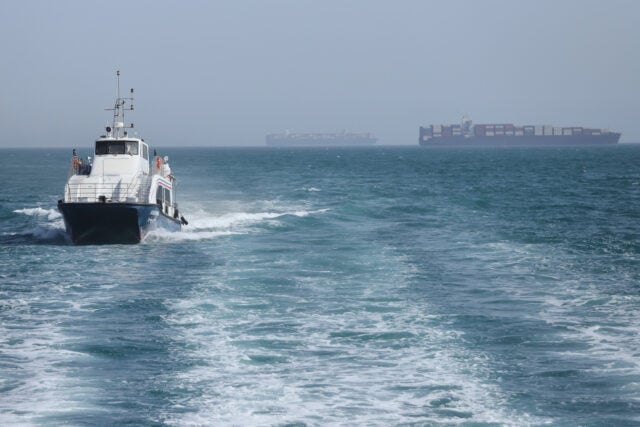
The strategic “dome” mentioned by Hegseth refers to a layered defense architecture of Aegis-equipped destroyers, carrier-based air cover, and a massive deployment of autonomous surveillance drones. Under Project Freedom, the U.S. Navy will not merely patrol the region but will actively “guide” commercial vessels through the narrow transit lanes. General Caine clarified that this guidance involves real-time intelligence sharing to avoid Iranian minefields and a standing order to engage any Iranian fast-attack craft or drones that attempt to interfere with merchant hulls.
Crucially, Hegseth emphasized that U.S. forces would not need to enter Iranian territorial waters or airspace to achieve these goals. “We aren’t looking for a fight,” he added, “but if Iran attacks commercial shipping, they will face overwhelming firepower.”
The Human and Economic Toll
General Dan Caine provided a sobering update on the human cost of the maritime standoff. Since the outbreak of hostilities on February 28, the Strait has become a graveyard of stalled commerce.
“There are currently some 22,500 mariners trapped in the Gulf,” Caine reported. These crews, hailing from dozens of nations, have been caught in a limbo of expiring supplies, heat exhaustion, and constant proximity to military engagements. General Caine noted that while the April 8 ceasefire stopped the massive missile exchanges between the two nations, it did little to clear the path for these vessels.
The economic implications have reached a breaking point. About one-fifth of the world’s oil and natural gas transits the Strait. The effective closure has sent fuel prices skyrocketing globally, rattling Western economies and forcing nations like Japan to seek expensive, long-haul alternatives, including recent shipments from Russia. Hegseth noted that it isn’t just oil; fertilizer and petroleum-derived products—essential for global food security—are also stuck behind the Iranian line.
A Shaky Ceasefire Under Pressure
The urgency of Project Freedom is driven by a series of weekend escalations. On Monday, May 4, an Iranian drone strike targeted an oil facility in Fujairah, UAE—a key hub that allows oil to bypass the Strait. This was followed by reports of a cargo ship ablaze off the coast of the Emirates and the UAE issuing its first three missile alerts since the ceasefire began.
Iran has framed these incidents as a response to “U.S. military adventurism.” Iranian Foreign Minister Abbas Araghchi warned on social media that the U.S. and UAE should be wary of being “dragged back into a quagmire.” Tehran’s stance is that any U.S.-led effort to create an “illegal passage” through the Strait constitutes a violation of the ceasefire.
General Caine addressed these threats directly during the briefing. He acknowledged that Iran has fired at commercial vessels nine times and seized two container ships since April 8. However, he maintained that these attacks have so far fallen “below the threshold” of restarting major combat operations.
“The ceasefire is not over,” Hegseth reiterated. “We are in a phase of defensive posture. We expected some friction as we began to move these ships, but our resolve is iron-clad.”
The Political Battle at Home
Beyond the physical battlefield, Hegseth and Caine are navigating a complex political landscape in Washington. The briefing follows two days of intense testimony before the House and Senate Armed Services committees.
The Trump administration is currently pushing for a historic $1.5 trillion defense budget for 2027, citing the need for a massive expansion of the Navy’s drone and missile defense capabilities to sustain operations like Project Freedom. Hegseth has faced sharp questioning from Democrats and some fiscal conservatives regarding the 60-day War Powers Resolution deadline. As of May 5, the administration is technically operating past the window for Congressional approval for the initial conflict, though Hegseth argued today that the new escort mission is a “temporary, defensive” action that falls under existing executive authority.
“We will not entangle Iran in a nation-building project,” Hegseth told reporters, responding to fears of a “forever war.” “This is a mission of maritime security, not regime change.”
Tactical Reality: The Six-Ship Standoff
One of the most striking details revealed in today’s update was the report of a direct confrontation within the last 24 hours. General Caine confirmed that six merchant ships attempted to break through the Iranian-enforced blockade from Iranian ports, likely carrying sanctioned goods or supplies for IRGC proxies.
These ships were intercepted and stopped by U.S. naval forces. Caine reported that the vessels eventually complied with directions to turn back. This successful interdiction served as a live-fire demonstration of the “dome” Hegseth described—a signal to Tehran that while the U.S. is not currently launching strikes on the Iranian mainland, it maintains total control of the sea lanes.
International Response and The Road Ahead
The reaction from the international community has been mixed. While the UAE and Oman have condemned the recent Iranian strikes on their territory, there is palpable anxiety about the U.S. “guidance” plan. Many shipping companies are hesitant to move their vessels even with a U.S. escort, fearing they will become primary targets for Iranian “low-level harassment” or sophisticated mine attacks.
Hegseth called on the rest of the world to “step up” and join the protection mission. He suggested that at the “appropriate time,” a coalition of nations would take over the escort duties, allowing the U.S. to scale back its presence.
For now, the world watches the narrow 21-mile-wide stretch of water between Oman and Iran. With 22,500 lives on the line and the global economy teetering, the success of Project Freedom is not just a military goal—it is a survival necessity. Hegseth concluded the briefing with a final warning: “The era of the Iranian chokepoint is over. We are moving the ships.”
Sources Used and Links:
- The Independent: “Hegseth claims Strait of Hormuz actions are ‘separate and distinct’ from Iran war” https://www.independent.co.uk/news/world/americas/us-politics/trump-iran-war-hormuz-hegseth-b2970677.html
- The Guardian: “Middle East crisis live: Hegseth gives Iran war update amid growing tensions in strait of Hormuz” https://www.theguardian.com/world/live/2026/may/05/iran-us-israel-lebanon-strait-of-hormuz-ships-oil-uae-latest-news-updates
- KARE 11 (TEGNA): “Defense Secretary Hegseth announces Project Freedom in effort to reopen the Strait of Hormuz” https://www.kare11.com/article/news/nation-world/attack-on-iran/pentagon-press-briefing-defense-secretary-pete-hegseth-iran-war-strait-of-hormuz-military/507-01d3e217-da98-4b1b-a6a4-b04f43a87a07
- KSAT (AP): “The Latest: US pushes to reopen Strait of Hormuz as Iranian attacks on UAE strain ceasefire”https://www.ksat.com/news/politics/2026/05/04/the-latest-trump-launches-a-new-effort-to-reopen-the-strait-of-hormuz/
- International Crisis Group: “Strait of Hormuz Flashpoints” https://www.crisisgroup.org/trigger-list/iran-usisrael-trigger-list/flashpoints/strait-hormuz
- Just Security / Axios: “Early Edition: May 5, 2026” https://www.justsecurity.org/138024/early-edition-may-5-2026/
- Fox 43: “Pentagon holds press briefing as tensions continue to escalate in the Strait of Hormuz” https://www.fox43.com/article/news/nation-world/attack-on-iran/pentagon-press-briefing-defense-secretary-pete-hegseth-iran-war-strait-of-hormuz-military/507-01d3e217-da98-4b1b-a6a4-b04f43a87a07
Disclaimer
Artificial Intelligence Disclosure & Legal Disclaimer
AI Content Policy.
To provide our readers with timely and comprehensive coverage, South Florida Reporter uses artificial intelligence (AI) to assist in producing certain articles and visual content.
Articles: AI may be used to assist in research, structural drafting, or data analysis. All AI-assisted text is reviewed and edited by our team to ensure accuracy and adherence to our editorial standards.
Images: Any imagery generated or significantly altered by AI is clearly marked with a disclaimer or watermark to distinguish it from traditional photography or editorial illustrations.
General Disclaimer
The information contained in South Florida Reporter is for general information purposes only.
South Florida Reporter assumes no responsibility for errors or omissions in the contents of the Service. In no event shall South Florida Reporter be liable for any special, direct, indirect, consequential, or incidental damages or any damages whatsoever, whether in an action of contract, negligence or other tort, arising out of or in connection with the use of the Service or the contents of the Service.
The Company reserves the right to make additions, deletions, or modifications to the contents of the Service at any time without prior notice. The Company does not warrant that the Service is free of viruses or other harmful components.