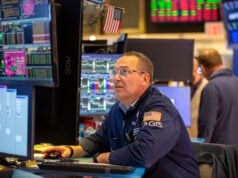
NEW YORK — The gavel fell on a historic day for the American financial system as the stock market closed at an all-time high this Thursday, April 30, 2026. In a session defined by relentless optimism and a resilient economic backdrop, the S&P 500 climbed to a never-before-seen closing price of 7,162.40, marking a pivotal moment in the current bull cycle that began in late 2022.
The day’s gains were fueled by a “perfect storm” of positive catalysts: a cooling PCE price index, the continued integration of generative AI into the industrial backbone, and a surprisingly robust labor market. Despite lingering geopolitical tensions in the Middle East that have pressurized energy markets, equity investors signaled a clear vote of confidence in the “soft landing” engineered by the Federal Reserve over the last three years.
The Numbers: A Triple Crown of Records
It was not just the S&P 500 that claimed glory today. The Dow Jones Industrial Average surged 412 points to close at a record 45,892.15, while the tech-heavy Nasdaq Composite outperformed its peers with a 1.8% jump, finishing at 21,245.80.
The breadth of today’s rally was particularly notable. Unlike the “Magnificent Seven” era of 2023 and 2024, where a handful of mega-cap tech stocks carried the entire market, today’s performance showed a “broadening bull market.” Small-cap stocks via the Russell 2000 also posted gains, suggesting that the benefits of cheaper capital and technological efficiency are finally trickling down to the broader economy.

The “Powell Swan Song” and the Fed’s Path
Central to the market’s enthusiasm today was the reaction to Federal Reserve Chair Jerome Powell’s recent appearances. With 2026 being a transitional year for the central bank, analysts have dubbed this period the “Powell Swan Song.” On Wednesday, Powell hinted that the tightening cycle was firmly in the rearview mirror, as core inflation (Core PCE) for March rose by just 0.3%, matching analyst expectations and bringing the year-on-year core figure to a manageable 3.2%.
“The Fed has successfully navigated the most difficult economic tightrope in forty years,” said a senior strategist at J.P. Morgan Global Research. “We are moving from a cycle of aggressive easing in 2025 to a ‘simultaneous hold’ at levels that support growth without reigniting the inflationary fires.”
This sentiment was echoed in the bond market. The yield on the 10-year Treasury note settled near 4.39%, while the 2-year Treasury traded near 3.89%. The narrowing gap between short-term and long-term yields—a reversal of the long-standing inversion—further boosted the narrative that a recession is no longer the base-case scenario for 2026.
The AI Engine: Beyond the Hype
If 2023 was the year of AI curiosity and 2024 was the year of AI infrastructure, 2026 has become the year of AI implementation. Today’s record high was largely driven by the second-wave AI boom—companies that aren’t just making the chips, but are using them to revolutionize their bottom lines.
Tech giants reported earnings earlier this week that showed massive productivity gains attributed to autonomous systems and LLM-integrated workflows. These efficiency gains have allowed corporations to maintain high margins even as labor costs rose. In today’s session, the technology sector led the charge, but was closely followed by healthcare and industrial firms that have successfully integrated AI into drug discovery and supply chain logistics.
Labor Market Resilience: A Multi-Year High
The “Goldilocks” nature of the current economy was further validated this morning by the Department of Labor. First-time claims for unemployment benefits dropped to a multi-year low of 189,000 for the week ending April 25. This labor market strength, combined with a 0.6% rise in personal income for March, has provided the American consumer with the “dry powder” necessary to keep the engine of consumption running.
“One week does not make a trend, but these are very good numbers,” noted market commentators at StoneX. “We are seeing a start to a stronger jobs market than many anticipated for the second quarter of 2026.”
Geopolitical Friction vs. Market Momentum
The climb to record highs today was not without its obstacles. Crude oil prices remained volatile, with WTI crude trading near $104 per barrel and Brent near $114. This volatility stems from the ongoing closure of the Strait of Hormuz and fears of resumed strikes in the Middle East.
Historically, such energy shocks would have sent the stock market into a tailspin. However, the modern U.S. economy’s decreased reliance on foreign oil, coupled with a massive pivot toward renewable energy infrastructure, has buffered the impact. Investors today focused on the “rotation” of capital; as money flowed out of food and energy commodities, it sought refuge and growth in the high-performing equity markets.
Sector Deep Dive: The Winners of April 30
- Technology (+2.1%): Led by semiconductors and cloud infrastructure providers. The “winner-takes-all” dynamic remains present but is diversifying into niche AI applications.
- Financials (+1.4%): Banks benefited from the stabilizing yield curve and a surge in deal-making as corporate mergers hit a two-year high.
- Consumer Discretionary (+1.2%): Retailers saw a boost following the personal consumption expenditures report which showed that spending rose 0.9% in March.
- Energy (-0.5%): The only major sector to lag today, as concerns over Middle East stability led to profit-taking in the oil majors.
Analyst Perspectives: Bubble or New Normal?
Despite the celebrations, some voices on Wall Street are urging caution. With the S&P 500’s Shiller CAPE ratio—a measure of valuation based on ten years of earnings—hovering near 36.48, critics argue the market is “priced for perfection.”
Goldman Sachs Research analysts noted that while they remain “constructive” on equities for the remainder of 2026, they expect lower index returns than the blockbuster 23% seen in 2024. “Tensions with ‘hot valuations’ may increase volatility in the second half of the year,” their latest report warned.
However, the consensus among the major firms—including Goldman and J.P. Morgan—is that the global economy remains sturdy. The 2.0% annualized GDP growth recorded in the first quarter of 2026 suggests that the U.S. continues to outperform its global peers, particularly as Japan and the Eurozone face more structural headwinds.
What This Means for the Average Investor
For the millions of Americans watching their 401(k) balances, today’s record high is a testament to the power of long-term compounding. The S&P 500 has delivered a staggering compound annual growth rate of approximately 11.5% over the last decade, overcoming a global pandemic, a spike in inflation, and multiple geopolitical crises.
As the VIX (the market’s “fear gauge”) remains below 18, the message from the floor of the New York Stock Exchange today was one of sustained, if watchful, optimism. The stock market is not just reflecting today’s profits, but is betting on a future where American innovation and a disciplined Federal Reserve continue to defy the skeptics.
As the closing bell rang at 4:00 PM ET, traders on the floor broke into rare applause. In a world that has felt increasingly uncertain, the scoreboard at 11 Wall Street offered a rare, clear victory: an all-time high that few would have predicted just two years ago.
Sources Used and Links:
- StoneX Insights: Morning Commentary for April 30, 2026
- J.P. Morgan Global Research: 2026 Market Outlook and Economic Forecasts
- Goldman Sachs: 2026 Outlook: Sturdy Growth and Markets Outlook
- Macrotrends: S&P 500 Historical Annual Returns (1927-2026)
- YCharts: S&P 500 Index Monthly Returns and Fundamentals
- Curvo: Nasdaq-100 vs S&P 500 Historical Performance
- SoFi: Average Stock Market Returns and Historical S&P 500 Data
- The Standard: S&P 500 Historical Index Values
Disclaimer
Artificial Intelligence Disclosure & Legal Disclaimer
AI Content Policy.
To provide our readers with timely and comprehensive coverage, South Florida Reporter uses artificial intelligence (AI) to assist in producing certain articles and visual content.
Articles: AI may be used to assist in research, structural drafting, or data analysis. All AI-assisted text is reviewed and edited by our team to ensure accuracy and adherence to our editorial standards.
Images: Any imagery generated or significantly altered by AI is clearly marked with a disclaimer or watermark to distinguish it from traditional photography or editorial illustrations.
General Disclaimer
The information contained in South Florida Reporter is for general information purposes only.
South Florida Reporter assumes no responsibility for errors or omissions in the contents of the Service. In no event shall South Florida Reporter be liable for any special, direct, indirect, consequential, or incidental damages or any damages whatsoever, whether in an action of contract, negligence or other tort, arising out of or in connection with the use of the Service or the contents of the Service.
The Company reserves the right to make additions, deletions, or modifications to the contents of the Service at any time without prior notice. The Company does not warrant that the Service is free of viruses or other harmful components.