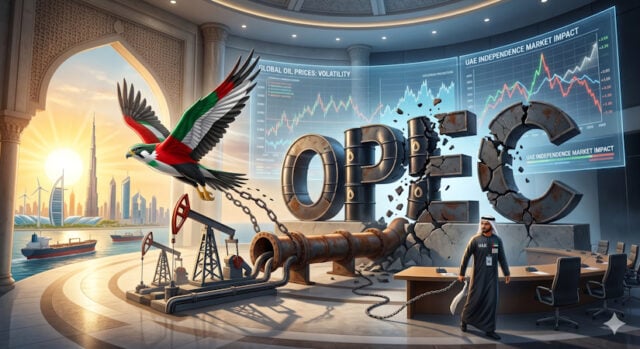
On April 28, 2026, the global energy landscape experienced a seismic shift as the United Arab Emirates (UAE) officially announced its withdrawal from the Organization of the Petroleum Exporting Countries (OPEC) and the wider OPEC+ alliance. Effective May 1, this decision marks the end of nearly six decades of Emirati participation in the cartel, leaving a leadership vacuum in the organization and raising profound questions about the future of global oil price stability.
As the third-largest producer within OPEC, the UAE’s exit is more than just a bureaucratic change; it is a declaration of economic sovereignty and a calculated gamble on a high-supply future. In a world currently reeling from the closure of the Strait of Hormuz and a regional conflict involving Iran, the move has sent shockwaves through financial markets, even as the “handcuffs” of production quotas are finally removed from Abu Dhabi’s oil industry.
The Catalyst: A Collision of Capacity and Quotas
For several years, the UAE has chafed under the restrictive production targets set by OPEC, primarily led by Saudi Arabia. Under the leadership of Sultan al-Jaber, CEO of the Abu Dhabi National Oil Company (ADNOC), the Emirates has invested tens of billions of dollars to expand its production capacity. By early 2026, ADNOC’s capacity reached approximately 4.85 million barrels per day (bpd), with a firm target of 5 million bpd by 2027.
However, OPEC+ quotas frequently forced the UAE to keep nearly 1.5 million bpd of its capacity offline to support global prices. This tension reached a breaking point this Tuesday. According to The Motley Fool, the UAE believes that leaving OPEC is in its best national interests, as it allows the country to monetize its massive reserves more aggressively before the global energy transition potentially peaks.

The Geopolitical Rift: Riyadh vs. Abu Dhabi
The exit is as much about regional politics as it is about petroleum. The relationship between the UAE and Saudi Arabia, once the closest of allies, has grown increasingly frosty. Competing visions for the region—from the war in Yemen to the race for foreign direct investment—have created a “divergence of destinies.”
The Washington Post reports that the decision follows a period of heightened friction where UAE-backed groups and Saudi-backed forces found themselves on opposite sides of territorial disputes in Yemen. Furthermore, as Saudi Arabia opens up under its own Vision 2030, it has directly challenged Dubai and Abu Dhabi for the title of the region’s economic hub. The exit from OPEC is the most visible sign yet of this “rupture in the Gulf,” as noted by experts at the University of Bristol.
Immediate Impact on Oil Prices: The Hormuz Hedge
Under normal circumstances, the departure of a major producer like the UAE would trigger an immediate sell-off in oil markets, as traders anticipate a flood of new supply. However, the current reality of April 2026 is anything but normal. Brent crude is currently trading above $111 per barrel, roughly 50% higher than its pre-war levels.
The reason prices haven’t collapsed today is the ongoing conflict in the Strait of Hormuz. With the waterway effectively closed due to Iranian military activity and U.S.-led blockades, the UAE’s ability to export its oil is severely restricted. As BNN Bloomberg highlights, the UAE “cannot produce what it cannot ship.”
| Metric | Pre-War Level (2024/25) | Current Level (April 2026) |
| Brent Crude Price | ~$75.00 | $111.00+ |
| UAE Production | 3.2M bpd | ~1.9M bpd |
| Global Supply Risk | Moderate | Extreme (Hormuz Closure) |
While the UAE can bypass the Strait using its 1.5 million bpd ADCOP pipeline to the port of Fujairah, this capacity is not enough to offset the total loss of Persian Gulf transit. Consequently, the price impact of the exit is being viewed by analysts as a “delayed-action bear fuse.” Once the Strait reopens, the UAE will be free to add up to 1.6 million bpd of incremental supply to the market—a move that IG suggests will exert meaningful downward pressure on prices in the medium term.
The Economic Long Game: Diversification and AI
Why leave now? According to analysts at Argus Media, the UAE is prioritizing a “fast-monetization” strategy. By pumping more oil now, the Emirates can fund its massive transition into non-oil sectors, specifically artificial intelligence, renewable energy, and lower-carbon technologies.
Bachar El-Halabi of Argus Media notes that while oil remains the backbone of the economy, the UAE’s sovereign wealth funds are increasingly tied to global growth rather than just the price of crude. By exiting OPEC, the UAE gains the flexibility to improve ties with major importers like China and the United States, positioning itself as a “reliable and independent” supplier that is not beholden to a cartel’s whims.
The Future of OPEC+: An Existential Crisis?
The UAE’s departure follows the exits of Qatar in 2019 and Angola in 2024, but it carries far more weight due to the UAE’s spare capacity. The Atlantic Council suggests that while OPEC has survived losses before, the absence of its most modernized and expansion-heavy member may pose an existential risk to the cartel’s long-term sustainability.
If other members—such as Iraq or Kuwait—see the UAE succeeding outside the group, the “cartel discipline” could evaporate entirely. As of now, the remaining 11 core members must decide whether to continue bearing the burden of production cuts or enter a market-share war that could mirror the devastating price crashes of 1986 or 2020.
What This Means for the Global Market
In the short term, consumers should not expect immediate relief at the pump. The geopolitical risk premium associated with the Iran conflict far outweighs the “paper” threat of increased UAE production. However, for the late 2026 and 2027 outlook, the UAE’s independence suggests a more volatile, price-competitive environment.
As BeInCrypto points out, the move leans bearish over time. If the UAE fulfills its goal of becoming a 5 million bpd producer outside of OPEC constraints, it adds approximately 1.5% of global demand to the “free” market. This could act as a crucial buffer against future supply shocks but will likely frustrate Saudi efforts to keep prices floor-managed above $80 or $90 per barrel.
Sources Used in This Article and Links:
- The Motley Fool: The UAE is Leaving OPEC. Here’s What It Means for the Global Oil Market.
- The Washington Post: UAE to leave OPEC amid Hormuz oil crisis, a blow to Saudi Arabia
- IG: UAE leaves OPEC: oil outlook for traders
- BNN Bloomberg: United Arab Emirates says it will leave OPEC in a blow to the oil cartel
- BeInCrypto: 5 Major Economic Implications of UAE Leaving the OPEC Oil Pact
- Atlantic Council: Why is the UAE leaving OPEC?
- Intellectia.ai: UAE Announces Exit from OPEC, Impacting Global Oil Market
- Argus Media: UAE to exit Opec: Update | Latest Market News
- Hindustan Times: United Arab Emirates says it will leave OPEC effective May 1
- Council on Foreign Relations (CFR): Why the UAE Walked Out on OPEC—and What It Means for the Cartel
Disclaimer
Artificial Intelligence Disclosure & Legal Disclaimer
AI Content Policy.
To provide our readers with timely and comprehensive coverage, South Florida Reporter uses artificial intelligence (AI) to assist in producing certain articles and visual content.
Articles: AI may be used to assist in research, structural drafting, or data analysis. All AI-assisted text is reviewed and edited by our team to ensure accuracy and adherence to our editorial standards.
Images: Any imagery generated or significantly altered by AI is clearly marked with a disclaimer or watermark to distinguish it from traditional photography or editorial illustrations.
General Disclaimer
The information contained in South Florida Reporter is for general information purposes only.
South Florida Reporter assumes no responsibility for errors or omissions in the contents of the Service. In no event shall South Florida Reporter be liable for any special, direct, indirect, consequential, or incidental damages or any damages whatsoever, whether in an action of contract, negligence or other tort, arising out of or in connection with the use of the Service or the contents of the Service.
The Company reserves the right to make additions, deletions, or modifications to the contents of the Service at any time without prior notice. The Company does not warrant that the Service is free of viruses or other harmful components.