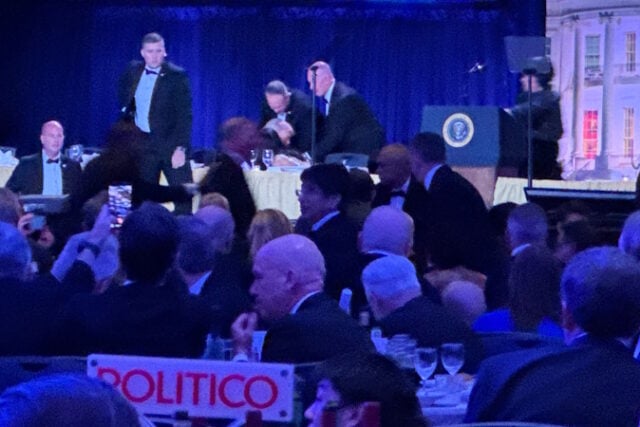
The annual White House Correspondents’ Association dinner has long been a symbol of the peaceful, if often prickly, coexistence between the American presidency and the free press. On the night of Saturday, April 25, 2026, that symbol was shattered. What was intended to be a night of tuxedoed camaraderie and sharp-witted oratory at the Washington Hilton turned into a theater of terror as a gunman attempted to breach the subterranean ballroom to target President Donald J. Trump and senior members of his administration.
The Atmosphere Before the Storm
The 2026 dinner carried a unique weight. It was the first time during his presidencies that Donald Trump had agreed to attend the event, a sharp departure from his first term when he famously boycotted the “nerd prom.” The ballroom was packed with approximately 2,600 attendees, including the President, First Lady Melania Trump, Vice President JD Vance, and a near-complete assembly of the Cabinet.
Security was described by experts as being at a “National Special Security Event” (NSSE) level. The Washington Hilton, the same site where President Ronald Reagan was shot in 1981, was a fortress. Magnetometers guarded every entrance, and hundreds of Secret Service agents, Metropolitan Police, and tactical units patrolled the corridors. Yet, at 8:36 PM, the unthinkable happened.
8:36 PM: The Breach at the Perimeter
The attack began not inside the ballroom, but at the main security screening area. A man later identified as 31-year-old Cole Tomas Allen, a guest at the hotel, approached the checkpoint. Carrying a heavy bag and exhibiting what witnesses described as “focused aggression,” Allen did not wait for the screening process.

According to interim D.C. Police Chief Jeff Carroll, Allen produced a shotgun and a handgun, charging past the first line of barricades. As Secret Service agents moved to intercept him, Allen fired between five and eight rounds. One shot struck a Secret Service agent directly in the chest. The officer was saved by his bullet-resistant vest and was later reported to be in stable condition.
Inside the ballroom, the sound of the shots was initially mistaken by some for popping balloons or technical equipment failure. However, the reality set in as Secret Service agents on the dais suddenly swarmed the President.
Chaos in the Ballroom
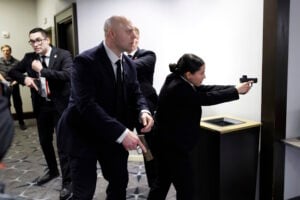
The scene inside the Washington Hilton ballroom was one of unprecedented disarray for a modern political event. Journalists, celebrities, and high-ranking officials—including Treasury Secretary Scott Bessent and Defense Secretary Pete Hegseth—dived under tables as the command “Shots fired! Get down!” echoed through the hall.
CNN anchor Wolf Blitzer, who was near the lobby when the shooting began, described seeing the gunman fire what appeared to be a “very serious weapon” before being tackled by law enforcement. On the main stage, the evacuation of the “Trump et al.” group—the President, the First Lady, and the Vice President—was immediate.
Secret Service agents utilized armored plating stored beneath the stage to shield the President and Melania Trump. During the high-stakes extraction, the President briefly stumbled but was quickly hoisted back up and rushed into a secure service hallway. Vice President Vance was evacuated in the opposite direction to ensure the continuity of government was not compromised by a single point of failure.
The Suspect: Cole Tomas Allen
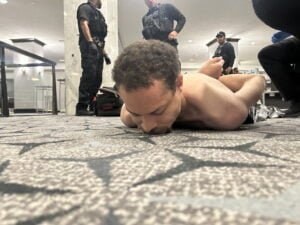
The investigation into Cole Tomas Allen paints a complex and chilling portrait of a “lone wolf” motivated by deep ideological shifts. A 31-year-old educator and Caltech graduate from Torrance, California, Allen had no significant criminal record. However, his digital footprint revealed a man spiraling into radicalization.
In a “manifesto” found in his hotel room and sent to family members minutes before the attack, Allen referred to himself as the “Friendly Federal Assassin.” His writings were a blend of anti-Trump sentiment and critiques of the administration’s policies, framed through a distorted religious lens. Federal authorities noted that his manifesto prioritized targets from “highest-ranking to lowest,” suggesting a premeditated plan to decimate the administration’s leadership in a single strike.
Records indicate Allen traveled by train from Los Angeles to Chicago and then to Washington, checking into the Hilton days before the event. Despite his previous $25 donation to a Democratic PAC in 2024, investigators believe his primary motivation was a self-styled crusade against perceived government corruption.
The “Et Al.” Victims and the Security Fallout
While the President remained the primary target, the “et al.” included the thousands of people whose lives were endangered. The injured Secret Service agent, who remained unnamed as of Sunday evening, became the latest hero in a line of duty that has seen increasing peril in recent years.
The psychological impact on the press corps and the attendees was profound. For many, the sight of the presidential seal being removed from a podium in a half-empty room of overturned chairs and abandoned champagne glasses became the defining image of the 2026 political climate.
The President’s Resolve
By 10:45 PM, President Trump appeared at the White House for a brief press conference. Still in his tuxedo, he described the attacker as a “sick person” and praised the “incredible bravery” of the Secret Service. He remarked on the dangers of his profession, stating that being President is now “statistically more dangerous than being a racecar driver.”
He also used the incident to reiterate his call for a larger, more secure ballroom to be built on the White House grounds—a project currently embroiled in legal and political controversy. Despite the trauma of the evening, the President vowed that the gala would be rescheduled, signaling a refusal to let political violence dictate the national schedule.
A Pattern of Violence
The April 25 attack marks the third assassination attempt involving Donald Trump since 2024, following the Butler rally shooting and the Florida golf course incident. Viewed alongside other recent tragedies—including the killing of commentator Charlie Kirk and the assassination of Minnesota lawmaker Melissa Hortman—the Hilton breach is seen by sociologists as a symptom of a deeply fractured American psyche.
As Washington D.C. begins the recovery process, the FBI and Secret Service are facing renewed scrutiny. Questions remain regarding how a guest with multiple weapons could move so freely within a high-security hotel. The “Friendly Federal Assassin” failed in his mission, but he succeeded in reminding the world that even the most secure rooms in the capital are not immune to the shadows of political violence.
Sources Used and Links:
- CBS News: What we know about the suspect in shooting at White House Correspondents’ Dinner https://www.cbsnews.com/news/white-house-correspondents-dinner-shooting-suspect-cole-allen/
- Wikipedia: 2026 White House Correspondents’ dinner shooting https://en.wikipedia.org/wiki/2026_White_House_Correspondents%27_dinner_shooting
- MS NOW: Trump evacuated after gunman breaches security at annual correspondents’ dinner, suspect in custody https://www.ms.now/news/trump-evacuated-after-security-incident-at-white-house-correspondents-dinner
- PBS NewsHour: Trump unharmed after security incident at White House Correspondents’ Dinner https://www.pbs.org/newshour/politics/trump-evacuated-after-security-incident-at-white-house-correspondents-dinner-no-sign-of-injuries
- The Guardian: White House press dinner shooting suspect could be charged with trying to assassinate Trump, says Blanche https://www.theguardian.com/us-news/2026/apr/26/details-white-house-correspondents-dinner-shooting
- AFP (via IndoPremier): Gunman sought to kill Trump, cabinet at gala dinner https://www.indopremier.com/ipotnews/newsDetail.php?jdl=Gunman_sought_to_kill_Trump__cabinet_at_gala_dinner&news_id=1727871
- WHYY: A gunman tried to breach Trump at the White House Correspondents’ Association dinner. Here’s what to know https://whyy.org/articles/white-house-correspondents-association-dinner-shooting/
- The Guardian (Feature): White House journalists’ gala ended like many US events do: with gun violence https://www.theguardian.com/us-news/2026/apr/26/white-house-correspondents-dinner-shooting-political-violence
- Commonwealth of Pennsylvania (Historical Context): Pennsylvania State Police Identify Victims Shot During Attempted Assassination of President Donald Trump https://www.pa.gov/agencies/psp/newsroom/pennsylvania-state-police-identify-victims-shot-during-attempted
Disclaimer
Artificial Intelligence Disclosure & Legal Disclaimer
AI Content Policy.
To provide our readers with timely and comprehensive coverage, South Florida Reporter uses artificial intelligence (AI) to assist in producing certain articles and visual content.
Articles: AI may be used to assist in research, structural drafting, or data analysis. All AI-assisted text is reviewed and edited by our team to ensure accuracy and adherence to our editorial standards.
Images: Any imagery generated or significantly altered by AI is clearly marked with a disclaimer or watermark to distinguish it from traditional photography or editorial illustrations.
General Disclaimer
The information contained in South Florida Reporter is for general information purposes only.
South Florida Reporter assumes no responsibility for errors or omissions in the contents of the Service. In no event shall South Florida Reporter be liable for any special, direct, indirect, consequential, or incidental damages or any damages whatsoever, whether in an action of contract, negligence or other tort, arising out of or in connection with the use of the Service or the contents of the Service.
The Company reserves the right to make additions, deletions, or modifications to the contents of the Service at any time without prior notice. The Company does not warrant that the Service is free of viruses or other harmful components.