The Return to the Brink
As of April 20, 2026, the world watches the Persian Gulf with a mixture of dread and grim fascination. What began in January 2025 as a return to “Maximum Pressure” has, in the span of fifteen months, spiraled into the most significant direct military confrontation between the United States and the Islamic Republic of Iran since the 1979 Revolution.
Since the commencement of the blockade against ships entering or exiting Iranian ports and coastal areas, U.S. forces have directed 27 vessels to turn around or return to an Iranian port. pic.twitter.com/G8dl96wN4H
— U.S. Central Command (@CENTCOM) April 20, 2026
The current conflict, which escalated into sustained kinetic operations in late February 2026, represents the culmination of a “Trump 2.0” foreign policy that has discarded the strategic patience of the previous four years in favor of a blunt, “unbound” approach to global hegemony. While the 2016-2020 era was defined by withdrawal from the JCPOA and the assassination of Qasem Soleimani, the 2025-2026 era is defined by something far more expansive: a naval blockade, the targeting of sovereign nuclear infrastructure, and an explicit call for regime change from the highest levels of the American executive.
Timeline of Escalation: 2025–2026
The following table outlines the rapid descent from diplomatic stalemate to active warfare during the second Trump term.

Maximum Pressure 2.0: Economic Warfare as a Prelude
Upon his inauguration in January 2025, President Trump made it clear that the “strategic ambiguity” regarding Iran’s oil exports would end. During the latter half of 2024, Iran had managed to export nearly 1.5 million barrels per day, largely to China through a “shadow fleet” of aging tankers. By February 2025, the new administration launched a multi-agency task force—involving the Treasury, State Department, and intelligence services—to systematically dismantle this network.
The strategy was simple: Total Exclusion. Unlike the first term, where waivers were occasionally granted to maintain market stability, the 2025 policy allowed for zero exceptions. The Treasury Department’s Office of Foreign Assets Control (OFAC) began sanctioning not just the ships, but the insurers, the port authorities in Southeast Asia, and the mid-level financial clearinghouses in Dubai and Turkey.
By late 2025, Iran’s inflation rate had ballooned past 70%, and the rial had reached a record low against the dollar. This economic strangulation was intended to force Tehran back to the table for a “Great Deal” that would include not only nuclear concessions but also the total dismantling of its regional proxy network—Hezbollah, the Houthis, and various Iraqi militias.
The Nuclear Calculus: A Race Against Time
The core justification for the February 2026 strikes was the “breakout time.” By the end of 2025, the International Atomic Energy Agency (IAEA) warned that Iran’s stockpile of highly enriched uranium ( at 60%) had reached a critical mass.
Mathematically, the time required to convert a stockpile of 60% enriched uranium to 90% (weapons-grade) is significantly shorter than starting from natural uranium. The “Breakout Time” () can be roughly modeled as:
Where is the “Significant Quantity” required for a single nuclear device (roughly 25kg of 90% ). In early 2026, intelligence assessments suggested that Iran’s had shrunk to less than two weeks. This triggered the “unconditional” posture from the White House. While the Omani foreign minister attempted to broker a deal in February 2026—suggesting Iran cap enrichment at 20% in exchange for partial sanctions relief—Trump famously posted on Truth Social that he was “not thrilled” with anything less than total surrender.
The Shadow War Goes Lights Up
On February 28, 2026, the transition from “Maximum Pressure” to “Maximum Kinetic Action” was finalized. In a series of strikes described by the UK Parliament as an attempt to “induce regime change,” the US and Israel targeted:
- Naval Infrastructure: The Iranian Navy’s capabilities in Bandar Abbas were effectively neutralized to prevent the mining of the Strait.
- Missile Silos: Hardened sites in the Zagros Mountains were targeted with “bunker-buster” munitions.
- Nuclear Facilities: While the Fordow and Natanz sites are deep underground, the strikes targeted the surface infrastructure, power grids, and cooling systems essential for centrifuge operation.
Iran’s response was swift and asymmetrical. Eschewing a conventional naval confrontation it knew it would lose, Tehran utilized its “Axis of Resistance.” Within 48 hours, US bases in Qatar and Bahrain came under heavy drone and missile fire. More critically, the Iranian government officially declared the Strait of Hormuz closed—a move that has effectively paralyzed 20% of the world’s oil supply.
The Blockade and the Global Energy Crisis
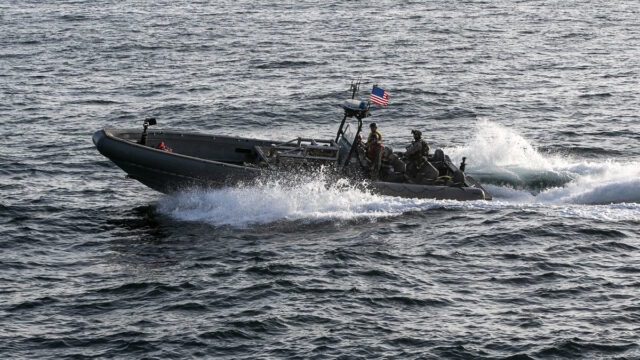
As of this week in April 2026, the US 5th Fleet has directed dozens of ships to return to Iranian ports as part of a total naval blockade. The logic from the White House is that if Iran will not allow the world’s oil to flow through the Strait, the US will not allow Iran’s economy to function at all.
However, the cost to the global economy has been staggering. Gasoline prices in the United States have surpassed $7.00 per gallon in some regions, and European allies—already weary from the protracted conflict in Ukraine—are seeing their industrial sectors buckle under the weight of energy costs.
“The President has a choice,” noted one senior diplomat in London. “He can either pursue an agreement that allows Iran a face-saving exit, or he can continue this blockade until the Iranian regime collapses—or the global economy does first.”
Internal Dynamics: A Regime Under Siege
Inside Iran, the situation is increasingly volatile. The protests that began in early 2026, sparked by infrastructure failures and the skyrocketing cost of bread, have been met with “extensive use of force” by the Revolutionary Guard (IRGC). Yet, unlike previous waves of unrest, these protests are occurring against a backdrop of external invasion.
The Iranian leadership has successfully used the “foreign aggressor” narrative to consolidate its hardline base, even as the middle class suffers. Rumors persist regarding the health of the Supreme Leader, and some analysts believe the current military escalation is a calculated move by IRGC hardliners to ensure a “war-time succession” that favors a military figure over a cleric.
The Russian and Chinese Factors
The 2026 conflict is not occurring in a vacuum. Russia, increasingly desperate for leverage against the West, has proposed a “Nuclear Swap” where it would take possession of Iran’s enriched uranium in exchange for security guarantees. While this might have been a viable diplomatic off-ramp in 2023, the Trump administration in 2026 has shown little interest in allowing Moscow to act as a power broker.
China, meanwhile, finds itself in a precarious position. As the primary purchaser of Iranian oil, the blockade directly threatens its energy security. While Beijing has officially condemned the “unilateral use of force,” it has stopped short of military intervention, preferring to use the crisis to further internationalize the Yuan and create “sanctions-proof” trade routes through Central Asia.
Conclusion: Diplomacy or Decimation?
As we reach the deadline of late April 2026, the world stands at a crossroads. President Trump’s rhetoric has shifted between a desire to “annihilate” the regime and a willingness to meet for a “summit of the century” should Iran agree to unconditional nuclear disarmament.
The Iranian leadership, for its part, has shown no sign of “crying uncle.” With the Strait of Hormuz closed and the “Axis of Resistance” fully activated, the conflict threatens to expand into a regional conflagration that could include Lebanon, Jordan, and the maritime routes of the Red Sea.
The “Art of the Deal” is being tested in the crucible of war. Whether this ends in a historic new framework for Middle Eastern security or a decades-long occupation remains the defining question of the second Trump presidency.
Sources Used and Links:
- House of Commons Library (UK Parliament): US/Israel-Iran conflict 2026 – Research Briefing, March 31, 2026. https://commonslibrary.parliament.uk/research-briefings/cbp-10521/
- Courthouse News Service: Trump offers mixed messages about path ahead for US war against Iran, April 20, 2026. https://www.courthousenews.com/trump-offers-mixed-messages-about-path-ahead-for-us-war-against-iran/
- U.S. Department of State: Iran Sanctions – Office of Economic Sanctions Policy and Implementation, April 15, 2026. https://www.state.gov/iran-sanctions
- International Atomic Energy Agency (IAEA): NPT Safeguards Agreement with the Islamic Republic of Iran – GOV/2026/8, February 27, 2026. https://www.iaea.org/sites/default/files/gov2026-8.pdf
- The Moscow Times: Russia Says It Can Take Iran’s Enriched Uranium. Will That Happen?, April 20, 2026. https://www.themoscowtimes.com/2026/04/20/russia-says-it-can-take-irans-enriched-uranium-will-that-happen-a92547
- Chicago Council on Global Affairs: Trump 2.0 Enters 2026 in Full Force, January 9, 2026. https://globalaffairs.org/commentary/analysis/trump-20-enters-2026-full-force
- Center for American Progress: The Human and Environmental Costs of the War in Iran, April 20, 2026. https://www.americanprogress.org/article/the-human-and-environmental-costs-of-the-war-in-iran/
- U.S. Department of the Treasury: Economic Fury Targets Illicit Oil Smuggling Network Run by Iranian Regime Elite, April 15, 2026. https://home.treasury.gov/news/press-releases/sb0443
Disclaimer
Artificial Intelligence Disclosure & Legal Disclaimer
AI Content Policy.
To provide our readers with timely and comprehensive coverage, South Florida Reporter uses artificial intelligence (AI) to assist in producing certain articles and visual content.
Articles: AI may be used to assist in research, structural drafting, or data analysis. All AI-assisted text is reviewed and edited by our team to ensure accuracy and adherence to our editorial standards.
Images: Any imagery generated or significantly altered by AI is clearly marked with a disclaimer or watermark to distinguish it from traditional photography or editorial illustrations.
General Disclaimer
The information contained in South Florida Reporter is for general information purposes only.
South Florida Reporter assumes no responsibility for errors or omissions in the contents of the Service. In no event shall South Florida Reporter be liable for any special, direct, indirect, consequential, or incidental damages or any damages whatsoever, whether in an action of contract, negligence or other tort, arising out of or in connection with the use of the Service or the contents of the Service.
The Company reserves the right to make additions, deletions, or modifications to the contents of the Service at any time without prior notice. The Company does not warrant that the Service is free of viruses or other harmful components.