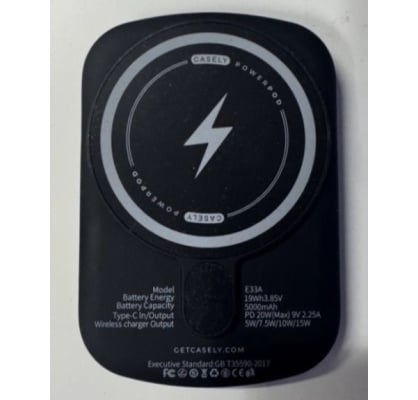
In the modern world, the portable power bank has transitioned from a niche accessory for tech enthusiasts to an essential survival tool for the everyday consumer. As we tether our lives increasingly to mobile devices, the anxiety of a low-battery notification has created a multi-billion-dollar market for compact, high-capacity chargers. However, a tragic and escalating series of events involving the popular accessory brand Casely has highlighted the hidden dangers lurking in these ubiquitous devices. On April 16, 2026, the U.S. Consumer Product Safety Commission (CPSC) took the rare step of re-announcing a major recall of nearly 430,000 power banks—not just because of property damage, but because of a reported death.
The Tragedy in New Jersey
At the heart of this urgent federal warning is the story of a 75-year-old woman from New Jersey. In August 2024, she was performing a task millions of us do daily: charging her smartphone using a portable power bank while resting the device in her lap. Without warning, the Casely Power Pod 5000mAh—a sleek, MagSafe-compatible wireless charger—suffered a catastrophic failure. The device did not merely overheat; it caught fire and exploded directly against her body.
The victim suffered second- and third-degree burns, the most severe types of tissue damage, which can lead to systemic shock, infection, and organ failure. Despite medical intervention, she ultimately died from complications related to the injuries sustained in the blast. While the incident occurred in late 2024, its connection to the specific Casely model has prompted federal regulators to amplify their warnings to the public. It serves as a grim reminder that the lithium-ion batteries we keep in our pockets and against our skin are, essentially, high-density energy storage units that can become incendiary devices if manufacturing standards or safety protocols fail.
A Pattern of Escalation: The Airplane Incident
The death of the New Jersey woman is not the only high-profile incident tied to this specific line of chargers. Since the initial, quieter recall in April 2025, the CPSC has received 28 additional reports of the Casely batteries overheating, expanding, or igniting. Perhaps the most alarming of these occurred in February 2026, when a 47-year-old woman was charging her phone during a commercial flight.

Mid-flight, the power bank “caught on fire and exploded,” according to the CPSC. The woman suffered first-degree burns, and the incident caused a localized fire on the aircraft. In-flight battery fires are a nightmare scenario for aviation safety, as the enclosed, pressurized environment of a plane makes even a small fire difficult to contain. This incident underscores why the Federal Aviation Administration (FAA) has such stringent rules regarding the transport of lithium-ion batteries in checked luggage—and why the failure of these devices in the cabin is so dangerous.
Identifying the Hazard: The Casely Power Pod
The specific product under recall is the Casely Power Bank 5000mAh portable MagSafe wireless phone charger, frequently marketed as the “Power Pod.” These devices were popular due to their aesthetic appeal, available in a variety of colorful patterns and designs that matched Casely’s signature phone cases.
The recalled units carry the model number E33A, which is printed on the back of the device. These chargers were sold between March 2022 and September 2024 for prices ranging from $30 to $70. They were available through major e-commerce platforms including Amazon and Casely’s own website. The sheer volume of units—approximately 429,200—means that many consumers may still have these dangerous chargers in their bags or bedside drawers, unaware that they are holding a potential fire hazard.
The Anatomy of a Thermal Runaway
To understand why a 5,000mAh battery can lead to a fatality, one must understand the science of the lithium-ion battery. These batteries work by moving lithium ions between a cathode and an anode through a flammable liquid electrolyte. When a battery is compromised—whether by a manufacturing defect, physical damage, or extreme heat—it can enter a state known as “thermal runaway.”
In thermal runaway, the heat generated by a failing cell triggers a chain reaction in neighboring cells. The temperature spikes almost instantaneously, often exceeding 1,000 degrees Fahrenheit. This process releases toxic, flammable gases and can culminate in a high-velocity jet of fire or a physical explosion. In the case of the Casely E33A, the CPSC’s reports of batteries “expanding” or “pillowing” were the early warning signs of internal pressure buildup. When a battery expands, it is often due to the off-gassing of the electrolyte; at that point, the device is a ticking time bomb.
Why the “Re-Announcement” Matters
It is relatively common for the CPSC to issue recalls, but it is much rarer for them to “re-announce” a recall with such urgency. The initial recall of these power banks occurred in April 2025 after 51 reports of overheating. However, the subsequent death and the in-flight explosion proved that the original recall effort had not reached enough consumers.
Recall effectiveness is a persistent challenge for consumer electronics. Unlike automobiles, which have registered owners and VIN numbers, a $40 power bank is often purchased anonymously or as a gift. Casely is now attempting to contact all known purchasers directly, but the second announcement is a “stop-use” order meant to reach those who may have purchased the device second-hand or ignored previous emails.
The Industry-Wide Problem
Casely is far from the only company to face these issues. In recent years, the power bank industry has seen a surge in recalls. Brands like Anker, myCharge (sold through Costco), and even Amazon Basics have had to pull thousands of units from shelves due to fire risks.
The pressure to make power banks smaller, thinner, and faster-charging is at odds with the physical stability of lithium-ion technology. To achieve high-speed wireless charging in a slim profile, manufacturers must push the limits of battery density and heat management. When cost-cutting measures are applied to internal safety separators or thermal sensors, the margin for error disappears. The Casely incidents suggest that the model E33A had a critical vulnerability that manifested not just during the first few months of use, but as the devices aged and were subjected to the wear and tear of daily life.
How to Safely Dispose of a Recalled Battery
One of the most dangerous aspects of this recall is the risk of improper disposal. The CPSC has issued a strict warning: Do not throw these power banks in the trash or in general recycling bins. When a lithium-ion battery is thrown in a garbage truck or sent to a standard recycling center, it can be crushed by heavy machinery. For a recalled, unstable battery, this mechanical stress is almost guaranteed to trigger a fire. Garbage truck fires caused by lithium batteries have become a major hazard for municipal workers across the country.
Instead, consumers are urged to:
- Stop using the device immediately. Unplug it and keep it away from flammable materials.
- Locate a hazardous waste center. Contact your local municipality to find a facility that specifically handles “recalled lithium-ion batteries.”
- Take photos for your refund. Casely requires two photos to process a replacement or store credit: one showing the model number and another showing the front of the device with the word “Recalled” and the date written in permanent marker.
Consumer Remedies and Action Plan
Casely is offering consumers a free replacement power bank or a $60 store credit. While this may seem like a standard remedy, the gravity of a fatal incident changes the context of consumer responsibility. If you or someone you know owns a Casely Power Pod, checking the model number on the back is a matter of physical safety, not just tech maintenance.
Conclusion: A New Standard for Safety
The death of the woman in New Jersey is a tragic milestone in the history of mobile accessories. It highlights the need for more rigorous independent testing of third-party chargers and more robust recall systems. For consumers, the lesson is clear: treats your portable chargers with the same respect you would a gallon of gasoline. If a battery feels excessively hot, appears swollen, or makes a hissing sound, it is no longer a convenience—it is a danger.
As the CPSC and Casely work to get the remaining 400,000 units out of circulation, this event serves as a stark warning to the tech industry. In the race to power our digital lives, the safety of the user must never be sacrificed for the sake of a few extra hours of battery life.
Sources Used and Links:
- Gizmodo: “After Woman’s Death From Exploding Charger, Power Banks Recalled for Second Time”
- U.S. Consumer Product Safety Commission (CPSC): “Casely Re-announces Recall of Power Banks Due to Fire and Burn Hazards; One Death Reported”
- MacRumors: “Casely MagSafe-Compatible Power Banks Recalled Again After Fire-Related Death and In-Flight Explosion”
- BGR: “The CPSC Issued An Urgent Recall On Over 400,000 Portable Power Banks”
- WHAS11 News: “Casely re-announces recall of 430K portable chargers after woman dies”
Disclaimer
Artificial Intelligence Disclosure & Legal Disclaimer
AI Content Policy.
To provide our readers with timely and comprehensive coverage, South Florida Reporter uses artificial intelligence (AI) to assist in producing certain articles and visual content.
Articles: AI may be used to assist in research, structural drafting, or data analysis. All AI-assisted text is reviewed and edited by our team to ensure accuracy and adherence to our editorial standards.
Images: Any imagery generated or significantly altered by AI is clearly marked with a disclaimer or watermark to distinguish it from traditional photography or editorial illustrations.
General Disclaimer
The information contained in South Florida Reporter is for general information purposes only.
South Florida Reporter assumes no responsibility for errors or omissions in the contents of the Service. In no event shall South Florida Reporter be liable for any special, direct, indirect, consequential, or incidental damages or any damages whatsoever, whether in an action of contract, negligence or other tort, arising out of or in connection with the use of the Service or the contents of the Service.
The Company reserves the right to make additions, deletions, or modifications to the contents of the Service at any time without prior notice. The Company does not warrant that the Service is free of viruses or other harmful components.