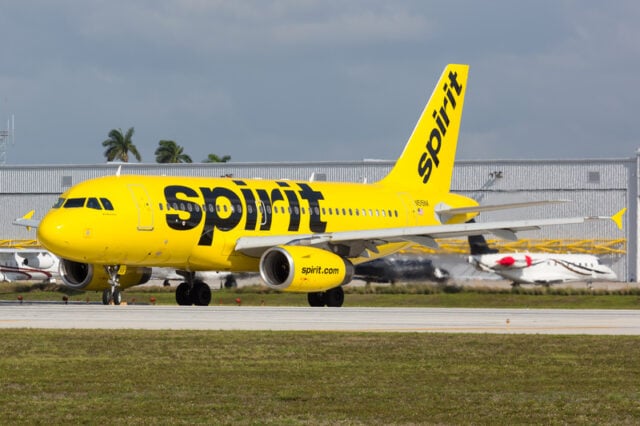
The yellow-clad “Spirit of America” is flickering. On this Thursday, April 16, 2026, the aviation world is watching the radar for what many analysts believe is the final, irreversible descent of Spirit Airlines. After years of financial turbulence, failed mergers, and two trips through the bankruptcy courts in less than twelve months, the ultra-low-cost carrier (ULCC) is reportedly on the verge of a Chapter 7 liquidation.
What began as a strategy to “democratize the skies” with unbundled fares and bright yellow planes is now a cautionary tale of debt, bad luck, and a rapidly changing global economy. If Spirit closes its doors this week, it will mark the largest collapse of a major U.S. airline since the industry’s massive consolidation era began decades ago.
The Dagger in the Heart: The 2026 Fuel Crisis
While Spirit has been on life support for years, the immediate threat—the “dagger,” as travel expert Zach Griff calls it—is the sudden and violent spike in global energy costs. Following the outbreak of large-scale hostilities between Israel and Iran in early April 2026, jet fuel prices have doubled in a matter of weeks.
For a legacy carrier like Delta or United, a fuel spike is a painful hit to the bottom line that can often be offset by premium ticket sales and corporate contracts. For an ultra-low-cost carrier like Spirit, which operates on razor-thin margins and sells $29 tickets, it is a death sentence.

According to reports from CNBC and the Wall Street Journal, Spirit is expected to see its operating expenses skyrocket by an additional $360 million through the remainder of 2026 if fuel stays at current levels. With a year-end cash balance of only $337 million, the math simply does not work. The airline is effectively out of money.
The Path to “Chapter 22”
To understand why Spirit is in this position, one must look back at the “Chapter 22” phenomenon—the industry term for a company that files for Chapter 11 bankruptcy twice in a short period.
- The First Filing (November 2024): Spirit first entered bankruptcy in late 2024 after a federal judge blocked its $3.8 billion merger with JetBlue Airways on antitrust grounds. That block left Spirit with no “Plan B” for its looming debt wall. The company emerged quickly in March 2025 after a “pre-packaged” restructuring that swapped debt for equity.
- The Second Filing (August 2025): The 2024 reset only fixed the balance sheet; it didn’t fix the business model. By mid-2025, persistent engine issues and a glut of seats in the Florida market forced a second filing. Spirit has spent the last nine months trying to reorganize its entire operation, but the fuel crisis has likely ended those hopes.
Spirit’s Financial Transformation (Attempted)
| Metric | Pre-2024 Filing | 2026 Restructuring Goal |
| Total Debt/Leases | $7.4 Billion | $2.1 Billion |
| Fleet Size | 214 Aircraft | 76-80 Aircraft |
| Primary Strategy | Volume & Low Fares | “Spirit First” & Premium Fares |
| Employee Status | Full Staffing | Mass Furloughs (inc. 270 pilots) |
The Ghost of the JetBlue Merger
Many industry observers trace Spirit’s current predicament back to the failed 2022-2024 merger saga. In 2022, Spirit originally agreed to merge with fellow ULCC Frontier Airlines. However, JetBlue launched a hostile takeover bid, eventually winning the board’s approval with a much higher offer.
The Department of Justice (DOJ) sued to block the deal, arguing that the loss of Spirit’s low fares would harm consumers. In early 2024, a judge agreed, effectively trapping Spirit in a “no man’s land.” It was too small to compete with the “Big Four” (American, Delta, United, and Southwest) but was saddled with too much debt to survive as an independent budget player.
Ironically, the very competition the DOJ sought to protect is now at risk of disappearing entirely through liquidation rather than merger.
The Pratt & Whitney GTF Engine Saga
Beyond the boardroom battles, Spirit’s fleet was plagued by mechanical nightmares. The airline was the largest U.S. operator of the Airbus A320neo family powered by Pratt & Whitney Geared Turbofan (GTF) engines.
In 2023 and 2024, a manufacturing flaw in the high-pressure turbine disks required hundreds of engines to be removed for inspection. At its peak, Spirit had dozens of its newest, most fuel-efficient aircraft grounded simultaneously. While the airline received some compensation from the manufacturer, the loss of capacity and the need to lease older, less efficient “CEO” models at high prices crippled its ability to return to profitability.
Liquidation vs. Restructuring: The Final Choice
As of April 16, 2026, Spirit is in a standoff with the U.S. Bankruptcy Trustee and its own creditors. The airline’s current plan involves downsizing to just 76 planes and adding “Big Front Seats” to more of the cabin to attract higher-paying travelers.
However, the U.S. Trustee has expressed deep skepticism, questioning why a second reorganization would succeed where the first failed. If the court determines that Spirit cannot prove it is a “going concern” (a business that can reasonably expect to make money), it may force a conversion from Chapter 11 (reorganization) to Chapter 7 (liquidation).
What Happens in a Liquidation?
- Operations Cease: Flights are typically grounded immediately.
- Asset Sale: The airline’s 70+ aircraft, airport gates, and takeoff/landing slots are auctioned off to the highest bidder.
- Employee Impact: Thousands of pilots, flight attendants, and ground crew members would lose their jobs permanently.
- Creditor Hierarchy: Secured lenders (those who hold the debt on the planes) get paid first. Shareholders and “unsecured” creditors (like passengers with unused tickets) usually get nothing.
The Post-Spirit Landscape: Who Wins?
If the “Yellow Bird” stops flying, the U.S. airline industry will undergo a seismic shift. Spirit’s footprint is particularly large in Fort Lauderdale (FLL), Orlando (MCO), Detroit (DTW), and Las Vegas (LAS).
- JetBlue: Analysts expect JetBlue to be the primary beneficiary in Fort Lauderdale. Without Spirit as a competitor, JetBlue could finally achieve the dominance in South Florida it sought through the merger.
- Frontier: As the last remaining major ULCC, Frontier would likely try to capture the “budget-conscious” segment, though they too are facing pressure from the same fuel costs.
- The Legacy Carriers: United and American have already signaled they are ready to jump into Spirit’s vacated gates.
For the traveler, the result is almost certainly higher fares. Spirit’s “Bare Fare” model acted as a ceiling for prices; whenever Spirit entered a route, legacy carriers were forced to lower their prices to compete. Without that pressure, the days of the $50 cross-country flight may be over.
A Warning to Passengers
For those holding Spirit tickets for the summer of 2026, the advice from experts is clear: be careful. “If you’re buying a ticket for late summer, or even early summer, I would definitely have a backup plan,” says travel expert Zach Griff. “Make sure you book with a credit card that offers insolvency protection.”
Unlike a normal Chapter 11 where the airline keeps flying, a Chapter 7 liquidation happens fast. If you are mid-trip when the airline shuts down, you could be stranded. While other airlines sometimes offer “rescue fares” for displaced passengers, they are not legally required to do so.
The End of an Era
Spirit Airlines was never the most “loved” airline. It was the subject of countless jokes about cramped seats and fees for everything from carry-ons to water. But it played a vital role in the American economy. It allowed families to fly who otherwise couldn’t afford it. It forced an entire industry to become more efficient.
As the sun sets on April 16, 2026, it seems increasingly likely that the yellow planes will soon be a memory, sold off piece by piece to satisfy a debt that even the most aggressive “unbundling” couldn’t pay.
Sources and Links:
- TravelPulse (April 16, 2026): “Spirit Airlines Could Liquidate Amid Surging Fuel Costs, Reports Say” – https://www.travelpulse.com/news/airlines-airports/spirit-airlines-could-reportedly-liquidate-amid-surging-fuel-costs
- CBS News Miami (April 16, 2026): “South Florida-based Spirit Airlines may be forced to liquidate due to surging fuel costs” – https://www.cbsnews.com/miami/news/south-florida-spirit-airlines-liquidate-surging-fuel-costs-reports/
- Holland & Knight (February 5, 2026): “2025 Aviation Bankruptcy Update” – https://www.hklaw.com/en/insights/publications/2026/02/2025-aviation-bankruptcy-update
- Spirit Airlines Investor Relations (March 13, 2026): “Spirit Airlines Announces Restructuring Support Agreement and Plan of Reorganization” – https://ir.spirit.com/news/news-details/2026/Spirit-Airlines-Announces-Restructuring-Support-Agreement-and-Plan-of-Reorganization/default.aspx
- Fox 35 Orlando (April 16, 2026): “Spirit’s bankruptcy uncertain as jet fuel prices soar” – https://www.fox35orlando.com/news/spirits-bankruptcy-jet-fuel-prices-rise
- Travel Tourister (February 26, 2026): “Spirit Airlines SURVIVES: Creditor Deal, Exits Bankruptcy 2026” – https://www.traveltourister.com/news/spirit-airlines-survives-creditor-deal-exits-bankruptcy-spring-2026-new-spirit-fleet-routes/
- View from the Wing (April 15, 2026): “Spirit Airlines Wants Out Of Bankruptcy Again — The U.S. Trustee Is Not Convinced” – https://viewfromthewing.com/spirit-airlines-wants-out-of-bankruptcy-again-the-u-s-trustee-is-not-convinced/
- The Points Guy (April 16, 2026): “Spirit Airlines could shut down: What travelers should know” – https://thepointsguy.com/news/spirit-airlines-liquidation-concerns-what-to-know/
Disclaimer
Artificial Intelligence Disclosure & Legal Disclaimer
AI Content Policy.
To provide our readers with timely and comprehensive coverage, South Florida Reporter uses artificial intelligence (AI) to assist in producing certain articles and visual content.
Articles: AI may be used to assist in research, structural drafting, or data analysis. All AI-assisted text is reviewed and edited by our team to ensure accuracy and adherence to our editorial standards.
Images: Any imagery generated or significantly altered by AI is clearly marked with a disclaimer or watermark to distinguish it from traditional photography or editorial illustrations.
General Disclaimer
The information contained in South Florida Reporter is for general information purposes only.
South Florida Reporter assumes no responsibility for errors or omissions in the contents of the Service. In no event shall South Florida Reporter be liable for any special, direct, indirect, consequential, or incidental damages or any damages whatsoever, whether in an action of contract, negligence or other tort, arising out of or in connection with the use of the Service or the contents of the Service.
The Company reserves the right to make additions, deletions, or modifications to the contents of the Service at any time without prior notice. The Company does not warrant that the Service is free of viruses or other harmful components.