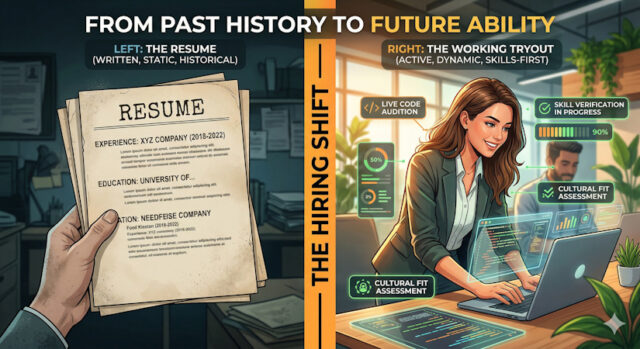
For nearly a century, the resume was the undisputed gatekeeper of the professional world. It was a candidate’s passport, a carefully curated document of past achievements, prestigious degrees, and chronological milestones. But as of April 2026, the resume is rapidly becoming a relic of a bygone era. In its place, a more rigorous, transparent, and effective method has emerged: the Working Tryout.
The shift is dramatic. According to recent industry reports, 85% of employers have now adopted skills-based hiring practices, a significant jump from just a few years ago. Companies are no longer asking “Where did you work?” but rather “Can you do the work?” This “Audition Economy” is fundamentally reshaping the relationship between talent and the modern enterprise.
The AI Catalyst: Why the CV Died
The primary driver behind the death of the resume is, ironically, the same technology that was supposed to make hiring easier: Artificial Intelligence. By early 2026, roughly 79% of job seekers were using sophisticated AI agents to “hyper-optimize” their applications.
When every candidate has a perfectly phrased, keyword-optimized resume that mirrors the job description exactly, the document loses its value as a filtering tool. Recruiters found themselves drowning in “perfect” candidates who, upon reaching the interview stage, lacked the practical ability to perform the tasks they claimed to master. This “credential inflation” and “AI-padding” forced a pivot. To find the top 1% of talent, companies realized they needed to observe behavior, not just read text.

Anatomy of a Modern Job Audition
A “Working Tryout” (or job audition) is not a simple interview. It is a structured, often paid, period where a candidate performs the actual duties of the role in a controlled environment.
Common Audition Formats in 2026:
- The Paid “Day-in-the-Life”: Candidates spend 4–8 hours working with the team on a non-mission-critical project. They are compensated for their time, often at a flat consulting rate.
- The Simulation Lab: Using platforms like TestTrick or Vervoe, candidates enter a virtual environment that mimics the company’s software stack to solve real-world tickets or bugs.
- The “Micro-Project”: For creative or strategic roles, companies assign a specific, time-bound deliverable (e.g., a 48-hour marketing plan for a fictional product launch).
- Technical Coding Sprints: Platforms like HackerRank have evolved beyond simple puzzles to “Live Debugging” sessions where candidates must fix a broken legacy codebase in real-time.
The Data-Driven Case for “Tryouts”
The move toward working tryouts isn’t just about frustration with resumes; it’s backed by a mounting mountain of ROI data.
| Metric | Traditional Resume-Based Hiring | Skills-Based Tryouts (2026) |
| Employee Retention | Baseline | 91% Increase |
| Diversity in Workforce | Variable | 90% Improvement Reported |
| Time-to-Fill Position | 45+ Days | 37% Reduction |
| Predictive Accuracy | Low (Education-heavy) | 5x more predictive of performance |
| Talent Pool Size | Narrow (Degree-filtered) | Up to 15.9x Expansion |
Sources: Scion Staffing (2026), Deloitte, LinkedIn Research.
By focusing on demonstrated ability, companies like Automattic, Menulog, and even traditional firms in the hospitality and manufacturing sectors are seeing a 22% lower turnover rate. When a candidate has already “tried out” the job, the cultural and technical “shock” of the first 90 days is virtually eliminated.
Breaking the Bias Barrier
One of the most profound impacts of the Audition Economy is its effect on Diversity, Equity, and Inclusion (DEI). Traditional resumes are inherently biased; they prioritize candidates who had the means to attend elite universities or those whose names and zip codes “fit” a recruiter’s unconscious prototype.
Working tryouts act as a “blind” filter. When an engineer is evaluated solely on the efficiency and elegance of their code, or a sales lead on their ability to handle a simulated objection, their pedigree becomes irrelevant. Research indicates that for AI-related positions, a skills-first approach has increased the presence of women in candidate pools by up to 24%.
The Challenges: Scalability and the “Time Tax”
While the benefits are clear, the transition to a tryout-based model is not without its hurdles.
- Scalability: Reviewing 1,000 resumes is easy for an AI; managing 1,000 working trials is a logistical nightmare. This has led to the rise of AI-assisted skill matching, where candidates undergo automated simulations before reaching a human-led trial.
- The Time Tax on Candidates: For job seekers, the “Audition Economy” can feel like a heavy burden. Being asked to perform 10 hours of “trial work” for five different companies is exhausting. This has led to a new industry standard: The Ethical Trial. Trials longer than two hours must be paid.
- Trials longer than two hours must be paid.
- Work produced during a trial cannot be used commercially by the company.
- Companies must provide a structured “Scorecard” feedback, regardless of the hiring outcome
- The “Hidden” Talent: Passive candidates—those already employed—are less likely to commit to an 8-hour tryout than an unemployed seeker. To counter this, savvy firms are moving toward “Micro-Auditions” that take place over a single evening or lunch hour.
The Role of Soft Skills (EQ and Adaptability)
As of 2026, technical skills are only half the battle. With AI handling routine processing, the demand for Analytical Thinking, AI Literacy, and Emotional Intelligence (EQ) has skyrocketed.
Working tryouts allow managers to observe how a candidate handles stress, how they communicate during a “crisis simulation,” and how they collaborate with prospective teammates. You cannot “fake” a collaborative spirit on a resume, but it becomes glaringly obvious within two hours of a shared Slack channel or a collaborative coding session.
Conclusion: A New Social Contract
The shift from resumes to tryouts represents a fundamental change in the social contract of employment. It moves the burden of proof from “what you say you did” to “what you can actually do.” For the high-performer, this is a liberation—a chance to prove their worth without the need for a “prestigious” pedigree. For the employer, it is an insurance policy against the rising tide of AI-generated mediocrity.
As we move further into 2026, the question for every hiring manager remains: Why read about someone when you can see them in action?
Sources Used and Links:
- Scale.jobs: What Employers Really Look for When Hiring in 2026 https://scale.jobs/blog/what-employers-really-look-for-when-hiring-2026
- HR Future: Top 5 Assessment Tools HR Teams Are Replacing Resumes With in 2026 https://www.hrfuture.net/employee-lifecycle/recruitment-hiring/top-5-assessment-tools-hr-teams-are-replacing-resumes-with-in-2026/
- Scion Staffing: The 2026 Talent Blueprint: Why Skills-Based Hiring is Replacing the Traditional Resume https://scionstaffing.com/skills-based-hiring-trends-2026/
- NACE (National Association of Colleges and Employers): Employer Use of Skills-Based Hiring Practices Grows – Job Outlook 2026 https://www.naceweb.org/job-market/trends-and-predictions/employer-use-of-skills-based-hiring-practices-grows
- iMocha: Top 50 Skills-Based Hiring Trends and Statistics for 2026 https://www.imocha.io/blog/skills-based-hiring-trends
- Compunnel: The Rise of Skills-Driven Hiring: Navigate the 2025 Job Market https://www.compunnel.com/blogs/the-rise-of-skills-driven-hiring-how-to-navigate-the-2025-job-market/
- Outsource Accelerator: Job audition: Significance, benefits, and process https://www.outsourceaccelerator.com/articles/job-audition/
- SEEK Employer: Do audition-style interviews really work? https://talent.seek.com.au/hiring-advice/article/do-audition-style-interviews-really-work
- Kelly Services: Top 8 Hiring Challenges of 2026 (And How Your Organization Can Prepare) https://www.kellyservices.com/impact-insights/top-hiring-challenges-2026
- Resume.org: 6 in 10 Companies Plan To Lay Off Employees in 2026 Amid Economic Uncertainty https://www.resume.org/6-in-10-companies-plan-to-lay-off-employees-in-2026-amid-economic-uncertainty/
Disclaimer
Artificial Intelligence Disclosure & Legal Disclaimer
AI Content Policy.
To provide our readers with timely and comprehensive coverage, South Florida Reporter uses artificial intelligence (AI) to assist in producing certain articles and visual content.
Articles: AI may be used to assist in research, structural drafting, or data analysis. All AI-assisted text is reviewed and edited by our team to ensure accuracy and adherence to our editorial standards.
Images: Any imagery generated or significantly altered by AI is clearly marked with a disclaimer or watermark to distinguish it from traditional photography or editorial illustrations.
General Disclaimer
The information contained in South Florida Reporter is for general information purposes only.
South Florida Reporter assumes no responsibility for errors or omissions in the contents of the Service. In no event shall South Florida Reporter be liable for any special, direct, indirect, consequential, or incidental damages or any damages whatsoever, whether in an action of contract, negligence or other tort, arising out of or in connection with the use of the Service or the contents of the Service.
The Company reserves the right to make additions, deletions, or modifications to the contents of the Service at any time without prior notice. The Company does not warrant that the Service is free of viruses or other harmful components.