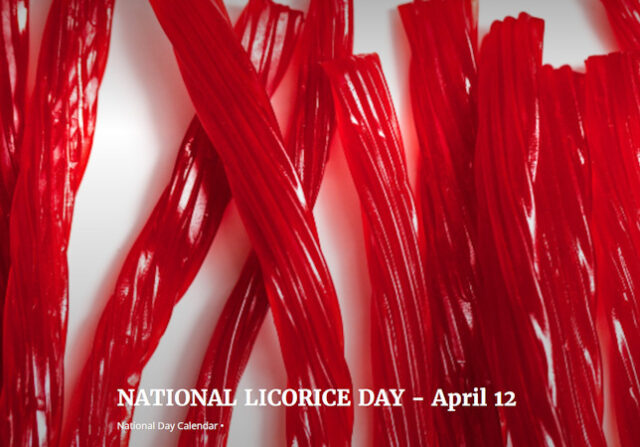
National Licorice Day is observed each year on April 12. This day was created to celebrate black licorice, its history, health benefits, and world renown. Enjoy black licorice in twists, stem shaped candies, licorice ropes, jelly beans, jewels, and many others.
- 2300 BC Licorice originated during this time period.
- 360 AD – Manuscripts from 360 A.D. talk of licorice helping eye ailments, skin diseases, coughs, and loss of hair. Alexander the Great and Julius Caesar are on record as endorsing the benefits of eating licorice.
- 13th Century – During this time, the licorice root was squeezed to extract its flavor, which was used to sweeten various cakes and breads.
- 14th Century – Licorice was used to soothe coughs, colds, and bronchitis.
- 17th Century – The earliest record of licorice as the candy most people know today is from this period.
- 1902 – The first products made in the factory are licorice shapes, salt pastilles, eucalyptus pastilles, and colored shapes with fruit flavor.
- 1933 – Ga-Jol is launched as a salt pastille and is one of the oldest licorice products still in use.
- 1996 – One of the premier licorice companies in the United States, Licorice International, was started in Lincoln, Nebraska, this year.
- 2004 – Licorice International and the National Confectioners Association collaborated to create the first National Licorice Day.
- If you’re a fan of licorice and have noticed it makes your tummy feel better, there’s a reason. Licorice root can soothe a stomach bothered by heartburn or gastritis. The glycyrrhizic acid in licorice contains immune-boosting and anti-inflammatory properties that can help to restore balance to the stomach lining.
- The botanical name for licorice translates to “sweet root.”
- The licorice plant is actually a member of the pea family.
- This flavor is used in many products other than licorice candy, such as alcohol, tobacco, and, of course, food.
- Carbenoxolone, a compound derived from licorice root, may help slow the effects of aging on the brain.
- The licorice plant, a shrub, is officially a weed. It is about four feet tall with purplish flowers and grows in hot, dry places.
- Licorice root is a botanical ingredient in modern Chinese medicine used to manage cancers. Current research conducted at Rutgers, the State University of New Jersey, supports the use of licorice in the treatment of prostate and breast cancer.
- In the United States, anise seed is a popular substitute for licorice flavoring. Although the anise seed has an unmistakable licorice flavor, it is not related to the European plant whose roots are the source of true licorice.
- Napoleon Bonaparte found licorice soothing during a battle; he allegedly ate so much of it that his teeth turned black.
- Salmiak or salmiakki is a type of licorice confectionery common in Germany, Finland, Sweden, and other Nordic countries. It’s flavored with ammonium chloride, which gives it a salty flavor. It’s commonly referred to as “salty licorice.”
- Here’s how to say licorice in 5 different languages: French: Regliss; German: Lakritze; Italian: Liquirizia; Spanish: Regaliz; Indian: Mulethi
- In the Middle Ages, Italian knights would use this romantic phrase to dedicate to the ladies they were sweet on: L’amore e’ un sogno, dolce come il latte e la liquirizia. What does it mean? “Love is a dream, sweet as milk and licorice.” How sweet!
- Root of licorice is used in the food industry for the production of candies, chewing gums and various liqueurs. Licorice is also popular and is often consumed as tea.
- Licorice helps relieve the pain associated with certain types of ulcers and is good for the adrenal glands.
- Licorice is used as a flavoring agent of tobacco and various types of beer and brandy.
- Thanks to the foaming properties of this plant, licorice root is used in the manufacture of foam for fire extinguishers.
- In Egypt the Pharaohs used licorice to create a traditional drink called erqesos, which was consumed as a healing tonic.
- Licorice is popular as medicine worldwide. It can be used in treatment of respiratory tract disorders, cough, mouth and gastric ulcers, indigestion, headache and neurodegenerative disorders. Some medical studies indicate that licorice may be beneficial in treatment of certain types of cancer. Creams made of licorice can be used for the removal of the freckles and other discolorations on the skin.
- Large quantities of licorice may induce side effects such as edema, hypertension and hypokalemia.
- ‘Liquorice’ sometimes has a different spelling – ‘licorice’, and is also known as ‘black licorice’.
- Sweet Finnish Licorice. These are classic, short tubes of pure black licorice candy, made from real licorice extract, that are soft, mellow and satisfying to chew.
- Licorice Chalk. This is a unique treat hailing from the Old World, it looks exactly like a piece of white school chalk but it boasts a minty shell on the outside and licorice flavor on the inside.
- Black Licorice Caramels. Exactly what the name says, this soft creamy caramel candy is infused with the flavor of black licorice and many people really enjoy the contrast of the sweetness.
- BlackJack Chewing Gum. This classic licorice-flavored gum has been around off-and-on since 1884, but a manufacturer recently committed to bringing it back for those faithful fans who are hoping for a blast from the past.
Sources:

Disclaimer
Artificial Intelligence Disclosure & Legal Disclaimer
AI Content Policy.
To provide our readers with timely and comprehensive coverage, South Florida Reporter uses artificial intelligence (AI) to assist in producing certain articles and visual content.
Articles: AI may be used to assist in research, structural drafting, or data analysis. All AI-assisted text is reviewed and edited by our team to ensure accuracy and adherence to our editorial standards.
Images: Any imagery generated or significantly altered by AI is clearly marked with a disclaimer or watermark to distinguish it from traditional photography or editorial illustrations.
General Disclaimer
The information contained in South Florida Reporter is for general information purposes only.
South Florida Reporter assumes no responsibility for errors or omissions in the contents of the Service. In no event shall South Florida Reporter be liable for any special, direct, indirect, consequential, or incidental damages or any damages whatsoever, whether in an action of contract, negligence or other tort, arising out of or in connection with the use of the Service or the contents of the Service.
The Company reserves the right to make additions, deletions, or modifications to the contents of the Service at any time without prior notice. The Company does not warrant that the Service is free of viruses or other harmful components.