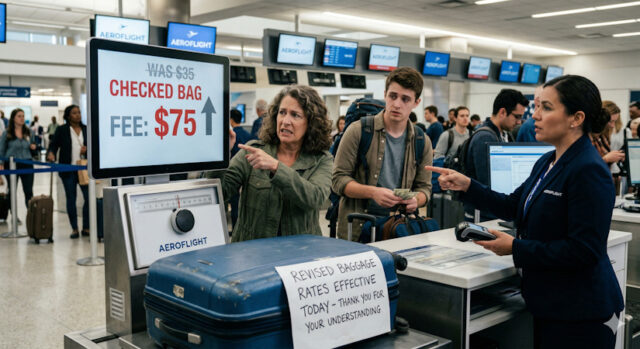
The spring of 2026 has brought a chill to the wallets of domestic and international travelers. In a rapid-fire series of announcements spanning the first ten days of April, the four largest carriers in the United States—United, Delta, American, and even the historically fee-averse Southwest—have implemented sweeping increases to checked baggage fees. This coordinated shift marks the most aggressive adjustment to ancillary pricing in nearly two decades, driven by a perfect storm of geopolitical instability, a crippled global oil supply chain, and a strategic pivot in airline revenue management.
The Catalyst: A Global Energy Crisis
The primary culprit behind this fiscal turbulence is the dramatic spike in jet fuel prices. As of early April 2026, the aviation industry is grappling with the fallout of the escalating conflict in the Middle East, specifically involving Iran and the subsequent closure of the Strait of Hormuz. Since roughly 25% of the world’s jet fuel exports transit through this narrow waterway, the disruption has sent shockwaves through energy markets.
According to data from the U.S. Energy Information Administration (EIA), jet fuel prices have surged by nearly 30% in just three months, moving from a projected $2.67 per gallon to an average of $3.39 per gallon. For major carriers, every cent increase in fuel cost translates to hundreds of millions of dollars in added annual expenses. Delta Air Lines CEO Ed Bastian recently noted that fuel volatility added approximately $400 million to the carrier’s operating expenses in March 2026 alone.
By raising baggage fees rather than base ticket prices, airlines can more precisely target revenue to offset these costs while keeping “sticker prices” on search engines like Google Flights and Expedia deceptively low.

A Carrier-by-Carrier Breakdown of the 2026 Hikes
The current wave of fee increases began with JetBlue in late March and culminated in a massive industry-wide shift by the second week of April. Below is the current landscape of baggage pricing for major U.S. airlines as of April 10, 2026:
1. United Airlines
Effective April 3, 2026, United hiked fees by $10 for most domestic and short-haul international flights (including Canada and Mexico).
- First Bag: $45 if prepaid online; $50 if paid at the airport.
- Second Bag: $55 prepaid; $60 at the counter.
- Third Bag: A staggering $200 (up from $150).
2. Delta Air Lines
Delta matched United’s move on April 8, citing “evolving global conditions.”
- First Bag: $45 (prepaid) / $50 (airport).
- Second Bag: $55 (prepaid) / $60 (airport).
- Third Bag: $200.
- Delta has notably exempted long-haul international routes from these increases for now, focusing the burden on domestic travelers.
3. American Airlines
American Airlines implemented a tiered structure on April 9 that specifically targets Basic Economy passengers.
- First Bag (Basic Economy): $50 prepaid / $55 at the airport.
- First Bag (Main Cabin): $40 (airport) / $35 (online).
- American’s strategy appears to be a dual-pronged approach: covering fuel costs while simultaneously pushing travelers toward higher fare classes or co-branded credit cards.
4. Southwest Airlines: The End of an Era
In perhaps the most shocking move for loyalists, Southwest Airlines—long the holdout with its “two bags fly free” policy—officially ended that legacy for most fares in May 2025 and followed up with a price hike on April 9, 2026.
- First Bag: $45.
- Second Bag: $55.
- Only “Choice Extra” fare holders and high-tier Rapid Rewards members now retain the free bag perk. This move signals a total industry alignment toward unbundled pricing.
5. JetBlue
JetBlue remains the most volatile in its pricing, utilizing “peak” and “off-peak” fee structures. In late March 2026, first-bag fees rose to a starting point of $39, but can reach $48 during high-demand windows.
The Economics of “Unbundling”: Why Fees Trump Fares
Airlines prefer baggage fees over ticket price increases for two primary reasons: tax efficiency and the “Credit Card Moat.”
Tax Avoidance: Under U.S. federal law, airlines pay a 7.5% excise tax on the base price of a domestic flight ticket. However, ancillary fees—such as those for baggage, seat selection, or Wi-Fi—are generally not subject to this tax. By shifting $10 of a flight’s cost from the ticket to a bag fee, an airline collectively saves tens of millions of dollars in tax liability across millions of passengers.
The Credit Card Moat: By making baggage fees prohibitively expensive ($50 for a single bag), airlines increase the perceived value of their co-branded credit cards. Most airline-affiliated cards (like the United Quest or Delta SkyMiles Gold) offer at least one free checked bag as a primary benefit. When the fee was $25, the card might not have paid for itself for an occasional traveler. At $50 per bag, the card becomes an essential tool for cost-avoidance, effectively locking consumers into a specific airline’s ecosystem.
The Critical Question: Will Fees Ever Come Down?
History and economic theory provide a grim outlook for travelers hoping for a reversal. Since baggage fees were first introduced in 2008 by American Airlines (initially at $15), they have followed a “ratchet effect”: they move up during crises and remain stationary—or continue to climb—once the crisis abates.
Probability Analysis of a Fee Decrease
Industry analysts place the probability of baggage fees returning to 2024 levels ($30–$35) at less than 5% over the next three years.
Several factors support this low probability:
- The Margin Requirement: Even if fuel prices drop (as the EIA predicts they might in 2027 to $2.59/gallon), airlines face rising labor costs. Pilots and flight attendants secured record-breaking contracts in 2024 and 2025, and fees provide the reliable cash flow needed to fund these long-term payroll obligations.
- Investor Expectations: Wall Street views ancillary revenue as “high-margin” and predictable. Once an airline proves it can collect $45 per bag without a significant drop in passenger volume, shareholders will resist any attempt to reduce that revenue stream.
- Consumer Normalization: Behavioral economists note that passengers eventually adjust their expectations. Within 12 to 18 months, the $50 bag fee will likely be viewed as the standard “cost of doing business” for travel, removing the competitive pressure for any single airline to lower its price first.
“Airlines are copycats,” says Katy Nastro, a travel expert. “When one moves, they all move. But when it comes to lowering prices, no one wants to be the first to leave money on the table.”
Consumer Strategies: Navigating the New Landscape
As we move further into 2026, travelers are forced to adapt. The “Carry-on Crisis” is expected to intensify, with more passengers attempting to squeeze larger items into overhead bins to avoid the $50 gate fee. This, in turn, has led some carriers to begin testing weight limits for carry-on luggage, a trend already common in Europe and Asia.
For those traveling this year, the most effective ways to mitigate these costs include:
- Prepaying Online: Most carriers offer a $5 discount for paying at least 24 hours in advance.
- Status and Credit Cards: The “free bag” perk is now the most valuable asset in a frequent flyer’s toolkit.
- Consolidation: Shipping bags via third-party services like LugLess is becoming price-competitive with airline fees for multi-bag travelers.
Conclusion
The 2026 baggage fee hike is more than a temporary response to fuel volatility; it is a fundamental restructuring of the cost of flight. While geopolitical tensions may eventually ease and the Strait of Hormuz may reopen, the precedent for $50 checked bags has been set. For the modern traveler, the “base fare” is increasingly becoming a small fraction of the total cost to actually get from point A to point B.
Sources Used and Links:
- TravelPirates: “US Airline Baggage Fees Just Got More Expensive in 2026”
- PBS NewsHour: “As jet fuel costs soar, Delta joins growing list of U.S. airlines raising checked bag fees”
- Argus Media: “EIA hikes US jet fuel price outlook by 30pc”
- Simple Flying: “American Airlines Joins 4 Other US Carriers In Raising Checked Bag Fees”
- Metro Airport News: “American Updates Basic Economy Fares, Hikes Checked Bag Fees”
- Morningstar / MarketWatch: “Why these 3 airlines are still raising bag fees even though passengers are already fed up”
- IndexBox: “Delta & Southwest Baggage Fee Increase 2026: New Costs & Details”
- Devdiscourse: “Global Aviation Faces Turbulence as Jet Fuel Prices Skyrocket”
- University of California, Irvine (Research Paper): “Product Unbundling in the Travel Industry: The Economics of Airline Bag Fees”
Disclaimer
Artificial Intelligence Disclosure & Legal Disclaimer
AI Content Policy.
To provide our readers with timely and comprehensive coverage, South Florida Reporter uses artificial intelligence (AI) to assist in producing certain articles and visual content.
Articles: AI may be used to assist in research, structural drafting, or data analysis. All AI-assisted text is reviewed and edited by our team to ensure accuracy and adherence to our editorial standards.
Images: Any imagery generated or significantly altered by AI is clearly marked with a disclaimer or watermark to distinguish it from traditional photography or editorial illustrations.
General Disclaimer
The information contained in South Florida Reporter is for general information purposes only.
South Florida Reporter assumes no responsibility for errors or omissions in the contents of the Service. In no event shall South Florida Reporter be liable for any special, direct, indirect, consequential, or incidental damages or any damages whatsoever, whether in an action of contract, negligence or other tort, arising out of or in connection with the use of the Service or the contents of the Service.
The Company reserves the right to make additions, deletions, or modifications to the contents of the Service at any time without prior notice. The Company does not warrant that the Service is free of viruses or other harmful components.