The Long Road Home: Artemis II Transitions to Earth Gravity
As of late Tuesday, April 7, 2026, the four-person crew of NASA’s Artemis II mission has officially crossed the invisible threshold of the lunar sphere of influence. For the first time in over five decades, humans are watching the Moon recede into the blackness of deep space as they accelerate toward a homecoming that will finalize the first crewed lunar mission of the 21st century.
The transition occurred at 1:28 p.m. EDT, a moment that marked a significant shift in the mission’s physics. After days where the Moon’s gravity was the primary force acting upon the Orion spacecraft, the Earth has now reassumed its role as the dominant gravitational anchor. The crew—Commander Reid Wiseman, Pilot Victor Glover, and Mission Specialists Christina Koch and Jeremy Hansen—are currently traveling through a vast expanse of space roughly 230,000 miles from their home planet, moving at thousands of miles per hour.
A Gallery from the Lunar Far Side
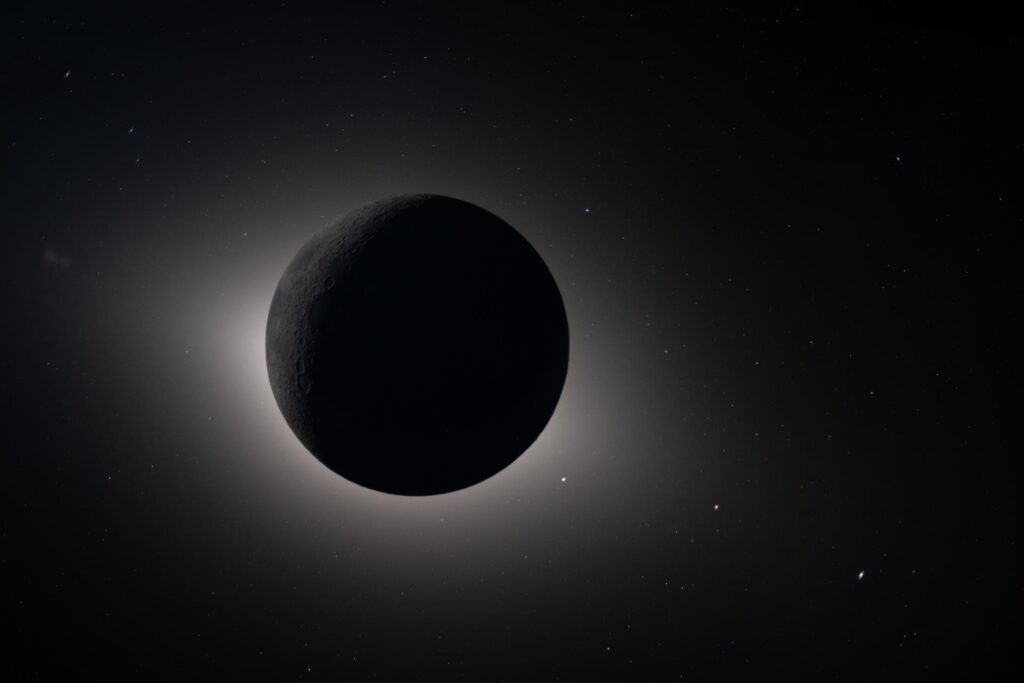
As the spacecraft began its homeward leg, NASA released a series of high-definition images and video downlinks that have captivated a global audience. These images, captured during the mission’s closest approach to the Moon on April 6, represent a quantum leap in lunar photography.
- The Earthset: One of the most hauntingly beautiful images released shows a “muted blue Earth with bright white clouds” setting behind the rugged, cratered horizon of the Moon. In the foreground, the Ohm crater—a massive lunar feature with distinct terraced edges—is visible in startling detail.
- The Far Side Vistas: Because the Moon is tidally locked to Earth, humans on the ground never see the lunar far side. The Artemis II crew, however, spent hours observing this “hidden” terrain. The photos reveal a surface much more rugged and crater-saturated than the familiar “near side.”
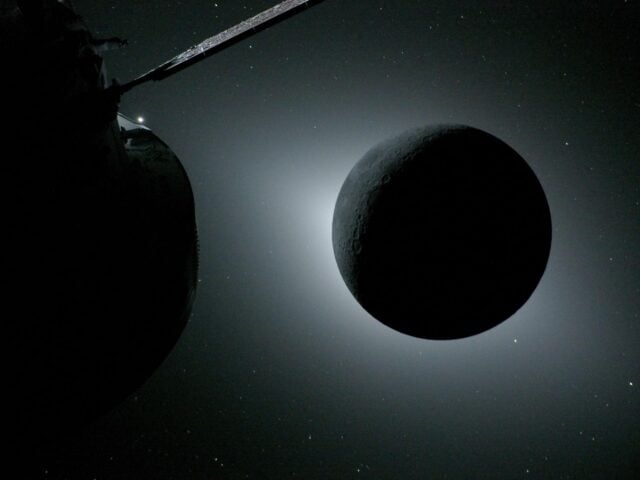
- The Solar Eclipse: In a rare celestial alignment, the crew captured the Moon fully eclipsing the Sun from their unique vantage point in deep space. The resulting imagery shows the solar corona shimmering around the dark disk of the Moon, a perspective impossible to achieve from Earth’s surface.
Breaking Records and Setting Precedents
The journey to this point has already been record-breaking. On April 6, the crew surpassed the distance record for human spaceflight previously held by the crew of Apollo 13. While the 1970 mission reached 248,655 miles from Earth due to an emergency loop around the Moon, Artemis II pushed that boundary further, reaching a maximum distance of approximately 252,756 miles.

During their time in the lunar vicinity, the crew made a poignant contribution to lunar nomenclature. Commander Reid Wiseman suggested naming a prominent lunar crater after his late wife, Carroll, while another was named Integrity, a nod to the name the crew has bestowed upon their Orion capsule. These names serve as emotional anchors for a mission that is as much about human spirit as it is about technical prowess.
Technical Performance of the Orion “Integrity”
Throughout the first seven days of flight, the Orion spacecraft has performed near flawlessly. Launched on April 1, 2026, atop the Space Launch System (SLS) rocket, the vehicle has successfully executed multiple orbital adjustments.
On Tuesday evening, at approximately 9:03 p.m. EDT, the crew is scheduled to conduct the Return Trajectory Correction (RTC) 1 burn. This 15-second ignition of Orion’s reaction control thrusters is designed to fine-tune the spacecraft’s path. Even a slight deviation at this distance could result in the capsule missing its narrow reentry corridor, making these small “nudges” in deep space critical to the mission’s safety.
The Human Element: Four Eyes on the Moon
The Artemis II mission is the first to send a diverse crew into deep space. Victor Glover, the mission pilot, reflected on the view of Earth from 200,000 miles away during a ship-to-ship call with the International Space Station (ISS).
“From up here, you look like one thing,” Glover told the ISS crew. “Homo sapiens is all of us—no matter where you’re from. We’re all one people.”
Christina Koch, who already holds records for the longest single spaceflight by a woman, and Jeremy Hansen, representing the Canadian Space Agency (CSA), have been tasked with a rigorous schedule of lunar observations. They are acting as the primary scientific observers, documenting lunar features with varying textures and illumination to help NASA geologists prepare for the Artemis III landing mission.
The Final Descent: Preparing for Splashdown
The journey home will take approximately four days. While the crew is currently in a “rest and recharge” phase, the intensity will ramp up significantly as they approach Earth on Friday, April 10.
The final phase of the mission is arguably the most dangerous. Orion will hit the Earth’s atmosphere at a staggering 25,000 miles per hour (40,000 kph). At these speeds, the spacecraft’s heat shield must withstand temperatures of nearly 5,000 degrees Fahrenheit—about half as hot as the surface of the sun.
NASA recovery teams, including the USS John P. Murtha, are already positioning themselves off the coast of San Diego. Once the capsule’s parachutes deploy and it splashes down in the Pacific Ocean, helicopters and specialized divers will move in to retrieve the four history-makers.
Beyond Artemis II: The Path to the Lunar South Pole
The success of Artemis II is the final green light required for Artemis III, which aims to land the first woman and first person of color on the lunar surface. The data being gathered right now regarding radiation levels, life support efficiency, and communications latency will be the foundation upon which the future lunar base is built.
As the crew of Artemis II sleeps tonight, they do so as the farthest-flung humans in history, hurtling toward a planet that is eagerly awaiting their return.
Sources and Links:
- NASA Blogs: Artemis II Flight Day 7: Crew Makes Long‑Distance Call, Begins Return
- Space.com: Artemis 2 LIVE: Astronauts set for deep space burn to tweak Orion trajectory
- Fox 35 Orlando: Artemis II live tracker, day 7: Astronauts returning to Earth after historic lunar flyby
- NASA News Release: NASA’s Artemis II Crew Eclipses Record for Farthest Human Spaceflight
- Associated Press: Artemis II’s moonbound astronauts capture Earth’s brilliant blue beauty
- Al Jazeera: NASA releases stunning first photos of Earth from Artemis II moon mission
Disclaimer
Artificial Intelligence Disclosure & Legal Disclaimer
AI Content Policy.
To provide our readers with timely and comprehensive coverage, South Florida Reporter uses artificial intelligence (AI) to assist in producing certain articles and visual content.
Articles: AI may be used to assist in research, structural drafting, or data analysis. All AI-assisted text is reviewed and edited by our team to ensure accuracy and adherence to our editorial standards.
Images: Any imagery generated or significantly altered by AI is clearly marked with a disclaimer or watermark to distinguish it from traditional photography or editorial illustrations.
General Disclaimer
The information contained in South Florida Reporter is for general information purposes only.
South Florida Reporter assumes no responsibility for errors or omissions in the contents of the Service. In no event shall South Florida Reporter be liable for any special, direct, indirect, consequential, or incidental damages or any damages whatsoever, whether in an action of contract, negligence or other tort, arising out of or in connection with the use of the Service or the contents of the Service.
The Company reserves the right to make additions, deletions, or modifications to the contents of the Service at any time without prior notice. The Company does not warrant that the Service is free of viruses or other harmful components.