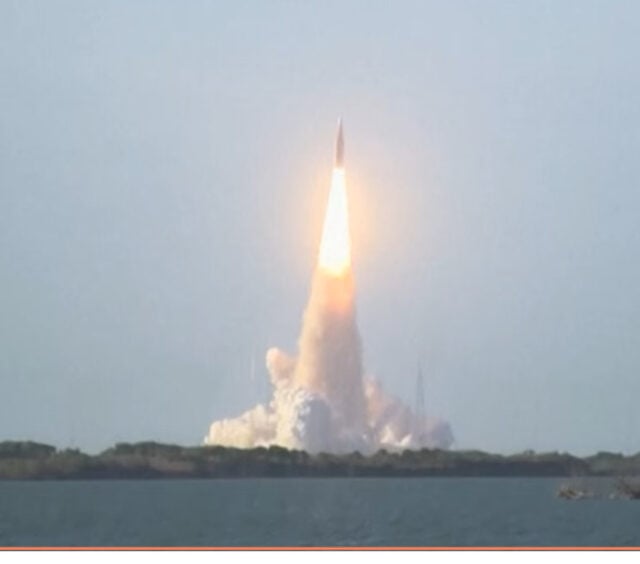
At precisely 6:35:12 PM EDT on April 1, 2026, the Florida coastline didn’t just witness a launch; it felt a tectonic shift in human history. Under a clear twilight sky at the Kennedy Space Center, the Space Launch System (SLS) rocket ignited its four RS-25 engines and twin solid rocket boosters, unleashing a staggering 8.8 million pounds of thrust. The resulting roar—a crackling, physical wall of sound—shook the viewing stands at the Banana River and echoed across the marshes of Cape Canaveral, signaling the end of a fifty-four-year hiatus from crewed deep-space exploration.
For the estimated 400,000 spectators packed onto the beaches of Cocoa Beach and Titusville, the spectacle was more than just a feat of engineering. It was the fulfillment of a promise made over a decade ago. As the orange glow of the SLS core stage ascended, piercing the upper atmosphere, it carried with it the hopes of a generation that had only ever seen the Moon through the grainy, black-and-white archives of the Apollo era.
“The nation and the world have been waiting a long time to do this again,” Commander Reid Wiseman told Mission Control shortly after reaching orbit. His voice, crisp and calm despite the $3g$ of acceleration he had just endured, echoed the sentiment of a planet watching in collective awe.
A Crew of Pioneers
The four individuals currently hurtling toward the lunar vicinity at roughly 17,500 mph represent a modern, inclusive vision of space exploration. Unlike the “Right Stuff” era of the 1960s, the Artemis II crew reflects a global partnership and a commitment to diversity.

- Commander Reid Wiseman (NASA): A veteran of the International Space Station, Wiseman brings the steady hand required to lead the first crewed flight of the Orion spacecraft.
- Pilot Victor Glover (NASA): With this mission, Glover becomes the first person of color to leave low Earth orbit (LEO). His role is critical in testing the manual handling qualities of Orion during the proximity operations phase.
- Mission Specialist Christina Koch (NASA): Already a record-holder for the longest single spaceflight by a woman, Koch is now the first woman to travel to the Moon. Her expertise in station systems is vital for monitoring Orion’s life support during the 10-day journey.
- Mission Specialist Jeremy Hansen (CSA): Representing the Canadian Space Agency, Hansen is the first non-American to venture beyond LEO, marking a significant milestone for international cooperation in the Artemis Accords.
Together, they are the vanguard. They are not landing—not yet—but their mission is the ultimate “stress test” for the systems that will eventually put boots back on the lunar dust.
The Beast: Engineering the Space Launch System
The SLS is often criticized for its “Old Space” heritage, utilizing components derived from the Space Shuttle and Apollo programs. However, watching it fly today silenced many skeptics. The Block 1 configuration used for Artemis II stands 322 feet tall. Its core stage, built by Boeing, houses 537,000 gallons of liquid hydrogen and 196,000 gallons of liquid oxygen.
The physics of the launch are staggering. To escape Earth’s gravity well and reach the Moon, the vehicle must achieve a velocity that overcomes the Earth’s gravitational potential. The energy required is defined by:
Where $\mu$ is the standard gravitational parameter of Earth. The SLS provides the necessary “kick” to achieve Translunar Injection (TLI), a maneuver that will occur approximately 24 hours into the mission. Unlike Artemis I, which was uncrewed, the Artemis II SLS had to meet much more stringent “human-rating” certifications, ensuring that the vibrations and acoustic loads would not harm the four pioneers inside the Orion capsule.
Orion: A Home in the Void
While the SLS is the muscle, the Orion spacecraft is the brain and the sanctuary. Developed by Lockheed Martin, Orion is designed to keep humans alive for weeks in the harsh radiation environment of deep space. For Artemis II, the life support systems are being tested with “full bio-load” for the first time.
The European Service Module (ESM), provided by the European Space Agency (ESA) and built by Airbus, is the powerhouse of the craft. It provides electricity via four iconic “X-wing” solar arrays, as well as water, oxygen, and nitrogen for the crew. One of the primary objectives of the next 24 hours is to ensure that the ESM can maintain a stable internal temperature while facing the extreme thermal gradients of space—where the side facing the Sun can reach $120^\circ\text{C}$ while the shadowed side plunges to $-150^\circ\text{C}$.
A significant focus of this mission is the heat shield. Following the Artemis I mission in late 2022, engineers noted unexpected “charring” and material loss on the shield during re-entry. This led to the significant delays that pushed the Artemis II launch from 2025 to 2026. NASA’s “root cause” analysis resulted in subtle modifications to the Avcoat thermal protection system, and the world will be watching closely when Orion hits the atmosphere at 25,000 mph on April 11.
The 10-Day Odyssey
The Artemis II flight profile is a masterclass in conservative, safety-first orbital mechanics. It utilizes a Hybrid Free-Return Trajectory.
- High Earth Orbit (HEO): After launch, the crew will spend the first 24 hours in a high Earth orbit with a high apogee. This allows them to test the life support systems while still being close enough to Earth to abort and return quickly if something fails.
- Translunar Injection (TLI): Once the “go” is given, the Interim Cryogenic Propulsion Stage (ICPS) will fire one last time to send them toward the Moon.
- The Lunar Flyby: The crew will not enter lunar orbit. Instead, they will fly around the far side of the Moon, using lunar gravity to “slingshot” them back toward Earth. At their furthest point, they will be approximately 4,700 miles beyond the lunar surface.
- The Return: After a 10-day round trip, the crew will splash down in the Pacific Ocean, where the U.S. Navy is already standing by for recovery.
This “free-return” setup is the ultimate safety net; if the Orion main engine were to fail after TLI, gravity would naturally pull the spacecraft back to Earth without the need for further burns.
Lessons from the Past, Eyes on the Future
It has been 19,471 days since Gene Cernan left the last human footprint on the Moon during Apollo 17. The geopolitical landscape has shifted from a bi-polar “Space Race” to a multi-polar era of commercial competition and international alliances.
While Apollo was about “flags and footprints,” Artemis is about “sustained presence.” The data collected by Wiseman, Glover, Koch, and Hansen will directly influence the construction of the Lunar Gateway—a small space station that will orbit the Moon and serve as a staging point for surface missions.
There is also the “Mars connection.” NASA views the Moon as a proving ground. The technologies being tested today—autonomous docking, deep-space radiation shielding, and cryo-fuel management—are the prerequisites for a crewed mission to the Red Planet in the 2030s. As NASA Administrator Jared Isaacman noted in a pre-launch briefing, “We go back to the Moon to learn how to live on another world, so that we may eventually walk on Mars.”
The Road Ahead: From II to III and Beyond
The success of today’s launch provides a much-needed boost to a program that has faced its share of budgetary and technical hurdles. In early 2026, NASA made the difficult decision to pivot the Artemis III mission. Originally intended to be the first lunar landing, Artemis III (slated for 2027) will now likely be a docking and rendezvous test in low Earth orbit between Orion and the SpaceX Starship Human Landing System (HLS).
This change in the roadmap was necessitated by delays in the development of the Starship HLS and the next-generation Axiom space suits. However, the pivot ensures that the program maintains momentum. The actual landing—the moment the world has been waiting for—is now targeted for Artemis IV in 2028.
While some critics argue that the delays and cost overruns (estimated at over $4 billion per launch) are prohibitive, the enthusiasm on the Florida coast today suggests that the public’s appetite for discovery remains unsated. Space is no longer just the province of government agencies; with companies like SpaceX and Blue Origin deeply integrated into the Artemis architecture, the “Lunar Economy” is beginning to take shape.
Conclusion: A New Dawn
As of this writing, the Artemis II crew has completed their first orbital checkout. They are currently eating their first “dinner” in deep space, looking back at a blue marble that is slowly shrinking in their windows. In three days, they will see the cratered, monochromatic expanse of the Moon rise over the horizon—a sight no human eyes have witnessed in person since the Nixon administration.
Today’s launch was a reminder of what humanity can achieve when it aims higher than the stratosphere. We aren’t just visiting the Moon; we are claiming our place as a multi-planetary species. The roar of the SLS may have faded from the Florida skies, but its echo will be felt for decades to come.
Godspeed, Artemis II. The Moon is waiting.
Sources Used and Links
- NASA News Release: Liftoff! NASA Launches Astronauts on Historic Artemis Moon Mission
- Wikipedia: Artemis II Mission Details and Crew
- The Guardian: Nasa’s Artemis II rocket lifts off for historic moon mission
- NASA Blogs: LIVE: Artemis II Launch Day Updates
- Royal Museums Greenwich: NASA’s Artemis Moon Missions: All You Need to Know
- NASA Strategic Document: Returning to the Moon: Artemis Progress Report
- Wikipedia: Artemis III Schedule and Pivot Updates
Disclaimer
Artificial Intelligence Disclosure & Legal Disclaimer
AI Content Policy.
To provide our readers with timely and comprehensive coverage, South Florida Reporter uses artificial intelligence (AI) to assist in producing certain articles and visual content.
Articles: AI may be used to assist in research, structural drafting, or data analysis. All AI-assisted text is reviewed and edited by our team to ensure accuracy and adherence to our editorial standards.
Images: Any imagery generated or significantly altered by AI is clearly marked with a disclaimer or watermark to distinguish it from traditional photography or editorial illustrations.
General Disclaimer
The information contained in South Florida Reporter is for general information purposes only.
South Florida Reporter assumes no responsibility for errors or omissions in the contents of the Service. In no event shall South Florida Reporter be liable for any special, direct, indirect, consequential, or incidental damages or any damages whatsoever, whether in an action of contract, negligence or other tort, arising out of or in connection with the use of the Service or the contents of the Service.
The Company reserves the right to make additions, deletions, or modifications to the contents of the Service at any time without prior notice. The Company does not warrant that the Service is free of viruses or other harmful components.