The Midnight Maneuver: A Fragile Peace Denied
In the quiet, early hours of Friday, March 27, 2026, the United States Senate attempted to break a 42-day legislative paralysis that has left the nation’s airports in shambles and its security apparatus on life support. By a unanimous voice vote at approximately 2:00 AM, the Senate approved a targeted “off-ramp” bill designed to restore funding to the Transportation Security Administration (TSA), the Coast Guard, and FEMA.
However, the celebratory mood in the upper chamber was short-lived. By dawn, House Speaker Mike Johnson (R-LA) had effectively torpedoed the proposal, labeling the bipartisan effort a “joke” and “shameful.” The Speaker’s refusal to bring the Senate’s partial funding measure to the House floor ensures that the Department of Homeland Security (DHS) shutdown—the most protracted and bitter in recent memory—will drag into a seventh week.
The conflict hinges on a fundamental disagreement over Immigration and Customs Enforcement (ICE) and Customs and Border Protection (CBP). While the Senate bill successfully carved out funding for the “non-controversial” elements of DHS, it left the immigration enforcement agencies unfunded, a move Johnson and his allies in the House Freedom Caucus view as a surrender to Democratic demands for radical agency reform.
Breaking Down the Senate “Off-Ramp”
The Senate-passed legislation was the result of high-stakes negotiations between Senate Majority Leader John Thune (R-SD) and Minority Leader Chuck Schumer (D-NY). With airport security lines in major hubs like Atlanta and Chicago stretching into five-hour ordeals, the Senate sought a middle ground that would alleviate public pressure without forcing a final resolution on the most divisive issues.

The Senate Funding Proposal (FY 2026 Emergency DHS Bill)
| Agency / Function | Funding Status | Key Provisions |
| TSA | Fully Funded | Immediate restoration of back-pay for agents working without checks since February. |
| Coast Guard | Fully Funded | Funding for maritime security and search-and-rescue operations amid heightened Iran tensions. |
| FEMA | Fully Funded | Replenishment of the Disaster Relief Fund following historic East Coast winter storms. |
| CISA | Fully Funded | Support for cybersecurity infrastructure ahead of the 2026 midterm elections. |
| ICE | NOT FUNDED | Excluded from the bill to allow for continued debate on enforcement tactics. |
| CBP (Border Patrol) | NOT FUNDED | Excluded due to disputes over detention facility oversight and use of force. |
“The White House made offer after offer, putting forward a robust list of additional reforms, and Democrats just kept moving the goal posts,” said Majority Leader John Thune following the vote. “We have provided a path to get TSA moving again, but we will not abandon our commitment to border security.”
Johnson’s Defiance: “This is Common Sense Versus Crazy”
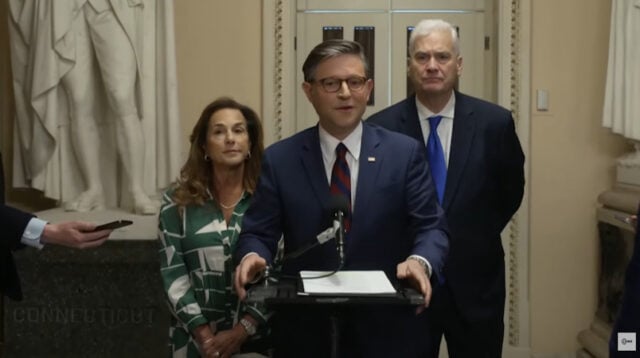
Speaker Johnson’s response to the Senate’s midnight vote was swift and unyielding. During a heated news conference at the U.S. Capitol, the Speaker argued that the House had already done its duty by passing a full-year, comprehensive DHS funding bill months ago. He accused Senate Democrats of “playing games” with the livelihoods of federal workers to shield illegal immigrants from enforcement.
“To send a bill over that funds the parts of the department they like while leaving our borders wide open and our enforcement agents hanging out to dry is a joke,” Johnson told reporters. “It’s crazy. I don’t know another word to describe it. They are putting the American people in jeopardy for their own political skins.”
Johnson’s primary grievance lies in the Democratic demand for “constitutional guardrails” on ICE agents. Following the tragic shooting of two citizens in Minneapolis by federal immigration officers in January—the event that catalyzed this shutdown—Democrats have refused to fund ICE without strict new requirements, including:
- Mandatory Unmasking: Requiring all agents to wear visible identification and remain unmasked in public.
- Judicial Warrants: Ending “roving patrols” and requiring signed warrants for entries into private homes.
- Qualified Immunity Reform: Providing civil recourse for victims of constitutional violations by DHS agents.
Johnson and House Republicans view these demands as an attempt to “rein in” a department that is already struggling to handle the fallout of a global migration crisis. “We’ve seen what happens when you defund the police,” one House leadership aide noted. “This is ‘defund the border’ by another name.”
The Human Cost: Chaos at 30,000 Feet
While the political theater continues in Washington, the real-world consequences are being felt at every major airport in the United States. The TSA, which relies on a workforce that largely lives paycheck to paycheck, is at a breaking point.
Reports indicate that as many as 450 TSA agents have resigned in the last two weeks alone, unable to sustain their households without pay. At Atlanta Hartsfield-Jackson International Airport, wait times surged to nearly six hours on Thursday. Travelers have reported “chaotic scenes” where frustrated passengers, missing flights and connections, have clashed with the skeletal crews remaining on duty.
Operational Impact of the 42-Day Shutdown
- TSA Staffing: Widespread call-outs and “sick-outs” have reduced staffing levels by 30% at Tier 1 airports.
- Coast Guard Readiness: While “essential” patrols continue, maintenance on cutters and long-range aircraft has been deferred, affecting maritime drug interdiction.
- FEMA Backlog: Processing of disaster aid for survivors of the January blizzards has slowed to a crawl, leaving thousands of families in the Northeast in temporary housing.
- Worker Morale: Unions representing DHS employees describe the workforce as “near a breaking point,” with many agents taking on part-time gig work to make ends meet.
The “Big Beautiful” Safety Net and the Trump Factor
The current standoff is unique because, unlike previous shutdowns, some agencies are not yet out of cash. President Donald Trump’s administration has utilized funds from the “One Big Beautiful Bill Act” (OBBB)—a massive tax and spending package passed last year—to keep ICE and parts of CBP operational despite the lapse in specific appropriations.
The OBBB provided approximately $75 billion in advanced funding for Homeland Security, which has allowed immigration enforcement to continue even as TSA agents go unpaid. This disparity has fueled Democratic outrage, with Senate Minority Leader Chuck Schumer accusing the administration of using “a rogue and deadly militia” while holding airport security hostage.
In a surprise move late Thursday, President Trump announced he would sign an executive order to pay TSA agents using discretionary funds, bypassing Congress entirely. While this “temporary fix” may alleviate the immediate threat of airport closures, it has been met with skepticism by legal experts and Republicans alike.
“If the President can just pay whoever he wants with whatever money he finds, why do we have a budget process at all?” asked one Republican senator who requested anonymity.
Reconciliation: The GOP’s “Nuclear Option”
With the Senate “off-ramp” dead on arrival in the House, Speaker Johnson is eyeing a more aggressive path forward. House leadership is preparing to use Budget Reconciliation, a procedural tool that allows certain spending bills to pass the Senate with a simple majority, bypassing the 60-vote filibuster.
The GOP plan is to bundle the remaining DHS funding with the SAVE America Act, a controversial bill that would require proof of citizenship for federal voting. By linking national security funding to election integrity, Republicans hope to force Senate Democrats into a difficult choice ahead of the 2026 midterms.
“We will move quickly and efficiently,” said Senator Lindsey Graham (R-SC), Chairman of the Senate Budget Committee. “We are going to fund ICE, we are going to secure the border, and we are going to make sure only Americans vote in American elections. If the Democrats want to block that, they can explain it to the voters.”
The Iran Context: National Security in a Time of War
Adding a layer of desperation to the negotiations is the ongoing military action in Iran. With the U.S. currently engaged in strikes against Iranian infrastructure following a series of maritime provocations, the need for a fully functional DHS has never been more acute.
Speaker Johnson has repeatedly cited the Iran conflict as a reason why a partial funding bill is unacceptable. “The military action in Iran makes it all the more urgent and crucial to have a fully staffed, fully funded Department of Homeland Security across all departments,” the Speaker stated in his March 3rd address. “Democrats withholding funding in the midst of rapidly mounting crises is the definition of irresponsibility.”
Critics, however, argue that if the situation is indeed so dire, the Speaker should accept the Senate’s “off-ramp” immediately to ensure that domestic security—specifically at airports and coastal borders—is not compromised while the broader fight over ICE continues.
The Road Ahead: Recess or Resolution?
As of Friday afternoon, the House remains in recess, with no scheduled votes on the Senate-passed package. The 42-day shutdown has now surpassed the 2018-2019 record, making it the longest in U.S. history.
For the millions of Americans planning to travel for the upcoming spring holidays, the message from Washington is clear: expect delays. For the TSA agents standing at the checkpoints, the message is even more sobering: your paycheck remains a pawn in a larger game of political chess.
Speaker Johnson shows no signs of blinking. “We are not going to be intimidated by the Senate’s failures,” he concluded. “The House has done its job. It’s time for the Senate to do theirs—and do it right this time.”
Sources Used and Links
- Washington Examiner: Senate sends DHS bill to the House without ICE funding
- LiveNOW from FOX: DHS funding deal reached in Senate, funds TSA and most of Homeland Security, House weighs next steps
- Courthouse News Service: Johnson comes out swinging against DHS funding compromise as bipartisan deal falters
- WABE (NPR): Senate votes to fund TSA and much of DHS, minus immigration enforcement
- CBS News: DHS funding live updates as Senate-approved bill faces headwinds in the House
- Speaker Mike Johnson Official Statement: Speaker Johnson Statement on Democrat DHS Shutdown
- The Guardian: ‘Really, really long lines’: ICE agents are now at US airports to help beleaguered TSA – to mixed results
Disclaimer
Artificial Intelligence Disclosure & Legal Disclaimer
AI Content Policy.
To provide our readers with timely and comprehensive coverage, South Florida Reporter uses artificial intelligence (AI) to assist in producing certain articles and visual content.
Articles: AI may be used to assist in research, structural drafting, or data analysis. All AI-assisted text is reviewed and edited by our team to ensure accuracy and adherence to our editorial standards.
Images: Any imagery generated or significantly altered by AI is clearly marked with a disclaimer or watermark to distinguish it from traditional photography or editorial illustrations.
General Disclaimer
The information contained in South Florida Reporter is for general information purposes only.
South Florida Reporter assumes no responsibility for errors or omissions in the contents of the Service. In no event shall South Florida Reporter be liable for any special, direct, indirect, consequential, or incidental damages or any damages whatsoever, whether in an action of contract, negligence or other tort, arising out of or in connection with the use of the Service or the contents of the Service.
The Company reserves the right to make additions, deletions, or modifications to the contents of the Service at any time without prior notice. The Company does not warrant that the Service is free of viruses or other harmful components.