WASHINGTON — As the partial shutdown of the Department of Homeland Security (DHS) grinds into its 39th day, a glimmer of legislative light has appeared in the halls of the Capitol. On Wednesday, March 25, 2026, reports emerged that a tentative funding framework has begun to coalesce between the White House and key Republican negotiators. However, the path to a fully operational aviation system remains blocked as Congressional Democrats signal that the current “bare-bones” proposal does not go far enough to secure long-term worker protections or address systemic issues within the nation’s immigration enforcement agencies.
The standoff, which began on February 14, has turned U.S. airports into arenas of operational chaos. With roughly 50,000 Transportation Security Administration (TSA) officers working without pay for over a month, the system has reached a breaking point. While the “Aviation Stability” proposal currently on the table offers a path to restoring salaries, the “more” that Democrats are demanding involves a complex mix of pay equity, infrastructure investment, and significant curbs on the executive branch’s use of law enforcement personnel.
The Emerging Framework
The potential deal, spearheaded by Republican Senator Katie Britt and newly confirmed DHS Secretary Markwayne Mullin, proposes a “surgical” funding strategy. Under this plan, the government would provide full-year appropriations for nearly all components of DHS—including the TSA, the Coast Guard, FEMA, and the Cybersecurity and Infrastructure Security Agency (CISA).
To navigate the political minefield, the proposal would carve out the most contentious element: the “Enforcement and Removal Operations” (ERO) division of Immigration and Customs Enforcement (ICE). Funding for ICE ERO would be moved into a separate legislative track, potentially to be resolved through the budget reconciliation process later this summer. This approach is intended to “shutdown-proof” the parts of the government that affect the traveling public and national disaster response, while allowing the broader battle over immigration policy to continue in a different arena.

“We have a solution on the table that funds our frontline defenders and keeps our airports moving,” Senator Britt told reporters on Monday evening following a meeting with President Trump. “It’s time to stop the games and get these paychecks out.”
Why Democrats Are Holding Out
Despite the progress, Democratic leadership—led by Senate Majority Leader Chuck Schumer and House Ranking Member Rosa DeLauro—has made it clear that a simple restoration of the status quo is insufficient. For Democrats, the 39-day lapse has exposed fundamental flaws in how federal workers are treated, and they are leveraging the moment to demand three specific “add-ons”:
1. Codified Pay Equity and the “Trust Fund” Guarantee
While Republicans have introduced the PAY TSA Act of 2026 to shift salary funding to a dedicated trust fund, Democrats want the bill expanded. They are pushing for language that would ensure TSA salaries remain at 100% parity with the General Schedule (GS) pay scale in perpetuity, preventing future administrations from rolling back the “pay equity” gains made in 2023. They also demand that the trust fund be shielded from any future executive “reprogramming” for border wall construction or detention facilities.
2. Accountability After Minnesota
The Democratic caucus remains firm on including “guardrails” for ICE and Customs and Border Protection (CBP) following the controversial deaths of Renee Good and Alex Pretti in Minnesota earlier this year. These deaths, involving federal agents, have become a rallying cry for the left. Democrats are demanding that any deal include the creation of a permanent, independent oversight body within DHS to investigate use-of-force incidents—a provision that many in the GOP view as a “poison pill.”
3. Massive Infrastructure Injection
Citing the record-breaking travel volumes of early 2026 and the upcoming FIFA World Cup, Democrats are demanding an additional $5 billion in immediate grants for airport infrastructure. This would fund the rapid deployment of Computed Tomography (CT) scanners and automated screening lanes. Their argument is simple: if the workforce is being depleted by shutdowns, the technology must step up to fill the gap.
The Trump Variable and the “SAVE America Act”
Adding a layer of unpredictability is President Trump’s own set of demands. On his Truth Social platform, the President has repeatedly linked any DHS funding deal to the passage of the SAVE America Act—a bill that would mandate proof of citizenship for voter registration.
“I don’t think we should make any deal with the Crazy, Country Destroying, Radical Left Democrats unless, and until, they Vote with Republicans to pass ‘THE SAVE AMERICA ACT,'” the President posted on March 22.
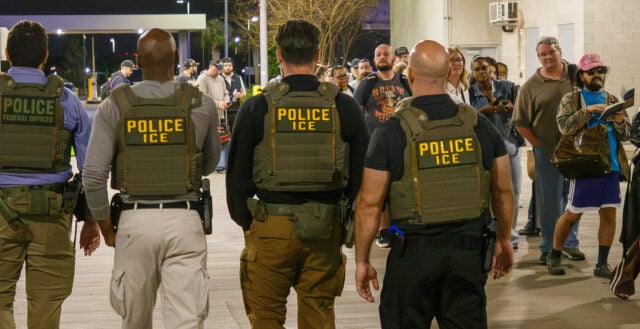
The White House has also doubled down on its threat to deploy ICE agents to airport checkpoints to replace absent TSA officers. Over the weekend, hundreds of ICE officers were reportedly ordered to Newark and Atlanta hubs, a move that Democrats have labeled as “political theater” and a “dangerous misappropriation of law enforcement resources.”
The irony of the current situation is not lost on observers: ICE agents, whose funding is at the heart of the dispute, are currently being paid thanks to the multi-year funding provided in President Trump’s 2025 “One Big Beautiful Bill Act.” Meanwhile, the TSA officers they are “bolstering” are entering their sixth week of work without a paycheck.
A System in Freefall
While the politicians haggle over the “more,” the reality on the ground is increasingly grim. According to DHS data, at least 458 TSA officers have resigned since the shutdown began on February 14. Absenteeism has surged, with some airports reporting call-out rates as high as 40% on peak travel days.
In Houston and Chicago, wait times have frequently exceeded three hours, with lines snaking through multiple levels of the terminal and out onto the sidewalk. The economic impact is radiating through the hospitality and airline sectors. Airlines for America (A4A) estimated this week that the industry is losing upwards of $150 million per day in lost productivity and missed bookings as travelers cancel plans to avoid the “airport gauntlet.”
“This is now the third time in six months that TSA agents have been forced to work without receiving a paycheck,” said Congressman Nick Langworthy. “Morale is at a grave risk. These men and women are our first line of defense, and we are treating them like pawns.”
The human toll is perhaps most visible in the “TSA Food Pantries” that have sprouted up at major hubs. In Atlanta, union leaders have described officers choosing between buying gas to get to work or buying groceries for their children. Some officers have reportedly resorted to selling plasma or taking ride-sharing shifts after their eight-hour airport shifts just to stay afloat.
The Path Forward
The “Aviation Stability Act” represents the most serious attempt yet to break the stalemate, but the gap between “restoring pay” and “reforming the system” remains wide. Republicans feel they have already made a massive concession by agreeing to fund DHS without the ICE ERO component. Democrats, conversely, feel they have the leverage of a public that is increasingly furious about travel disruptions.
The next 48 hours will be critical. If the House can pass a version of the bill that includes at least some of the Democratic infrastructure demands, the pressure will shift to the Senate to see if a 60-vote majority can be reached. If the deal collapses under the weight of the “more,” the nation’s aviation system may face a total grounding as the spring break travel season reaches its apex.
For now, the thousands of TSA officers at checkpoints across the country continue to scan bags and pat down passengers, fueled by a sense of duty—and the hope that their next shift might actually come with a paycheck.
Sources and Links
- AFGE Press Release (March 23, 2026): AFGE Calls for DHS Workers to Be Paid As Hardships Mount
- The Wellsville Sun (March 18, 2026): Congressman Langworthy Introduces PAY TSA Act of 2026
- Everett Post (March 24, 2026): Potential DHS funding deal taking shape, but roadblocks still ahead
- Wisconsin Independent (March 23, 2026): Trump: No TSA funding deal until Senate passes SAVE America Act
- PBS NewsHour (March 24, 2026): Why do ICE agents get paid during the partial government shutdown, but not TSA?
- The Guardian (March 24, 2026): TSA workers try to survive second shutdown and ICE influx: ‘We need to be paid’
- TSA Testimony (Feb 11, 2026): Oversight Hearing – Potential DHS Shutdown Impacts
- Senate Appropriations Committee (March 12, 2026): Senate Republicans Block Five Separate Bills to Fund TSA
Disclaimer
Artificial Intelligence Disclosure & Legal Disclaimer
AI Content Policy.
To provide our readers with timely and comprehensive coverage, South Florida Reporter uses artificial intelligence (AI) to assist in producing certain articles and visual content.
Articles: AI may be used to assist in research, structural drafting, or data analysis. All AI-assisted text is reviewed and edited by our team to ensure accuracy and adherence to our editorial standards.
Images: Any imagery generated or significantly altered by AI is clearly marked with a disclaimer or watermark to distinguish it from traditional photography or editorial illustrations.
General Disclaimer
The information contained in South Florida Reporter is for general information purposes only.
South Florida Reporter assumes no responsibility for errors or omissions in the contents of the Service. In no event shall South Florida Reporter be liable for any special, direct, indirect, consequential, or incidental damages or any damages whatsoever, whether in an action of contract, negligence or other tort, arising out of or in connection with the use of the Service or the contents of the Service.
The Company reserves the right to make additions, deletions, or modifications to the contents of the Service at any time without prior notice. The Company does not warrant that the Service is free of viruses or other harmful components.