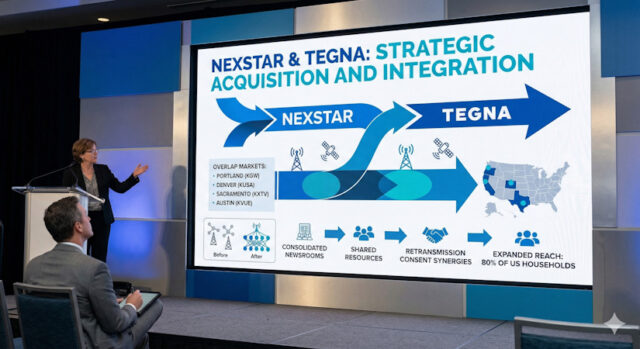
In a landmark decision that resets the boundaries of American media ownership, the Federal Communications Commission (FCC) and the Department of Justice (DOJ) officially approved Nexstar Media Group’s $6.2 billion acquisition of TEGNA Inc. on March 19, 2026. This merger unites the nation’s largest and fourth-largest television station conglomerates, creating a broadcast behemoth with 265 full-power stations across 44 states and the District of Columbia.
While Nexstar executives hail the deal as a “lifeline” for local journalism in a fragmented digital age, the approval has ignited a firestorm of legal challenges from state attorneys general and consumer advocacy groups. At the heart of the controversy is a rare regulatory waiver granted by FCC Chairman Brendan Carr, which allows Nexstar to bypass the congressionally mandated 39% national audience reach cap, effectively doubling it to 80%.
What This Means for Local TV Stations
For the hundreds of local stations involved, the merger signals a shift toward centralized operations. Nexstar CEO Perry Sook argued that the scale provided by the merger is “essential to sustaining strong local journalism,” providing the resources needed to compete with “Big Tech” and global streaming platforms.
However, industry analysts and internal reports suggest a different reality for station employees. Internal documents indicate that nearly 45% of the projected $300 million in “synergies” from the deal will come from “net operating expense reductions.” In practical terms, this often translates to:

-
Newsroom Consolidation: Sharing scripts, anchors, and investigative resources across multiple stations in the same region.
-
Hubbing: Moving technical roles, such as master control and traffic, to centralized regional hubs.
-
Layoffs: Historical trends in Nexstar acquisitions suggest a “line-by-line” analysis of staff to eliminate redundant positions in overlap markets.
The Impact on Viewers
For the average viewer, the most immediate impact may be felt in the monthly cable or satellite bill. Because the combined entity now controls an unprecedented 221 “Big Four” affiliates (ABC, CBS, NBC, and Fox), it possesses massive leverage in “retransmission consent” negotiations.
When a broadcaster owns multiple top-tier stations in a single market, they can demand higher fees from cable providers like Comcast or DirecTV. If those providers refuse to pay, Nexstar can “black out” those channels. Ultimately, these increased fees are typically passed down to the consumer. A coalition of eight state attorneys general, led by New York’s Letitia James and California’s Rob Bonta, filed a lawsuit to block the deal, alleging it will “raise fees for consumers by combining hundreds of TV stations under the same owner.”
Navigating the Overlap Markets
A critical component of the FCC’s approval was the handling of “overlap markets”—cities where both Nexstar and TEGNA already owned competing stations. To satisfy antitrust concerns, the FCC required Nexstar to divest six stations in key markets:
| Market | Station to be Divested | Network Affiliate |
| Denver, CO | KTVD | MyNetworkTV |
| Indianapolis, IN | WTHR | NBC |
| Hartford/New Haven, CT | WCTX | MyNetworkTV |
| Norfolk/Portsmouth, VA | WAVY-TV | NBC |
| New Orleans, LA | WUPL | MyNetworkTV |
| Fort Smith/Rogers, AR | KNWA-TV | NBC |
Despite these divested properties, the merger remains highly concentrated. In 17 other markets, the FCC granted waivers allowing Nexstar to own two stations simultaneously. In markets like Sacramento, Buffalo, and Charlotte, the loss of a primary local news competitor has raised alarms about “news duplication,” in which identical segments are aired across different channels, reducing the diversity of local editorial voices.
A Politicized Regulatory Path
The approval process was notably unique due to high-level political involvement. In February 2026, President Trump publicly urged the FCC to “Get that deal done!” as a means to “knock out the fake news.” Following this, Chairman Carr moved to approve the transaction via a “Bureau-level” order, bypassing a full Commission vote.
FCC Commissioner Anna M. Gomez, the lone dissenter, condemned the process as “opaque,” stating the deal was “approved behind closed doors with no transparency for the consumers and communities who will bear the consequences.”
As the deal closes, the battle shifts to the federal courts, where the coalition of states and providers like DirecTV hope to freeze the integration. For now, Nexstar stands as the undisputed titan of the American airwaves, promising a new era of “dynamic” broadcasting that its critics fear will come at the expense of local identity and consumer wallets.
Sources and Links
- Nexstar Media Group Official Press Release: Nexstar Media Group, Inc., Closes Acquisition of TEGNA Inc.
- The Washington Post: U.S. approves $6.2 billion merger set to reshape local TV
- WCNC Charlotte: Nexstar closes $6.2 billion acquisition of TEGNA
- Office of the Attorney General of New York: Attorney General James Sues to Stop Nexstar-Tegna Merger
- Free Press: Trump FCC Ignores Evidence and the Law, Approves Nexstar’s Tegna Takeover
- ProMarket: The Nexstar-Tegna Merger Will Raise Your Cable Bill, and Then Some
Disclaimer
Artificial Intelligence Disclosure & Legal Disclaimer
AI Content Policy.
To provide our readers with timely and comprehensive coverage, South Florida Reporter uses artificial intelligence (AI) to assist in producing certain articles and visual content.
Articles: AI may be used to assist in research, structural drafting, or data analysis. All AI-assisted text is reviewed and edited by our team to ensure accuracy and adherence to our editorial standards.
Images: Any imagery generated or significantly altered by AI is clearly marked with a disclaimer or watermark to distinguish it from traditional photography or editorial illustrations.
General Disclaimer
The information contained in South Florida Reporter is for general information purposes only.
South Florida Reporter assumes no responsibility for errors or omissions in the contents of the Service. In no event shall South Florida Reporter be liable for any special, direct, indirect, consequential, or incidental damages or any damages whatsoever, whether in an action of contract, negligence or other tort, arising out of or in connection with the use of the Service or the contents of the Service.
The Company reserves the right to make additions, deletions, or modifications to the contents of the Service at any time without prior notice. The Company does not warrant that the Service is free of viruses or other harmful components.