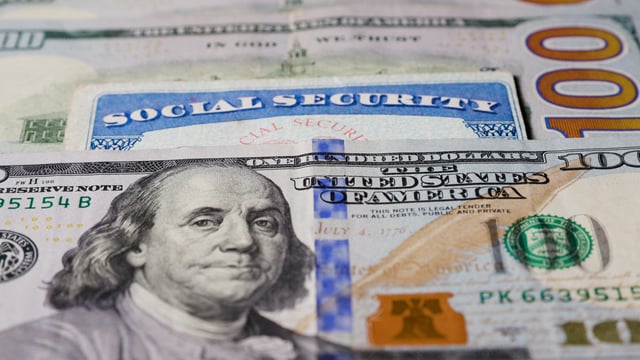
Pop the (good) Champagne: As of Monday, millionaires are officially paying less taxes than the rest of us.
In 2026, March 9 is the day that workers earning $1 million stop contributing to Social Security for the year. This cutoff occurs despite the well-documented solvency problem facing the nation’s bedrock safety-net program. Many economists say Social Security’s precarious finances could be significantly stabilized if the richest Americans kicked in a little more.
As it stands, though, “those who are theoretically most able to pay get to stop doing so,” Hayley Brown, a labor and disability researcher at the left-leaning Center for Economic and Policy Research, wrote in an analysis published Friday.
But the U.S. government only collects these taxes up to a “taxable maximum,” a figure pegged to the national average wage index that gets adjusted annually. In 2026, the taxable maximum is $184,500. Once a worker has earned that amount, they’re off the hook for further Social Security contributions until the clock resets next January.

In terms of absolute dollars, high earners don’t pay less Social Security tax. In fact, their required maximum tax of $11,439 (that’s $184,500 times 6.2%) is more than the contributions paid by the roughly 94% of workers who earn less than $184,500.
Millionaires and billionaires do, however, pay less as a share of their overall income.
This matters because as the result of demographic shifts — a wave of aging baby boomers, longer lifespans and a shrinking workforce — the amount of money the government takes in via payroll taxes to fund Social Security isn’t enough to cover benefits it pays out to nearly 70 million beneficiaries each month.
For the past 15 years, the Social Security Administration has been supplementing that tax revenue with money taken from two trust funds, which will be depleted in 2032, according to the most recent calculations by the Congressional Budget Office. If lawmakers don’t intervene, that will trigger an immediate reduction in benefits.
What’s fueling debate over the Social Security payroll tax cap
One of the oft-proposed solutions for reducing Social Security’s looming budget cliff is for the U.S. to raise or get rid of the payroll tax cap.
Eliminating the payroll tax cap would cover more than half the shortfall without any other changes or decrease in benefits, according to one estimate. Even lifting the cap to $250,000 would stave off insolvency for several more years.
The tax cap provision isn’t new; in fact, it’s been around as long as Social Security has. But over the years, the share of high earners’ paychecks exempt from the payroll tax has been rising.
In 1983, only 10% of earnings exceeded the cap. By 2024, it had risen to more than 17%.
Growing income inequality between executives and rank-and-file workers is a dynamic economists and researchers have been tracking for decades. According to CEPR’s Brown, there are several culprits.
“The reduction in union density has coincided with ballooning CEO pay, and both of those are substantial contributors to the income inequality we’re seeing,” she says. Other long-term changes include deregulation, changes to antitrust regulations and lax corporate governance.
Compared to the 1980s, today’s highest earners not only earn more but also get to keep more of it, because a larger share of that income falls above the taxable maximum, Brown says.
The end result? “The burden of supporting Social Security falls more heavily on those who make less,” she wrote.
Disclaimer
Artificial Intelligence Disclosure & Legal Disclaimer
AI Content Policy.
To provide our readers with timely and comprehensive coverage, South Florida Reporter uses artificial intelligence (AI) to assist in producing certain articles and visual content.
Articles: AI may be used to assist in research, structural drafting, or data analysis. All AI-assisted text is reviewed and edited by our team to ensure accuracy and adherence to our editorial standards.
Images: Any imagery generated or significantly altered by AI is clearly marked with a disclaimer or watermark to distinguish it from traditional photography or editorial illustrations.
General Disclaimer
The information contained in South Florida Reporter is for general information purposes only.
South Florida Reporter assumes no responsibility for errors or omissions in the contents of the Service. In no event shall South Florida Reporter be liable for any special, direct, indirect, consequential, or incidental damages or any damages whatsoever, whether in an action of contract, negligence or other tort, arising out of or in connection with the use of the Service or the contents of the Service.
The Company reserves the right to make additions, deletions, or modifications to the contents of the Service at any time without prior notice. The Company does not warrant that the Service is free of viruses or other harmful components.