A field technician stands beside a broken utility cabinet somewhere off a rural highway. Wind is picking up. Clouds rolling in.
He pulls out his phone.
No signal.
Of course.

Meanwhile, his supervisor—thirty miles away—needs a status update. The rest of the crew is waiting to hear whether to reroute the equipment or stay put.
This is the reality of remote workforce management. People picture freedom, flexibility, maybe a truck parked beside a scenic mountain road. The truth? It’s logistics, coordination, and a constant battle with unreliable communication.
Which is exactly why the two-way radio still plays such a crucial role in remote operations.
Simple tools tend to survive for a reason.
Remote Teams Aren’t Just Far Away—They’re Hard to Reach
Managing a remote workforce isn’t simply about distance. It’s about unpredictability.
Workers may be scattered across construction zones, energy facilities, infrastructure projects, or miles of transportation routes. One team might be deep in a valley while another is operating from a regional hub.
Now add the classic problem: connectivity.
Cell service in remote areas is… inconsistent. Generously speaking.
Phones drop calls. Messages show up late. Apps freeze exactly when you need them most.
A two-way radio cuts through all of that with push-to-talk communication. No dialing. No waiting. Just a quick press of a button and a clear message across the network.
Sometimes the most advanced solution is the one that removes the most steps.
Push-to-Talk: The Speed Remote Work Actually Needs
Remote teams don’t have the luxury of slow communication.
If a technician encounters a problem installing equipment, waiting ten minutes for a return call can stall an entire workflow. Multiply that delay across multiple crews and suddenly a project schedule starts slipping.
Push-to-talk communication fixes this problem beautifully.
Press the button. Speak. Message delivered.
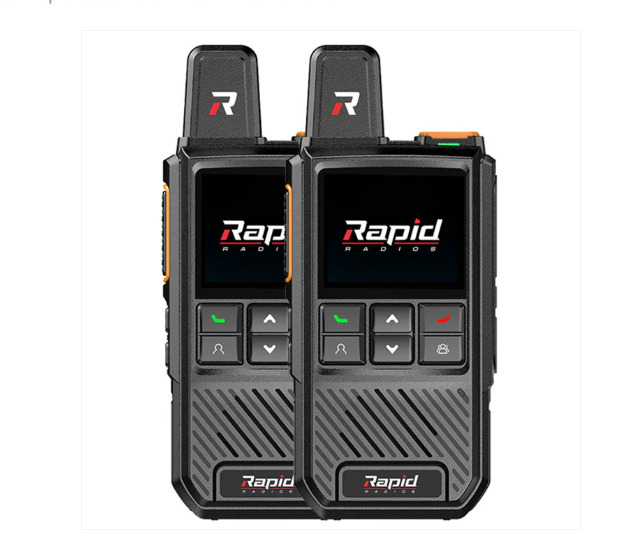
With systems like this modern two-way radio, teams can maintain instant contact even when they’re spread across large regions or multiple job sites.
It’s direct communication. No friction.
And in remote operations, friction is the enemy.
Field Updates Should Take Seconds, Not Minutes
Imagine a maintenance crew repairing infrastructure miles from the nearest office.
They discover a damaged component that requires approval before replacement.
With traditional communication? They call a manager. The manager misses the call. A message gets sent. Maybe a photo follows. Everyone waits.
Work stops.
With a radio system, the same conversation happens instantly.
“Found damage on the south line. Need confirmation before replacement.”
The supervisor responds within seconds. Decision made. Work continues.
Remote teams rely on that kind of speed to stay productive. Communication shouldn’t be the bottleneck.
Yet surprisingly often, it is.
Emergencies Don’t Wait for a Good Reception
Here’s a scenario nobody enjoys thinking about—but every field manager plans for.
A worker gets injured. Weather conditions shift suddenly. Equipment fails in a hazardous environment.
When something goes wrong in a remote location, communication becomes the first step toward solving the problem.
Two-way radios shine in these moments because they’re built for immediacy. Workers don’t need to unlock screens, navigate apps, or hope the network cooperates.
They press the talk button.
Help is alerted. Instructions are shared. Teams coordinate their response quickly.
In remote environments, that simplicity isn’t just convenient—it’s critical.
Oversight Without Hovering
Managing remote teams comes with a delicate balance.
Managers need visibility into operations, but nobody enjoys constant check-ins or endless phone calls.
Two-way radios provide a middle ground.
Supervisors can request quick updates, coordinate schedules, and direct resources without interrupting workers for long conversations. Field teams stay focused on their tasks while remaining connected to the broader operation.
It’s communication that supports autonomy rather than suffocating it.
And honestly, most crews prefer it that way.
Tools That Survive the Field
Let’s talk about something every field worker knows: equipment gets abused.
Dust. Rain. Extreme temperatures. Accidental drops. Devices sliding off dashboards. Sometimes things even get run over. (It happens.)
Traditional smartphones weren’t exactly built with these realities in mind.
Two-way radios, on the other hand, are designed for demanding environments. Rugged casings, long battery life, and weather-resistant builds make them reliable companions for remote work.
When your communication tool survives the environment, your team doesn’t have to worry about it failing mid-shift.
And that peace of mind matters more than people think.
The Invisible Backbone of Remote Operations
Remote workforce management looks impressive from the outside—teams operating across vast distances, coordinating complex projects, solving problems in the field.
Behind the scenes, though, success often comes down to one simple thing: communication.
Without a reliable connection between workers and managers, everything slows down. Decisions stall. Risks increase. Productivity drops.
Two-way radio systems solve that problem quietly but effectively.
No drama. No complicated setup. Just fast, dependable communication that works wherever the job happens to be.
And when your team is miles apart, that connection becomes the thread that holds the entire operation together
Disclaimer
Artificial Intelligence Disclosure & Legal Disclaimer
AI Content Policy.
To provide our readers with timely and comprehensive coverage, South Florida Reporter uses artificial intelligence (AI) to assist in producing certain articles and visual content.
Articles: AI may be used to assist in research, structural drafting, or data analysis. All AI-assisted text is reviewed and edited by our team to ensure accuracy and adherence to our editorial standards.
Images: Any imagery generated or significantly altered by AI is clearly marked with a disclaimer or watermark to distinguish it from traditional photography or editorial illustrations.
General Disclaimer
The information contained in South Florida Reporter is for general information purposes only.
South Florida Reporter assumes no responsibility for errors or omissions in the contents of the Service. In no event shall South Florida Reporter be liable for any special, direct, indirect, consequential, or incidental damages or any damages whatsoever, whether in an action of contract, negligence or other tort, arising out of or in connection with the use of the Service or the contents of the Service.
The Company reserves the right to make additions, deletions, or modifications to the contents of the Service at any time without prior notice. The Company does not warrant that the Service is free of viruses or other harmful components.