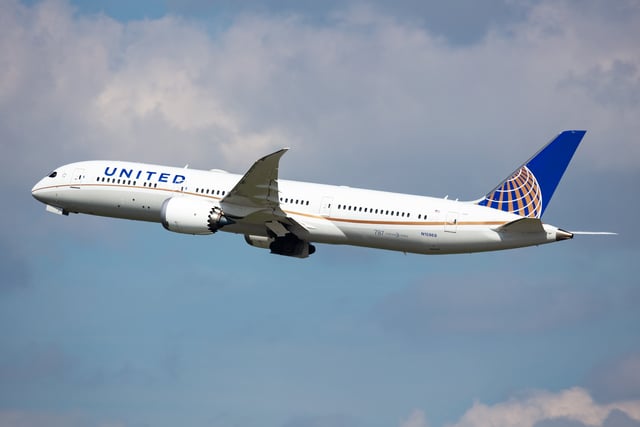
CHICAGO — For decades, the “unwritten rule” of air travel was simple: if you want to watch a movie or scroll through social media, you wear headphones. But as common courtesy has seemingly declined in the age of viral short-form video, United Airlines is no longer leaving it to chance or social pressure.
In a landmark move that has delighted frequent flyers and sent a stern warning to the “speakerphone” crowd, United Airlines has officially updated its Contract of Carriage—the legally binding agreement between a passenger and the airline—to include a specific clause regarding the use of personal audio. The message is clear: plug in, or you might find yourself back at the gate.
The New Rule of the Skies
The policy change, which took effect on February 27, 2026, adds a 22nd reason to United’s list of grounds for “Refusal of Transport.” Under Rule 21, the airline now explicitly states it has the right to remove any passenger who “fails to use headphones while listening to audio or video content.”
While flight attendants have long had the authority to ask passengers to lower their volume or use earbuds under general “disorderly conduct” or “failure to follow crew instructions” rules, this marks the first time a major U.S. carrier has codified headphone etiquette as a standalone, enforceable safety and conduct violation.

The update means that United personnel now have the legal backing to:
- Refuse boarding at the gate if a passenger is seen using speakers.
- Remove a passenger from the aircraft at any point before takeoff.
- Permanently ban repeat offenders from future United flights.
Why Now? The Starlink Factor
The timing of the update is not accidental. United Airlines is currently in the midst of a massive fleet-wide rollout of SpaceX’s Starlink Wi-Fi, which offers high-speed, low-latency internet capable of seamless video streaming and gaming at 35,000 feet.
“We’ve always encouraged customers to use headphones… but with the expansion of Starlink, it seemed like a good time to make that even clearer,” a United spokesperson said in a statement.
The airline recognizes that as Wi-Fi becomes faster and more accessible, the temptation for passengers to browse TikTok, YouTube, or Netflix without the “hassle” of wires or Bluetooth pairing increases. By putting the rule in the contract now, United is attempting to get ahead of a potential “noise pollution” epidemic in the cabin.
A “Graceful” Solution to a Modern Nuisance
Travel experts have largely praised the move. Scott Keyes, founder of Going (formerly Scott’s Cheap Flights), called the decision a “graceful way” to handle a small but disruptive segment of the traveling public.
“This is in line with how the vast majority of travelers comport themselves and would like others to comport themselves,” Keyes noted. “It gives the crew a specific tool to point to, rather than just relying on a subjective plea for politeness.”
The move also addresses a growing frustration among flight crews. Flight attendants often find themselves acting as mediators in “speaker wars” between passengers. Having the rule in the Contract of Carriage provides a black-and-white standard that simplifies enforcement and reduces the likelihood of arguments on board.
What If You Forget Your Headphones?
United isn’t looking to strand every forgetful traveler. The airline has confirmed that for those who accidentally leave their AirPods at home or find their battery dead, free earbuds will be provided on board, subject to availability.
Most United aircraft are also being retrofitted with Bluetooth-capable seatback screens, allowing passengers to sync their own wireless headphones directly to the in-flight entertainment system. However, the new rule applies primarily to personal devices—phones, tablets, and laptops—where the sound is emitted directly from the device’s speakers.
The Industry Standard?
While other major carriers like Delta and Southwest “require” or “encourage” headphone use through verbal announcements and website FAQs, United is currently the only “Big Four” U.S. airline to make it a contractual condition of carriage.
Industry analysts expect competitors to follow suit. As planes become more connected, the cabin environment risks becoming a chaotic cacophony of competing soundtracks. United’s move sets a precedent that the “quiet enjoyment” of a flight is a right, not a luxury.
As one frequent flyer put it on social media following the announcement: “I’m tired of hearing someone’s toddler watch Cocomelon at max volume for four hours. This isn’t just a policy; it’s a restoration of civilization.”
Sources and Links
- Travel Tomorrow: United Airlines reserves right to remove passengers who don’t use headphones
- The Independent: United Airlines quietly updates its ‘contract of carriage’ adding clause for passengers who refuse to use headphones
- CBS News: United Airlines can now boot passengers who refuse to use headphones with their devices
- The Points Guy: No headphones? United passengers could be barred from flying
- Gizmodo: The New United Airlines Policy That Could Get You Kicked Off a Flight
- Fodor’s Travel: United Airlines Will Kick You Off Your Flight if You Don’t Use Headphones
Disclaimer
Artificial Intelligence Disclosure & Legal Disclaimer
AI Content Policy.
To provide our readers with timely and comprehensive coverage, South Florida Reporter uses artificial intelligence (AI) to assist in producing certain articles and visual content.
Articles: AI may be used to assist in research, structural drafting, or data analysis. All AI-assisted text is reviewed and edited by our team to ensure accuracy and adherence to our editorial standards.
Images: Any imagery generated or significantly altered by AI is clearly marked with a disclaimer or watermark to distinguish it from traditional photography or editorial illustrations.
General Disclaimer
The information contained in South Florida Reporter is for general information purposes only.
South Florida Reporter assumes no responsibility for errors or omissions in the contents of the Service. In no event shall South Florida Reporter be liable for any special, direct, indirect, consequential, or incidental damages or any damages whatsoever, whether in an action of contract, negligence or other tort, arising out of or in connection with the use of the Service or the contents of the Service.
The Company reserves the right to make additions, deletions, or modifications to the contents of the Service at any time without prior notice. The Company does not warrant that the Service is free of viruses or other harmful components.