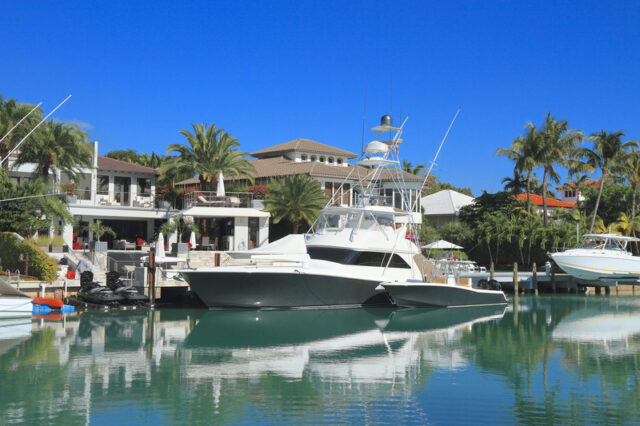
The transformation of Miami from a seasonal vacation playground into a permanent “operational fortress” for the world’s wealthiest individuals reached a new zenith today. Mark Zuckerberg, the billionaire founder and CEO of Meta Platforms, has officially closed on a sprawling waterfront estate on Indian Creek Island for a record-breaking $170 million, marking the most expensive residential real estate transaction in the history of Miami-Dade County.
The deal, which closed Monday, signals a profound shift in the American socioeconomic landscape. For decades, the Silicon Valley elite remained anchored to the tech corridors of Northern California. However, a combination of shifting political climates and the allure of Florida’s favorable tax structure has turned the “Sunshine State” into a primary residence for the ultra-high-net-worth.
The Anatomy of a Record-Breaking Buy
The property, located at 7 Indian Creek Island Road, was purchased from celebrity plastic surgeon Dr. Aaron Rollins and his wife, Marine. According to property records, the Rollinses acquired the two-acre site in 2020 for roughly $30 million and spent the intervening years commissioning a limestone masterpiece that defines the pinnacle of modern luxury.

While the residence remains under construction, architectural plans reveal a 30,000-square-foot compound designed by Ferris Rafauli, the acclaimed designer known for his opulent and high-tech approach to residential engineering. The estate is set to include nine bedrooms and 11.5 bathrooms, but it is the bespoke amenities that truly set it apart. Reports indicate the home will feature a 1,500-gallon aquarium, a library equipped with secret passageways, a private hair salon, a world-class wellness gym, and a waterfront pool overlooking Biscayne Bay.
As The New York Times noted in its coverage of the accelerating luxury boom, “The scale of these transactions reflects more than just a desire for beachfront views; it represents a strategic relocation of capital. For the tech elite, Miami has become the new Palo Alto, but with 200 feet of waterfrontage and a significantly more welcoming tax code.”
The Rise of the ‘Billionaire Bunker’
Indian Creek Island, colloquially known as the “Billionaire Bunker,” is a 294-acre gated village accessible only via a single guarded bridge. With just 41 residential lots, its own private police force, and a marine patrol that circles the perimeter 24/7, the island offers a level of seclusion that is increasingly rare in the digital age.
Zuckerberg and his wife, Dr. Priscilla Chan, join a neighborhood roster that reads like a Forbes 400 list. Their new neighbors include Amazon founder Jeff Bezos—who recently expanded his own footprint on the island—as well as Tom Brady, Ivanka Trump, Jared Kushner, and financier Carl Icahn.
The concentration of such immense wealth in a single municipality has created a unique micro-economy. Local real estate analysts suggest that on Indian Creek, property values are no longer determined by traditional comparables but by “privacy at any price.”
A Tax-Driven Migration
The timing of Zuckerberg’s acquisition is not coincidental. Industry experts point to California’s proposed “billionaire tax”—a measure that would impose a one-time 5% wealth tax on residents with a net worth exceeding $1 billion—as a primary catalyst for migration.
“We are seeing a ‘Tax-Refugee Billionaire’ class,” says Danny Hertzberg of the Jills-Zeder Group, who represented the sellers in the record-breaking deal. While he declined to name the buyer, he noted that the Miami market has escalated sharply in recent months as wealthy individuals seek “politically safe harbors” for their capital.
Florida’s lack of a state income tax has long been a draw, but the 2026 market is different. It is no longer about vacation homes. As reported by The New York Times, “The narrative has shifted from ‘Where do I spend my winters?’ to ‘Where do I base my empire?’ The infrastructure of Miami—from the expansion of elite private schools to the rise of ‘operational fortresses’ with medical-grade air filtration and cloud-managed security—is now being built to accommodate the permanent residency of the global elite.”
The Economic Ripple Effect
While the $170 million price tag is staggering, its implications for the broader Miami market are even more significant. High-value purchases of this magnitude expand the Miami-Dade tax base, providing municipalities with unprecedented revenue for infrastructure and coastal resilience projects. However, the influx of billionaire buyers has also put upward pressure on the mid-market.
Real estate economists observe that when a tech titan like Zuckerberg sets a new price ceiling, it creates a “signal effect” that emboldens other buyers. In the first quarter of 2026, luxury sales above $10 million in Miami-Dade jumped by 18%, with cash purchases accounting for over half of all high-end transactions.
This surge has led to a redevelopment boom. Older waterfront properties are being razed to make way for custom-built “biophilic” estates that blend luxury with environmental sustainability—a hallmark of the “Palo Alto mindset” now taking root in Florida.
Future Outlook
As Zuckerberg prepares to move his family into the Indian Creek compound upon its completion, the message to the global tech community is clear: Miami is no longer a satellite office; it is the headquarters.
With Larry Page acquiring estates in Coconut Grove and Sergey Brin reportedly eyeing Miami Beach, the “Big Tech” footprint in Florida is now permanent. The record-breaking sale at 7 Indian Creek is not just a real estate transaction; it is a milestone in the realignment of American wealth.
For the residents of the Billionaire Bunker, the arrival of the Meta CEO marks the final piece of the puzzle in making Indian Creek the most exclusive—and expensive—zip code on earth.
Source: The New York Times
Disclaimer
Artificial Intelligence Disclosure & Legal Disclaimer
AI Content Policy.
To provide our readers with timely and comprehensive coverage, South Florida Reporter uses artificial intelligence (AI) to assist in producing certain articles and visual content.
Articles: AI may be used to assist in research, structural drafting, or data analysis. All AI-assisted text is reviewed and edited by our team to ensure accuracy and adherence to our editorial standards.
Images: Any imagery generated or significantly altered by AI is clearly marked with a disclaimer or watermark to distinguish it from traditional photography or editorial illustrations.
General Disclaimer
The information contained in South Florida Reporter is for general information purposes only.
South Florida Reporter assumes no responsibility for errors or omissions in the contents of the Service. In no event shall South Florida Reporter be liable for any special, direct, indirect, consequential, or incidental damages or any damages whatsoever, whether in an action of contract, negligence or other tort, arising out of or in connection with the use of the Service or the contents of the Service.
The Company reserves the right to make additions, deletions, or modifications to the contents of the Service at any time without prior notice. The Company does not warrant that the Service is free of viruses or other harmful components.