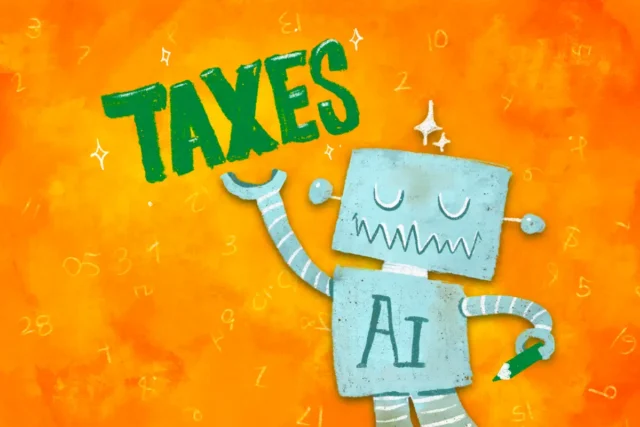
It may be a nice idea, but experts says using AI to do your taxes is a risky and likely unnecessary move.
TurboTax’s Keela Robison, who oversees the company’s AI efforts as vice president of product management, tells Money that Intuit extensively tested leading AI models ahead of this tax season — and determined the technology is not yet reliable enough to trust for tax preparation.
“Look, AI is great at a lot of things. It’s getting better at math, but it turns out that tax calculations and tax law are incredibly complex,” Robison says. Though the company is actively collaborating with frontier labs, she adds, “We don’t feel like the accuracy is high enough right now to toss out our tax engine and rely on LLMs.”
TurboTax found during testing that AI models confused tax years and tax deadlines. They also failed to understand newly created tax benefits. Even when models were pretrained on relevant tax code, they fell short when it came to actual calculations, Robison says.

To be clear: TurboTax is leaning into AI, integrating new features like product selection tools, a digital assistant and a cost-basis agent designed to help users report stock grants and stock options. More features are coming, too, like an AI agent to determine whether a taxpayer has claimed the right deductions and credits.
But it’s not handing over the reins just yet.
“What we believe is that these [tools] will actually help us … deliver better outcomes for people: higher refunds, lower balance due (if that’s their situation). That’s really where the power of AI starts coming in,” Robison says.
A note on the TurboTax website draws a clear line: “Human tax experts, not AI, write the tax calculations that power our product.”
Why AI can’t be trusted to do your taxes (yet)
TurboTax isn’t the only financial firm that has concluded that current AI tools are incapable of reliably preparing taxes. This year, april landed an eye-catching partnership with PayPal to offer free online tax filing. It has also teamed up with Chime, OnePay and others for no-cost tax filing, boasting an average time to file of less than 20 minutes.
april calls itself an AI-powered tax engine — and yet, when you file your taxes with april, you’re not actually having AI do your taxes.
Like TurboTax, april describes its tax software as “deterministic.” What does that mean? Founder Ben Borodach explains that a reputable tax software’s answers need to be consistent and precise to be valuable.
That’s not what out-of-the-box AI offers.
“When you look at an LLM like a Claude Code or an OpenAI, they’re probability based — they’re probabilistic. And so you’re not going to necessarily get the same answer every single time,” Borodach says. “It’s also unexplainable. You cannot go back and audit that.”
AI models are also known to “hallucinate,” or invent claims when pushed beyond their capabilities. So for now, careful experimentation — not a complete surrender — is the way forward.
april is making progress fast. It created its tax software using an in-house AI tool, allowing the company to reach a major milestone: the capability to prepare and e-file state tax returns in all 50 states.
“We built our own version of Claude Code that we call ‘Tax-to-Code’ that assisted us in transferring or translating the tax law into production software,” Borodach says. “We do it at about 20 times the speed of a human only.”
These efficiency gains allow april to fill a void in free tax filing after the IRS eliminated its Direct File program last year, leaving consumers with fewer options.
Across the industry, the race is on to make better tax software with AI. Bill Harris, founder of Evergreen Wealth and former CEO of TurboTax, says the differences between how tax software providers like TurboTax and april are built reflect a divide that will only deepen AI tax filing startups mature.
Harris explains that large, established tax software companies will likely “put a veneer of AI on top of their existing engines,” while others like april will use AI as a development tool to build new software.
“I ran TurboTax for 10 years. It was a long time ago, but there is a tremendous codebase that has been built up … highly complex, very specialized and not something that you can whip up quickly,” he says. “There’s a lot of institutional knowledge and code. Therefore, I think that the established players are unlikely to start from scratch.”
Despite the obstacles to using AI for tax prep and tax filing, AI-powered advancements in tax software are already making filing cheaper and easier, as april and TurboTax hope to prove this season.
But returning to the original question: Can you file your taxes using AI? Harris says the answer is a clear “no.”
Current AI models cannot comprehend all the complexities of an individual’s tax circumstances, nor can they complete the key step of actually e-filing tax returns. Even someone with the simplest imaginable taxes should not bother trying to use ChatGPT or any LLM to do their taxes this year, Harris says.
You could make a make a mistake potentially leading to an audit, or you could miss out on a tax credit that would have put money in your pocket.
“It could be an interesting science project, but it’s not a practical thing,” Harris says.
Small ways AI can help you with taxes — if you’re careful
Despite its limitations, experts agree that taxpayers can and should use artificial intelligence to research tax questions.
That could mean asking a chatbot like Gemini to help you dig into the rules around specific deductions or improve your understanding of IRS forms. Even questions around trickier tax topics like “What is modified adjusted gross income?” or “What is a refundable tax credit?” can be answered quickly by an LLM.
While researching questions in general terms is encouraged, you should think twice before uploading private financial materials or disclosing sensitive information in an AI chat. W-2s often contain Social Security numbers, for example, and earnings figures, employment information, investment details and home addresses are all sensitive.
Experts caution against putting these personal details into an open AI model, especially not a free version that trains on your data, because you lose your privacy and could even expose accounts.
One way around this is to use AI chat tools inside of existing tax prep platforms, which typically have robust security systems and data encryption policies, making them safer sources of information.
“AI can be a great tool just to learn about your taxes, learn about what parts of the tax law apply to you, or become more educated,” Borodach says. “From that perspective, AI has really opened up what’s possible for everyday people to become more aware of how taxes impact their financial picture.”
Disclaimer
Artificial Intelligence Disclosure & Legal Disclaimer
AI Content Policy.
To provide our readers with timely and comprehensive coverage, South Florida Reporter uses artificial intelligence (AI) to assist in producing certain articles and visual content.
Articles: AI may be used to assist in research, structural drafting, or data analysis. All AI-assisted text is reviewed and edited by our team to ensure accuracy and adherence to our editorial standards.
Images: Any imagery generated or significantly altered by AI is clearly marked with a disclaimer or watermark to distinguish it from traditional photography or editorial illustrations.
General Disclaimer
The information contained in South Florida Reporter is for general information purposes only.
South Florida Reporter assumes no responsibility for errors or omissions in the contents of the Service. In no event shall South Florida Reporter be liable for any special, direct, indirect, consequential, or incidental damages or any damages whatsoever, whether in an action of contract, negligence or other tort, arising out of or in connection with the use of the Service or the contents of the Service.
The Company reserves the right to make additions, deletions, or modifications to the contents of the Service at any time without prior notice. The Company does not warrant that the Service is free of viruses or other harmful components.