The United States is bracing for a “historic” weather event this weekend as a powerful nor’easter is forecast to rapidly intensify into a bomb cyclone, threatening a massive stretch of the Eastern Seaboard from Georgia to Maine. According to the latest data from the National Weather Service and AccuWeather, the combination of deep Arctic air and a developing coastal system will trigger heavy snowfall and life-threatening temperatures beginning Friday, January 30, and lasting through Sunday, February 1.
A Rapidly Intensifying Threat
Meteorologists have dubbed the approaching system Winter Storm Gianna. The storm is expected to undergo “bombogenesis”—a process where atmospheric pressure drops at least 24 millibars in 24 hours—as it tracks along the coast. This rapid intensification will generate powerful winds and heavy precipitation.

AccuWeather, which flagged the potential for this system as early as mid-January, warns that the storm’s impacts will be felt most acutely across the Carolinas and the coastal Mid-Atlantic. While the previous week’s storm focused on ice and freezing rain, this system is primarily a snow producer for the interior regions, though coastal flooding remains a significant concern for the Atlantic beaches.
Regional Snowfall Forecasts
The heaviest snow is expected to fall across the Carolinas and parts of the Northeast.
- North and South Carolina: Forecasters at NWS-Wilmington are calling this a potentially historic event for the region. Snowfall totals are expected to range from 4 to 10 inches, with “high-end” scenarios suggesting up to 18 inches in localized bands north of the Cape Fear region.
- Georgia: A Winter Storm Watch is in effect for North Central and Northeast Georgia. Residents in the Atlanta metro area are bracing for 1 to 3 inches, though heavier bands could set up along the I-75 corridor.
- The Northeast: While the storm’s exact track remains subject to slight shifts, areas from southeast Virginia to southeast Massachusetts could see amounts eclipsing 6 to 12 inches.
Dangerous Cold and Record Lows
Perhaps more dangerous than the snow is the Arctic air following the storm. AccuWeather reports that temperatures will dive to 30 to 40 degrees below average in many states.
- Wind Chills: In the Midwest and parts of the South, wind chills are expected to plunge into the single digits and negatives. In states like Minnesota and North Dakota, wind chills have already been reported as low as 50 degrees below zero.
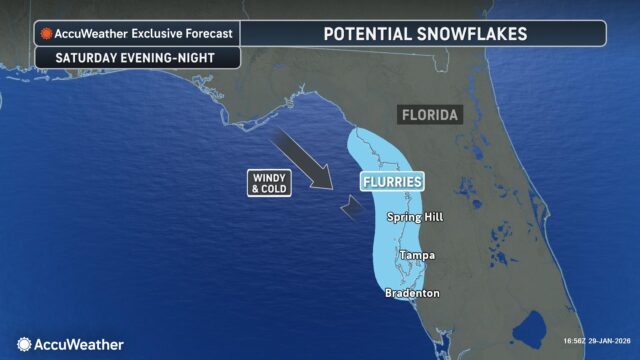
- The Southern Reach: The cold spell is unusually far-reaching, with freezing or near-freezing conditions expected to stretch as far south as central Florida. Residents in the Florida Panhandle and the Keys are being warned that wind chills will reach the teens and 20s by Sunday morning.
Infrastructure and Travel Disruptions
The timing of the storm poses a severe threat to travel and power infrastructure.
- Power Outages: With winds gusting between 35 and 50 mph, scattered power outages are highly likely. The weight of heavy snow on branches, combined with these gusts, could snap lines in regions not accustomed to such heavy accumulation.
- Travel: Ground temperatures are already well below freezing in many areas, meaning any snow or sleet will stick instantly to roads. Authorities are urging residents to avoid travel starting Friday night.
- Aviation: Following the previous week’s 15,000 cancellations, major hubs including Hartsfield-Jackson Atlanta International and New York-area airports are preparing for significant delays and ground stops.
Safety Reminders
Federal and state officials have already begun pre-positioning resources. Governors in North Carolina and Georgia have declared States of Emergency to mobilize National Guard units for debris removal and road treatment.
FEMA suggests that residents remain indoors and check on vulnerable neighbors, particularly older adults and those without reliable heating. With prolonged periods of sub-freezing temperatures expected—some areas facing 60 consecutive hours below 32°F—the risk of pipe bursts and cold-related illnesses like hypothermia is extreme.
Sources and Links
- AccuWeather: Case Study: Historic Winter Storm Warnings
- National Weather Service (NWS) Atlanta: Special Weather Briefing (Jan 29, 2026)
- FEMA.gov: 2026 Winter Storm Response and Recovery
- The Washington Post: Nor’easter to bring snow and flooding: Regional Impacts
- Brunswick County NC: Winter Storm Gianna Information and Safety
- Cardinal & Pine: Bomb Cyclone North Carolina Forecast
Disclaimer
Artificial Intelligence Disclosure & Legal Disclaimer
AI Content Policy.
To provide our readers with timely and comprehensive coverage, South Florida Reporter uses artificial intelligence (AI) to assist in producing certain articles and visual content.
Articles: AI may be used to assist in research, structural drafting, or data analysis. All AI-assisted text is reviewed and edited by our team to ensure accuracy and adherence to our editorial standards.
Images: Any imagery generated or significantly altered by AI is clearly marked with a disclaimer or watermark to distinguish it from traditional photography or editorial illustrations.
General Disclaimer
The information contained in South Florida Reporter is for general information purposes only.
South Florida Reporter assumes no responsibility for errors or omissions in the contents of the Service. In no event shall South Florida Reporter be liable for any special, direct, indirect, consequential, or incidental damages or any damages whatsoever, whether in an action of contract, negligence or other tort, arising out of or in connection with the use of the Service or the contents of the Service.
The Company reserves the right to make additions, deletions, or modifications to the contents of the Service at any time without prior notice. The Company does not warrant that the Service is free of viruses or other harmful components.