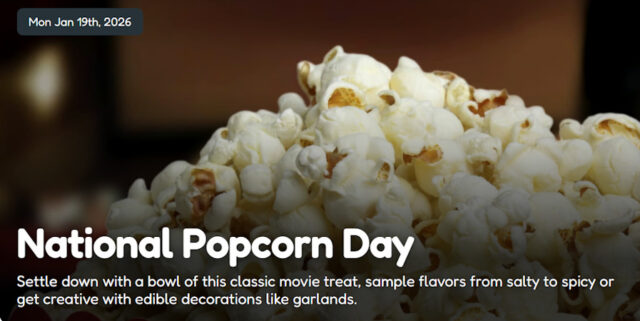
On January 19th, National Popcorn Day pops onto the scene with a crunch we all love to enjoy! The annual celebration recognizes a treat that satisfies munchies, day or night.
- 3600 BC – Evidence of popcorn from 3600 BCE was found in New Mexico and even earlier evidence dating to perhaps as early as 4700 BCE was found in Peru.
- 300 AD – The world’s oldest known popper, a shallow vessel with a handle and hole on top, was designed around A.D. 300.
- 16th Century – The Aztecs used popcorn in headdresses worn during ceremonies honoring Tlaloc, their god of maize and fertility. Early Spanish explorers were fascinated by the corn that burst into what looked like a white flower.
- 1650 – Padre Bernabé Cobo writes about Peruvian Natives, and notes, “They toast a certain kind of corn until it bursts. They call it pisancalla, and they use it as a confection.”
- 1885 – Popcorn became popular in the United States. When Charles Cretors developed a machine for popping corn with steam. By 1900, he had horse-drawn popcorn wagons going through the streets of Chicago.
- 1885 – At about the same time, Louise Ruckheim added peanuts and molasses to popcorn to bring Cracker Jack to the world.
- 1893 – The first popcorn machine made its debut 1,500 years later at the 1893 World’s Fair (Columbian Exposition) in Chicago.
- 1908 – The national anthem of baseball was born. Jack Norworth and Albert Von Tilzer wrote Take Me Out to the Ballgame. From that point onward, popcorn, specifically, Cracker Jack, became forever married to the game.
- 1920s – Many theaters refused to sell popcorn because they believed it was too messy.
- 1948 – Small heads of zea mays everta (small ears of corn) were discovered by Herbert Dick and Earle Smith in the Bat Cave of west central New Mexico. Ranging from smaller than a penny to about two inches, the oldest Bat Cave ears were about 4,000 years old.
- 1958 – Popcorn became the official snack of Illinois. Since 1958, there has been an annual “Popcorn Day.”
- 1981 – A General Mills patent for microwave popcorn bags is approved
- 1988 – National Popcorn Day falls on Super Bowl Sunday. Announced in The Calumet City Star, as well as other publications, National Popcorn Day is placed on January 31st, presumably to coordinate with families all over the United States who are throwing Super Bowl parties
- 2003 – No one is sure why it was moved, but a newspaper in Brownfield, Texas, is the first to report that National Popcorn Day has been moved to January 19. And this date seems to stick!
- While popcorn was an economical choice for a snack, the cost of installing a machine and adequately venting the building didn’t seem worth the effort. If it weren’t for Glen W. Dickson, we would be purchasing our popcorn from a vendor on the street before taking in the show. Dickson put in the effort and expense of placing machines inside his theaters. After realizing how quickly he recouped his costs, other theater owners followed suit.
- The microwave oven spurred the next big advancement for popcorn. With the invention of the microwave, a whole new market for snack foods opened. Magnetrons, a technology produced by Raytheon Manufacturing Corporation for the military during World War II, were later used to develop microwave ovens. Percy Spencer was the man who made it happen. He used popcorn in his initial experiments during the microwave’s development.
- Americans eat around 17 billion quarts of popcorn every year. This amount would fill the Empire State Building 18 times.
- An Average American eats almost 70 quarts of popcorn every year
- Popcorn is the world’s most popular snack food.
- Popcorn is also the most profitable snack food, with over 1 thousand percent markup.
- Some popcorn was found to be purple in the early 1900s.
- At least six localities (all in the Midwestern United States) claim to be the “Popcorn Capital of the World”: Ridgway, Illinois; Valparaiso, Indiana; Van Buren, Indiana; Schaller, Iowa; Marion, Ohio; and North Loup, Nebraska.
- Popcorn kernels can pop up to 3 feet in the air.
- There are about 1,600 popcorn kernels in 1 cup.
- Unpopped popcorn kernels are called “spinsters” or “old maids.” Quality popcorn should produce 98% popped kernels with under 2% being spinsters.
- Orville Redenbacher is the #1 best-selling popcorn in the world. Its inventor, Orville, began to grow popping corn in 1919 when he was just 12 years old.
- The scientific name for popcorn is Zea Mays Everta. It is a type of maize, a member of the Maydeae tribe in the large, natural order of grasses called the Gramina.
- More than 200 million boxes of Cracker Jack caramel-coated popcorn are consumed every year in the U.S. alone.
- Compared to most snack foods, popcorn is low in calories. Air-popped popcorn has only 31 calories per cup. Oil-popped is only 55 per cup
- Most popcorn comes in two basic shapes when it’s popped: snowflake and mushroom. Snowflake is used in movie theaters and ballparks because it looks and pops bigger. Mushroom is used for candy confections because it doesn’t crumble.
- Popping popcorn is one of the number one uses for microwave ovens. Most microwave ovens have a “popcorn” control button.
- Nebraska produces the most popcorn out of all the states.
- 70% — the percentage of popcorn eaten at home.
- 90% — the percentage of unpopped popcorn sales.
- 13.5% — the percentage of moisture content in popcorn.
- 31 — the number of calories in a cup of popcorn.
- 250 million — the number of pounds of popcorn produced in Nebraska every year.
- 3 – the number of feet that a single popped corn can fly when popping.
- During World War II, sugar was in short supply, so Americans ate three times more popcorn.
- Popcorn is GMO-free and gluten-free.
Sources:

Disclaimer
Artificial Intelligence Disclosure & Legal Disclaimer
AI Content Policy.
To provide our readers with timely and comprehensive coverage, South Florida Reporter uses artificial intelligence (AI) to assist in producing certain articles and visual content.
Articles: AI may be used to assist in research, structural drafting, or data analysis. All AI-assisted text is reviewed and edited by our team to ensure accuracy and adherence to our editorial standards.
Images: Any imagery generated or significantly altered by AI is clearly marked with a disclaimer or watermark to distinguish it from traditional photography or editorial illustrations.
General Disclaimer
The information contained in South Florida Reporter is for general information purposes only.
South Florida Reporter assumes no responsibility for errors or omissions in the contents of the Service. In no event shall South Florida Reporter be liable for any special, direct, indirect, consequential, or incidental damages or any damages whatsoever, whether in an action of contract, negligence or other tort, arising out of or in connection with the use of the Service or the contents of the Service.
The Company reserves the right to make additions, deletions, or modifications to the contents of the Service at any time without prior notice. The Company does not warrant that the Service is free of viruses or other harmful components.