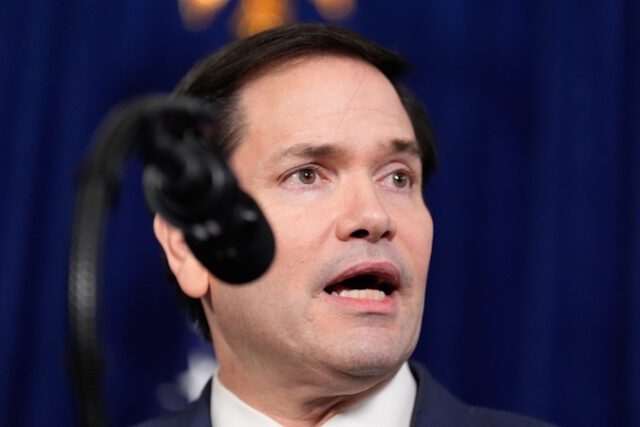
WASHINGTON — Secretary of State Marco Rubio spent Sunday navigating a complex diplomatic tightrope, seeking to clarify President Donald Trump’s assertion that the United States would “run” Venezuela following the dramatic weekend capture of Nicolás Maduro. Appearing on multiple morning news programs, Rubio characterized the American role as “running policy” rather than establishing a colonial-style administration or engaging in nation-building.
The flurry of clarification follows a high-stakes military operation on Saturday that saw U.S. special forces extract Maduro and his wife, Cilia Flores, from Caracas. Following the raid, President Trump announced at Mar-a-Lago that the U.S. would oversee the country until a “safe, proper and judicious transition” is achieved. He gestured to a team including Rubio and Defense Secretary Pete Hegseth as the group that would ensure the nation is “run properly.”
“Running Policy,” Not the Country
Speaking on NBC’s Meet the Press, Rubio pushed back against the notion of a formal U.S. occupation. “It’s not about governing the country day-to-day,” Rubio explained. “It’s about running policy. We want Venezuela to move in a certain direction because it is in our national interest.”
Rubio emphasized that the primary “lever of influence” remains a strict naval “oil quarantine.” By controlling the flow of Venezuela’s vast crude reserves, the administration intends to force concessions from the remaining leadership in Caracas—currently headed by interim President Delcy Rodríguez, who was sworn in by the Venezuelan Supreme Court following Maduro’s removal.

Security and National Interests
During an interview on CBS’s Face the Nation, Rubio argued that the U.S. mission is distinct from past interventions in the Middle East. “This is the Western Hemisphere,” he noted, asserting that the U.S. cannot tolerate a “crossroads for Hezbollah and Iran” on its doorstep. He listed the administration’s top priorities as:
- Ending narco-terrorism: Halting the flow of drugs through the “Cartel de los Soles.”
- Regional Stability: Stopping the export of gang violence, specifically citing the Tren de Aragua.
- Resource Management: Ensuring oil revenues benefit the Venezuelan people rather than “corrupt pirates.”
Domestic and International Backlash
While the administration views the operation as a “law enforcement action” against an indicted criminal, the move has sparked a firestorm on Capitol Hill. Senate Democrats, led by Chuck Schumer, have accused the administration of misleading Congress about the military buildup in the region. Schumer announced plans for a War Powers Resolution vote this week to limit further unauthorized military action.
Rubio maintained that the administration is “judging by actions, not words,” regarding the new interim government. While the U.S. continues to support opposition figures like Edmundo González and María Corina Machado, Rubio signaled that the immediate priority is securing U.S. interests through the maritime blockade. “The leverage remains,” Rubio told ABC’s This Week. “And we expect it to lead to results.”
- Media Sources & Links
- Associated Press: Rubio says US won’t govern Venezuela but will press for changes through oil blockade
- CBS News: Marco Rubio says “the president always retains optionality” to occupy Venezuela
- The Guardian: Top Republicans backpedal from Trump claim that US will run Venezuela
- NBC News: Rubio says there’s ‘not a war against Venezuela’ despite U.S. capture of Maduro
- U.S. Department of State: Secretary of State Marco Rubio with Kristen Welker of NBC’s Meet the Press
Disclaimer
Artificial Intelligence Disclosure & Legal Disclaimer
AI Content Policy.
To provide our readers with timely and comprehensive coverage, South Florida Reporter uses artificial intelligence (AI) to assist in producing certain articles and visual content.
Articles: AI may be used to assist in research, structural drafting, or data analysis. All AI-assisted text is reviewed and edited by our team to ensure accuracy and adherence to our editorial standards.
Images: Any imagery generated or significantly altered by AI is clearly marked with a disclaimer or watermark to distinguish it from traditional photography or editorial illustrations.
General Disclaimer
The information contained in South Florida Reporter is for general information purposes only.
South Florida Reporter assumes no responsibility for errors or omissions in the contents of the Service. In no event shall South Florida Reporter be liable for any special, direct, indirect, consequential, or incidental damages or any damages whatsoever, whether in an action of contract, negligence or other tort, arising out of or in connection with the use of the Service or the contents of the Service.
The Company reserves the right to make additions, deletions, or modifications to the contents of the Service at any time without prior notice. The Company does not warrant that the Service is free of viruses or other harmful components.