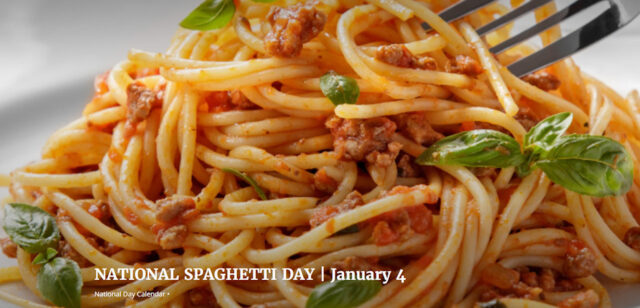
Though the origins of spaghetti are disputed—whether it was Marco Polo bringing back culinary invention from the East, an Arab trade-route delicacy, or a home-grown Sicilian treat dating back to the 12th Century—we can all agree that a cold night with a big bowl of noodle-y, saucy goodness is a balm for the soul. So join us on January 4th as we celebrate National Spaghetti Day with this amazing dish!
- 3rd-5th Century AD – Records in the Jerusalem Talmud of itrium, a kind of boiled dough, commonly available in Palestine from the 3rd to 5th centuries AD.
- 9th Century – A 9th-century Arab dictionary describes itriyyaas as string-like shapes made of semolina and dried before cooking.
- 1st Century BC – The oldest recorded documentation of pasta is found in the writings of Roman poet Quintus Horatius Flaccus, referring to sheets of dough called lagana.
- 1154 – In an 1154 writing for the Norman King of Sicily, itriyya is mentioned being manufactured and exported from Norman Sicily.
- 12th Century – Spaghetti production kicks off in Sicily.
- 13th Century – One story about the origin of spaghetti involves spaghetti-like noodles being brought back from China by explorer Marco Polo. The first versions of this are likely made from rice flour but perhaps evolve into something made from the more available durum wheat grains.
- 14th Century – Dried pasta became popular in the 14th and 15th centuries due to its easy storage
- 1789 – Thomas Jefferson, the third president of the United States, is credited with being the first person to introduce pasta to America, back in 1789.
- 1870 – The combination of tomato juice and spaghetti is printed for the first time in Italian chef Francesco Leonardi’s cookbook “L’Apicio moderno”.
- 19th Century – American restaurants offered Spaghetti around the end of the 19th century as Spaghetti Italienne
- 19th Century – Thin spaghetti served with tomato sauce dates only as far back as the 19th century, to Naples, Italy.
- 20th Century – Spaghetti evolves to a more American style, prepared with basil or oregano.
- 1928 – Chef Boyardee’s canned spaghetti hits the market. Named after Italian immigrant and restaurant owner Hector Boiardi, this company develops after locals want to buy this delicious sauce to take home in cans. The demand eventually catalyzes the convenience foods of canned pasta, including spaghetti, ravioli and other noodles
- 1953 – In an effort to get people to come to the restaurant, Horton’s of Walla Walla, Washington, ran promotions declaring every Thursday as “National Spaghetti Day”
- 1957 – On April 1 in 1957, the BBC made everyone believe that spaghetti grows on trees. At the time, spaghetti was considered by many as an exotic delicacy. The spoof program explained how severe frost can impair the flavor of the spaghetti and how each strand of spaghetti always grows to the same length. This is believed to be one of the first times television was used to stage an April Fools Day hoax.
- 1963 – Sung to the tune of “On Top of Old Smoky,” the fun children’s song, “On Top of Spaghetti,” was written and originally sung by folk singer Tom Glazer with the Do-Re-Mi Children’s Chorus in 1963.
- “On top of spaghetti, All covered with cheese, I lost my poor meatball, When somebody sneezed.
- It rolled off the table, And on to the floor, And then my poor meatball, Rolled out of the door.”
- 1969 – The first Old Spaghetti Factory opens. Run by Guss and Sally Dussin, this quintessential family restaurant launches in Portland, Oregon, USA and features a family favorite recipe for Spaghetti with Mizithra Cheese and Browned Butter.
- 2000 – Over 1.3 million pounds of spaghetti were sold in American grocery stores. If all of those packages were lined up, they could circle the Earth nine times.
- 2009 – In March of 2009, the world record for the largest bowl of spaghetti was set and then reset in March of 2010 when a Garden Grove, California Buca di Beppo restaurant successfully filled a swimming pool with more than 13,780 pounds of pasta.
- Italians never use a spoon and a fork when eating spaghetti. This is an American habit. In Italy you simply twirl a fork against the dish.
- In Naples, the sauce was served with fatty meats like bacon, ham, or sausage. Meatballs made with beef as an accompaniment to spaghetti started showing up in American cookbooks around World War II.
- The average Italian eats more than 51 pounds of pasta each year.
- As you’d expect, Italy is the country that eats the most significant amount of pasta worldwide. As you might not expect, however, the 2nd- and 3rd-most pasta-eating countries are Venezuela and Tunisia.
- One of the most important times in the history of spaghetti was World War II. It was then that American soldiers came in close contact with European cuisine, bringing home tales about spaghetti and demanding its presence on the American market.
- Pasta was first made in China, not Italy. While pasta is pretty much synonymous with Italian cuisine, in fact, the first recorded reports of pasta being eaten actually come from China. Those reports date back to 5,000 BC. In fact, legend says that Marco Polo, the famous Venetian explorer, actually introduced noodles to Italy sometime in the 12th century. However, historical records show that pasta was already eaten in Italy by 500 BC. Still, that’s 4500 years after China.
- The word spaghetti is plural for the Italian word spaghetto, which is a diminutive of spago, meaning “thin string” or “twine.”
- 13,780 pounds — the amount of pasta that was filled in a swimming pool by a restaurant in Los Angeles.
- 1.3 million — the number of pounds of spaghetti sold in U.S. stores in 2000.
- 10-12 inches — the length of spaghetti is primarily available in.
- 600 — the number of shapes of pasta available.
- 1,300 — the number of pasta names used around the world.
Sources:

Meyer Food Blog
Disclaimer
Artificial Intelligence Disclosure & Legal Disclaimer
AI Content Policy.
To provide our readers with timely and comprehensive coverage, South Florida Reporter uses artificial intelligence (AI) to assist in producing certain articles and visual content.
Articles: AI may be used to assist in research, structural drafting, or data analysis. All AI-assisted text is reviewed and edited by our team to ensure accuracy and adherence to our editorial standards.
Images: Any imagery generated or significantly altered by AI is clearly marked with a disclaimer or watermark to distinguish it from traditional photography or editorial illustrations.
General Disclaimer
The information contained in South Florida Reporter is for general information purposes only.
South Florida Reporter assumes no responsibility for errors or omissions in the contents of the Service. In no event shall South Florida Reporter be liable for any special, direct, indirect, consequential, or incidental damages or any damages whatsoever, whether in an action of contract, negligence or other tort, arising out of or in connection with the use of the Service or the contents of the Service.
The Company reserves the right to make additions, deletions, or modifications to the contents of the Service at any time without prior notice. The Company does not warrant that the Service is free of viruses or other harmful components.