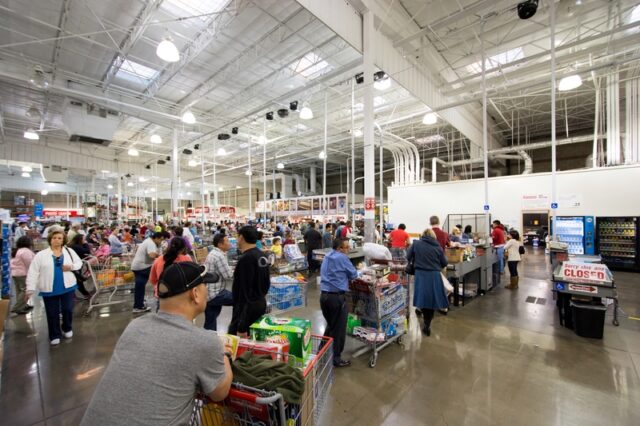
Retail giant Costco Wholesale has formally entered the growing wave of companies urging the courts to return money paid under sweeping tariffs imposed by Donald Trump. This move could reshape the financial stakes for importers if those duties are struck down.
In a complaint filed Nov. 28 in the U.S. Court of International Trade, Costco argues that the emergency‑powers statute used to justify the tariffs — the International Emergency Economic Powers Act (IEEPA) — does not legally authorize widespread import duties. The company seeks a full refund of tariffs it has already paid, a halt to further collections, and a ruling that the tariff orders are unlawful.
Costco’s filing is urgent: the company says it requested extra time from U.S. Customs and Border Protection (CBP) to finalize the tariff calculations — a process called “liquidation” — but was denied. Once liquidation happens, importers may permanently lose the ability to claim refunds even if the tariffs are later voided.
The backdrop to Costco’s lawsuit is a significant legal defeat for the government earlier this year. In V.O.S. Selections, Inc. v. Trump, the court ruled that the IEEPA‑based tariffs exceeded the president’s authority — finding the law did not clearly empower tariffs and that trade duties remain a congressional power.

Still, lower‑court rulings in similar cases do not ensure refunds for every importer. That has prompted major firms like Costco — which imports a significant portion of its merchandise — to file their own lawsuits to safeguard their refund rights.
Costco did not disclose the total amount of duties it has paid, but said in its filing that the risk of losing refunds is real because CBP has scheduled widespread liquidation of entries starting Dec. 15. If the court fails to block liquidation, many importers could permanently forfeit their refund claims.
With the high‑stakes case now before the Supreme Court — which heard oral arguments in early November — the outcome could ripple across import‑heavy sectors. For Costco, the lawsuit reflects an aggressive attempt to void tariff costs imposed this year and reclaim what it considers unlawfully collected duties.
Sources:
Disclaimer
Artificial Intelligence Disclosure & Legal Disclaimer
AI Content Policy.
To provide our readers with timely and comprehensive coverage, South Florida Reporter uses artificial intelligence (AI) to assist in producing certain articles and visual content.
Articles: AI may be used to assist in research, structural drafting, or data analysis. All AI-assisted text is reviewed and edited by our team to ensure accuracy and adherence to our editorial standards.
Images: Any imagery generated or significantly altered by AI is clearly marked with a disclaimer or watermark to distinguish it from traditional photography or editorial illustrations.
General Disclaimer
The information contained in South Florida Reporter is for general information purposes only.
South Florida Reporter assumes no responsibility for errors or omissions in the contents of the Service. In no event shall South Florida Reporter be liable for any special, direct, indirect, consequential, or incidental damages or any damages whatsoever, whether in an action of contract, negligence or other tort, arising out of or in connection with the use of the Service or the contents of the Service.
The Company reserves the right to make additions, deletions, or modifications to the contents of the Service at any time without prior notice. The Company does not warrant that the Service is free of viruses or other harmful components.