In a dramatic push of executive power, President Donald Trump has informed Congress that he believes the 1973 War Powers Resolution does not govern lethal U.S. military strikes against drug cartels, asserting those operations fall outside the law’s scope.
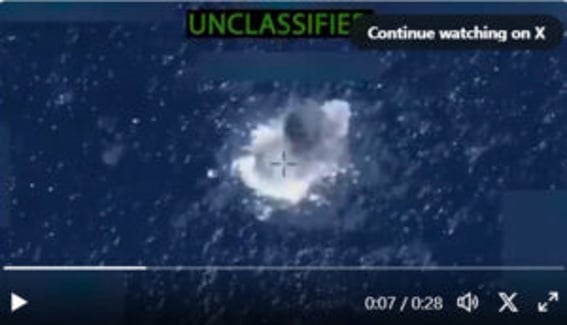
On Oct. 27th, at the direction of President Trump, the Department of War carried out three lethal kinetic strikes on four vessels operated by Designated Terrorist Organizations (DTO) trafficking narcotics in the Eastern Pacific.
The four vessels were known by our intelligence… pic.twitter.com/UhoFlZ3jPG
— Secretary of War Pete Hegseth (@SecWar) October 28, 2025
During recent briefings and internal legal memos, the White House’s Office of Legal Counsel argued that the ongoing counter-narcotics strikes — many carried out via drones and naval vessels in international waters — do not rise to the level of “hostilities” under the War Powers statute. The administration insists that since U.S. personnel are not exposed to direct danger, the law requiring congressional approval is inapplicable.
Trump has repeatedly stated he will inform Congress of planned operations against drug cartels but will not seek a formal war declaration. Critics in Congress and the legal community warn that this posture sidesteps constitutional checks on the use of military force and threatens separation of powers.

Already, the U.S. has conducted multiple strikes on vessels suspected of narcotics trafficking, reportedly resulting in dozens of deaths — yet the administration has provided only limited evidence to justify targeting decisions. Senators from both parties have demanded greater transparency, and efforts to pass resolutions constraining the strikes have met resistance.
As tensions rise, Congress faces a constitutional reckoning: whether to reclaim its war powers or allow the executive branch to define new boundaries for military action without statutory constraints.
Source links:
Disclaimer
Artificial Intelligence Disclosure & Legal Disclaimer
AI Content Policy.
To provide our readers with timely and comprehensive coverage, South Florida Reporter uses artificial intelligence (AI) to assist in producing certain articles and visual content.
Articles: AI may be used to assist in research, structural drafting, or data analysis. All AI-assisted text is reviewed and edited by our team to ensure accuracy and adherence to our editorial standards.
Images: Any imagery generated or significantly altered by AI is clearly marked with a disclaimer or watermark to distinguish it from traditional photography or editorial illustrations.
General Disclaimer
The information contained in South Florida Reporter is for general information purposes only.
South Florida Reporter assumes no responsibility for errors or omissions in the contents of the Service. In no event shall South Florida Reporter be liable for any special, direct, indirect, consequential, or incidental damages or any damages whatsoever, whether in an action of contract, negligence or other tort, arising out of or in connection with the use of the Service or the contents of the Service.
The Company reserves the right to make additions, deletions, or modifications to the contents of the Service at any time without prior notice. The Company does not warrant that the Service is free of viruses or other harmful components.