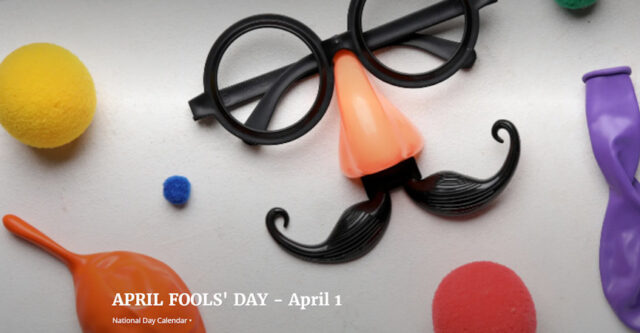
April Fools’ Day on April 1 is a day where many of us unleash our most creative sides, all in a hilarious – sometimes over the top – attempt at bamboozling those around us.
- 1392 – Geoffrey Chaucer writes the line “March 32” in his book, potentially birthing April Fools’ Day.
- 1500s – The French adopt January 1 as the first day of the year.
- 1592 – Gregorian calendar is introduced to replace the Julian calendar, changing the first day of the new year from April 1 to January 1.
- 1776 – April Fools’ Day begins to sweep across the UK.
Some “famous” pranks
- 1864 – The Evening Star of Islington advertised in 1864 a display of donkeys at the Agricultural Hall the next day. Those who arrived early soon realized who the donkeys on display really were.
- 1950 – The Progress in Clearfield, Pennsylvania, published a picture of a UFO flying over the town. Claiming to have “scooped” larger publications of the first-ever published picture of a real flying saucer.
- 1957 – the BBC aired a segment on its news program showing footage of Swiss farmers harvesting spaghetti from trees. The segment was presented as a serious news story, and many people believed it was true.
- 1983 – Professor Joseph Boskin fabricated a story that Emperor Constantine let a jester, Kugel, rule for a day, leading to April Fools’ Day. The Associated Press published it before realizing it was a hoax.
- 1992 – Times of London reported in 1992 that Belgium was negotiating to join Holland.
- 1996 – Taco Bell announced that it had purchased the Liberty Bell and would be renaming it the “Taco Liberty Bell.”
- 1998 – Burger King advertised a “Left-Handed Whopper.” Both were hoaxes that fooled many.
- 2007 – Google announced that it was launching a new service called “Gmail Paper,” which would allow users to have physical copies of their emails printed and mailed to them.
- 2008 – the BBC presented a documentary on flying penguins.
- In France, April Fools’ Day is called “Poisson d’Avril” or “April Fish.” Children tape paper fish onto unsuspecting friends’ backs and shout “Poisson d’Avril!” when discovered.
- In Scotland, April 1st is “Hunt the Gowk Day.” “Gowk” means cuckoo or fool. People send others on fool’s errands with messages reading, “Dinna laugh, dinna smile. Hunt the gowk another mile.”
- In the UK, pranks are only until noon; after that, the prankster becomes the fool.
- In Brazil, this day is referred to as “Lie Day” or Dia da Mentira.
April Fools’ Day Survey

Sources:
Disclaimer
Artificial Intelligence Disclosure & Legal Disclaimer
AI Content Policy.
To provide our readers with timely and comprehensive coverage, South Florida Reporter uses artificial intelligence (AI) to assist in producing certain articles and visual content.
Articles: AI may be used to assist in research, structural drafting, or data analysis. All AI-assisted text is reviewed and edited by our team to ensure accuracy and adherence to our editorial standards.
Images: Any imagery generated or significantly altered by AI is clearly marked with a disclaimer or watermark to distinguish it from traditional photography or editorial illustrations.
General Disclaimer
The information contained in South Florida Reporter is for general information purposes only.
South Florida Reporter assumes no responsibility for errors or omissions in the contents of the Service. In no event shall South Florida Reporter be liable for any special, direct, indirect, consequential, or incidental damages or any damages whatsoever, whether in an action of contract, negligence or other tort, arising out of or in connection with the use of the Service or the contents of the Service.
The Company reserves the right to make additions, deletions, or modifications to the contents of the Service at any time without prior notice. The Company does not warrant that the Service is free of viruses or other harmful components.