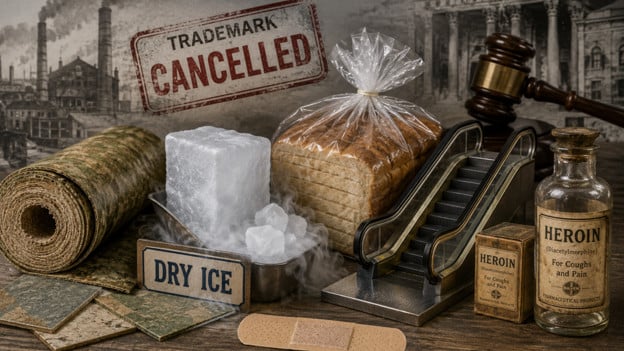
When customers walk into a store and ask for a Band-Aid or cellophane, they are just ordinary nouns to them. However, a simple trademark lookup reveals a big difference in its legal status. While Band-Aid is still active, searching for cellophane returns completely dead results.
A trademark exists to tell consumers exactly who made a product. However, sometimes brands become victims of their own success. Consumers stop treating them as a brand and start using the term as an everyday noun for the product itself. This triggers a legal process known as “genericide.”
The trademark has been legally canceled, and now anyone can use that word. While modern companies fight hard to protect their name, history shows that many corporate giants have fallen victim to genericide. This article shares stories of five such brands.
1. Linoleum (1878)
In 1855, English inventor Frederick Walton noticed a flexible, rubbery crust of oxidized linseed oil on top of an open can of paint. He perfected a manufacturing process that blended this solidified oil with resins, ground cork, and wood flour. This dense mixture was then pressed onto a heavy burlap canvas backing to create a durable sheet of flooring.

He launched the Linoleum Manufacturing Company Ltd in 1864. The word Linoleum is a combination of the following Latin words:
- Flax (linum)
- Oil (oleum)
This patent gave him a monopoly over the flooring market. Once his patent expired, manufacturers like Michael Nairn & Co. began replicating his material and openly selling it as linoleum. Walton sued for trademark infringement, but the court ruled decisively against him.
The judge declared that people had come to understand that “linoleum” was the name of the substance itself, not Walton’s specific corporate brand. The name became public property.
2. Dry Ice
Solid carbon dioxide is a substance that remains at a freezing temperature of -109.3°F and sublimates directly from a solid to a gas without leaving any liquid residue. The DryIce Corporation of America originally registered its brand name in 1925. The company aggressively marketed the blocks for commercial refrigeration and shipping. However, a company cannot lock up a purely descriptive phrase that simply details the inherent physical characteristics of a product.
DryIce Corp. of America v. Louisiana DryIce Corp. changed everything. DryIce Corp. of America sued Louisiana DryIce Corp. to stop it from using the term “dry ice” on its packaging. However, the U.S. Court of Appeals for the Fifth Circuit completely dismissed the lawsuit.
The panel of judges ruled that “dry ice” was an entirely descriptive phrase for solid carbon dioxide. The trademark was permanently canceled.
3. Cellophane
Swiss chemist Jacques Brandenberger spent a decade developing a process to extrude liquid cellulose into thin, transparent, waterproof sheets. Manufacturing giant DuPont bought the U.S. patent and naming rights in 1923.
This transformed the packaging industry by allowing shoppers to see inside food items for the first time.
They spent millions on national advertising campaigns and positioned “DuPont Cellophane” as a premium shield of freshness for everything from bread to cigars.
However, Waxed Products Co. began selling a competing cellulose wrap under the name cellophane. DuPont Cellophane Co. sued Waxed Products Co.
For the general public, “cellophane” simply meant transparent wrapping film. DuPont lost its exclusive monopoly.
4. Escalator
In 1900, inventor Charles Seeberger registered the word escalator as a trademark and partnered with the Otis Elevator Company to mass-produce the invention. Otis successfully installed these moving staircases in department stores and the subway.
However, Otis’s marketing department used the word “escalator” as a generic, lowercase noun for five decades. They frequently printed phrases like “Otis elevators and escalators.”
As a result, the public, architects, and city planners began to view the word as a generic equipment category rather than a brand. In 1950, Haughton Elevator Co. successfully petitioned to cancel the trademark.
5. Heroin
In 1898, researchers at the German pharmaceutical giant Bayer synthesized diacetylmorphine, a drug intended for treating respiratory illnesses. Bayer trademarked the drug under the name “Heroin.”
They marketed Heroin globally as a non-addictive cough syrup for children and a safe medical substitute for morphine.
When the U.S. entered World War I, the federal government enacted the Trading with the Enemy Act, and all of Bayer’s American facilities, chemical patents, and brand names were seized.
However, the legitimacy of the drug was destroyed due to severe public health crises and soaring addiction rates. The U.S. Congress passed a federal ban on the manufacture and sale of heroin in 1924.
This made it impossible to enforce the trademark, and the brand name permanently defaulted to a generic street term for the illicit opiate.
Disclaimer
Artificial Intelligence Disclosure & Legal Disclaimer
AI Content Policy.
To provide our readers with timely and comprehensive coverage, South Florida Reporter uses artificial intelligence (AI) to assist in producing certain articles and visual content.
Articles: AI may be used to assist in research, structural drafting, or data analysis. All AI-assisted text is reviewed and edited by our team to ensure accuracy and adherence to our editorial standards.
Images: Any imagery generated or significantly altered by AI is clearly marked with a disclaimer or watermark to distinguish it from traditional photography or editorial illustrations.
General Disclaimer
The information contained in South Florida Reporter is for general information purposes only.
South Florida Reporter assumes no responsibility for errors or omissions in the contents of the Service. In no event shall South Florida Reporter be liable for any special, direct, indirect, consequential, or incidental damages or any damages whatsoever, whether in an action of contract, negligence or other tort, arising out of or in connection with the use of the Service or the contents of the Service.
The Company reserves the right to make additions, deletions, or modifications to the contents of the Service at any time without prior notice. The Company does not warrant that the Service is free of viruses or other harmful components.