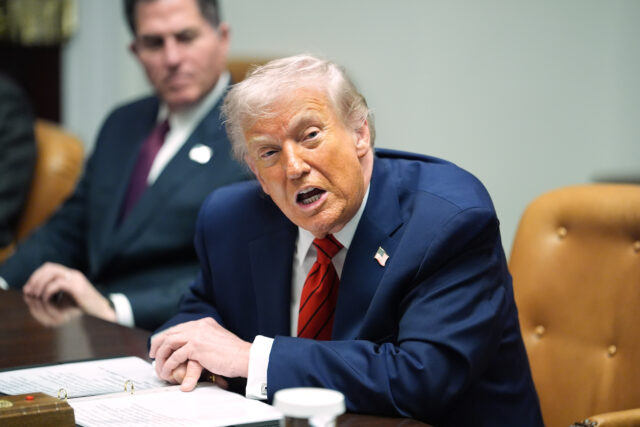
WASHINGTON D.C.—President Donald Trump signed a major executive order Thursday aimed at curbing the ability of individual states to regulate the rapidly expanding field of artificial intelligence. Titled “Ensuring a National Policy Framework for Artificial Intelligence,” the order asserts that a “patchwork” of disparate state laws threatens to undermine the nation’s AI dominance in a fierce global race, particularly against competitors like China.
The executive action establishes a “one rule” approach, centralizing regulatory authority at the federal level and signaling the administration’s policy of prioritizing innovation and minimal burden on the tech industry.
The order directs the Department of Justice to establish an AI Litigation Task Force with the sole responsibility of challenging state AI laws deemed to unconstitutionally regulate interstate commerce, conflict with federal law, or otherwise be unlawful. This effort immediately targets pioneering legislation in states like Colorado, which passed a comprehensive law to prevent algorithmic discrimination, and California, which has established its own safety and transparency requirements.

Furthermore, the order directs the Department of Commerce to identify state laws considered “onerous” and threatens to restrict a state’s eligibility for specific discretionary federal grant programs—including funds for broadband deployment—if they do not refrain from enforcing these identified regulations. This use of federal funding as leverage is a powerful tool for pressuring states into compliance.
The White House argues that forcing AI companies to obtain up to 50 state-level approvals for their products is unfeasible and will destroy the burgeoning industry “in its infancy.” The administration also expressed concern that specific state laws requiring impact assessments or fairness standards could compel AI models to alter their outputs to embed “ideological bias.”
Critics, however, argue the executive order is a major concession to Big Tech, creating a regulatory vacuum that favors corporate growth over public safety and consumer protection. Civil liberties and consumer rights groups have expressed deep concern, noting that, in the absence of a comprehensive federal AI law, state measures are the primary defense against algorithmic bias in critical areas such as employment, housing, and lending. The move follows two earlier attempts by Congress this year to impose a temporary moratorium on state AI laws, suggesting the administration is pursuing an executive workaround after the legislative path stalled.
The order directs the President’s Special Advisor for AI and Crypto, David Sacks, to jointly prepare a legislative recommendation for a uniform federal framework that would ultimately preempt state laws, though such legislation still requires an act of Congress. While the battle over AI governance shifts from state houses to federal courts and agencies, the order makes clear the administration’s priority is a unified, minimally burdensome regulatory environment to secure U.S. leadership in the pivotal technology.
📚 Sources and Links
- The White House: Ensuring a National Policy Framework for Artificial Intelligence.
- Times Union/San Francisco Chronicle: Trump signs executive order to block state AI regulations
- The Guardian: Trump signs executive order blocking states from regulating AI
- Colorado General Assembly – Colorado AI Act: SB24-205 Consumer Protections for Artificial Intelligence
- Governor Newsom’s Office: California AI Safety Law: SB 53, the Transparency in Frontier Artificial Intelligence Act
- CalMatters: Trump’s new order against AI regulation hits California especially hard.
Disclaimer
Artificial Intelligence Disclosure & Legal Disclaimer
AI Content Policy.
To provide our readers with timely and comprehensive coverage, South Florida Reporter uses artificial intelligence (AI) to assist in producing certain articles and visual content.
Articles: AI may be used to assist in research, structural drafting, or data analysis. All AI-assisted text is reviewed and edited by our team to ensure accuracy and adherence to our editorial standards.
Images: Any imagery generated or significantly altered by AI is clearly marked with a disclaimer or watermark to distinguish it from traditional photography or editorial illustrations.
General Disclaimer
The information contained in South Florida Reporter is for general information purposes only.
South Florida Reporter assumes no responsibility for errors or omissions in the contents of the Service. In no event shall South Florida Reporter be liable for any special, direct, indirect, consequential, or incidental damages or any damages whatsoever, whether in an action of contract, negligence or other tort, arising out of or in connection with the use of the Service or the contents of the Service.
The Company reserves the right to make additions, deletions, or modifications to the contents of the Service at any time without prior notice. The Company does not warrant that the Service is free of viruses or other harmful components.