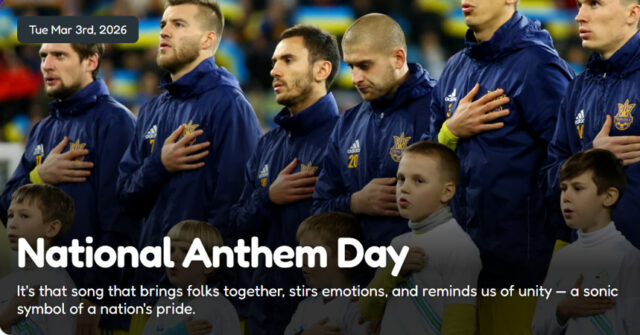
Written by Francis Scott Key, the “Star Spangled Banner” is the national anthem of the United States of America. National Anthem Day commemorates the day our nation adopted “The Star Spangled Banner” as our National Anthem.
The story behind “The Star Spangled Banner” is as moving as the anthem itself.
- 1745 – The song “God Save the King” is first published and rapidly becomes associated with the British monarchy, later serving de facto as the national anthem of the United Kingdom and inspiring other royal and national anthems.
- 1792 – Spain’s royal march, known today as “Marcha Real,” is officially regulated as the ceremonial march for the monarchy, making it one of the earliest melodies to function in practice as a national anthem.
- 1795 – France officially adopts “La Marseillaise” as its national anthem during the French Revolution, establishing one of the first modern, explicitly national anthems tied to popular sovereignty and citizen-soldiers.
- 18th Century – The melody is actually based on an old English drinking song called To Anacreon in Heav’n. It was the official song of the Anacreontic Society, an 18th-century men’s social club in London.
- 1814 – Francis Scott Key wrote the poem “Defence of Fort McHenry” while on a mission to make a prisoner exchange for Dr. William Beanes, who had been captured by the British. This was September 14, 1814.
- Francis Scott Key was aboard a British ship until the end of the bombardment of Fort McHenry. He agreed to stay aboard the ship as part of the conditions for the release of Dr. William Beanes and wrote the poem the next morning, when he realized the Americans had won the battle and their flag was still flying.
- The Original Sheet Music Featured a Spelling Mistake. When sheet music for the Star-Spangled Banner was first printed in 1814, the original printing featured a glaring misspelling. The song’s subtitle was supposed to read “A Patriotic Song,” but it was printed as “A Patriotic Song.” There are about a dozen copies of the original printing left today.
- 1861 – The Anthem is Longer than One Verse. Most Americans only know the first verse of the Star-Spangled Banner because that is all we really hear when it’s sung at sporting events. But, the original anthem consisted of four verses, with each one ending in “O’er the land of the free and the home of the brave.” A fifth verse was added in 1861 by poet Oliver Wendell Holmes. His verse included the words “the traitor that dares to defile the flag of her stars,” and it was added to support the Union cause in the Civil War.
- 1863 – The poem that forms the lyrics of Japan’s “Kimigayo” is set to music for ceremonial use in 1863, marking an early move toward an official song representing the Japanese state and its emperor.
- 1889 – Benjamin F. Tracy ordered “The Star-Spangled Banner” to be the official tune when raising the Navy flag.
- 1896 – At the first modern Olympic Games in Athens, the “Olympic Hymn” with lyrics by Kostis Palamas and music by Spyridon Samaras is performed, helping cement the idea of playing anthems and ceremonial songs at international sporting events.
- 1907 – The Flag was Hidden During World War II. The actual flag that the poem was based on first came to the Smithsonian Museum on the National Mall in 1907. But, after the Japanese attacked Pearl Harbor to kick off World War II, President Roosevelt had the flag and other national treasures moved from the National Mall to Shenandoah National Park in Virginia for safekeeping. They remained there from 1942 to 1944.
- 1918 – The Star-Spangled Banner played during the 7th inning of game 1 of the 1918 World Series between the Boston Red Sox and the Chicago Cubs.
- 1924 – From the 1924 Olympic Games, the practice of raising the winner’s flag and playing the gold medalist’s national anthem becomes standard, reinforcing national anthems as key symbols in global sports ceremonies.
- 1931 – 117 years passed after Key penned “Defence of Fort M’Henry” before it became the national anthem of the United States of America. “Hail Columbia” and “My Country ‘Tis of Thee” held honorary places as patriotic songs. But the United States didn’t have an officially declared anthem until a congressional resolution, signed by President Herbert Hoover, made “The Star Spangled Banner” the national anthem of the United States of America on March 3rd, 1931.
- 1969 – Jimi Hendrix sang “The Star-Spangled Banner” and went on to sing his iconic version 60 more times over the next two years.
- It Was a Poem Before a Song. Francis Scott Key was a poet, not a musician, so the words he wrote were originally in the form of a poem, which was to be titled Defense of Fort McHenry.
- There Were Two Flags Raised at the Battle of Baltimore. The poem mentions that the flag flew “through the perilous fight,” but that’s not entirely true. There were two flags used at the Battle of Baltimore, the massive 30-by-42-foot garrison flag and a smaller 17-by-25-foot storm flag. During the battle, the rain was so heavy that the larger flag (which weighed over 500 pounds when wet) had to be lowered and replaced by the smaller storm flag. In the morning, the storm flag was dropped and the large flag was hoisted.
- The first public performance of the song occurred in 1814, when Ferdinand Durang, an actor from Baltimore, sang it at a tavern called Captain McCauley’s.
- You can thank the Red Sox and the Cubs when you sing it before a sporting event. The history of the national anthem at sporting events is “murky,” according to ESPN, but many trace its place as a commonplace tradition to the 1918 World Series in Chicago. During the seventh inning stretch, in a show of patriotism in the midst of World War I, the military band at the stadium began playing the national anthem. People spontaneously began to sing along, until the entire stadium was filled with song. The Cubs’ administration was so moved by the moment that they made it a ritual.
- Whitney Houston’s version dominated the Billboard charts…twice. The singer astounded audiences with her rendition of the patriotic song at the 1991 Super Bowl. Her recording of the song peaked at number 20 on Billboard’s Hot 100, where it spent 11 weeks. A decade later, Houston’s version was re-released in the wake of 9/11 and spent another 16 weeks on the chart, peaking at number 6.
- Today’s version of the Anthem is Much Different from the Original. What you hear today when the Star-Spangled Banner is sung is much different than what it sounded like over 200 years ago. Originally, it was designed to be sung by a group of people together, but today it has been converted into a much slower song sung by a soloist and often without any musical accompaniment.
- The Song is Surprisingly Not Easy to Sing. Of all of the songs performed in front of American crowds, you would think that our national anthem would be the easiest. But, the song has stumped even some of our country’s biggest and best singers and artists. Whether it’s forgetting words or failing to reach the song’s epic high note, more singers get it wrong than they do right.
- Before it became “The Star-Spangled Banner”, our National Anthem was titled “Defence of Fort M’Henry”.
Sources:

Disclaimer
Artificial Intelligence Disclosure & Legal Disclaimer
AI Content Policy.
To provide our readers with timely and comprehensive coverage, South Florida Reporter uses artificial intelligence (AI) to assist in producing certain articles and visual content.
Articles: AI may be used to assist in research, structural drafting, or data analysis. All AI-assisted text is reviewed and edited by our team to ensure accuracy and adherence to our editorial standards.
Images: Any imagery generated or significantly altered by AI is clearly marked with a disclaimer or watermark to distinguish it from traditional photography or editorial illustrations.
General Disclaimer
The information contained in South Florida Reporter is for general information purposes only.
South Florida Reporter assumes no responsibility for errors or omissions in the contents of the Service. In no event shall South Florida Reporter be liable for any special, direct, indirect, consequential, or incidental damages or any damages whatsoever, whether in an action of contract, negligence or other tort, arising out of or in connection with the use of the Service or the contents of the Service.
The Company reserves the right to make additions, deletions, or modifications to the contents of the Service at any time without prior notice. The Company does not warrant that the Service is free of viruses or other harmful components.