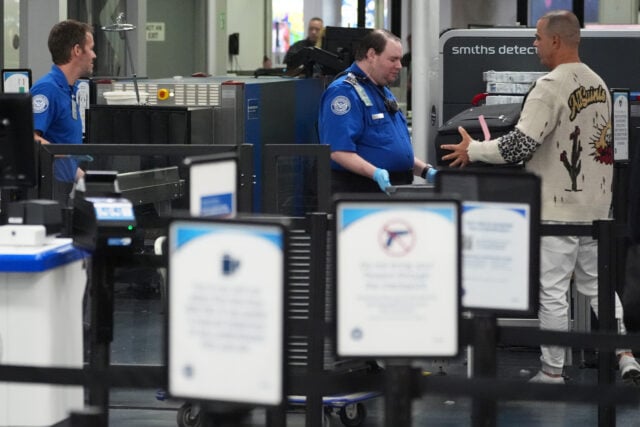
For over two decades, the blue-shirted officers of the Transportation Security Administration (TSA) have been the face of American aviation security—and, for many, the face of travel frustration. However, in April 2026, a significant policy pivot has emerged from the White House. President Trump’s latest budget proposal for Fiscal Year 2027 signals the beginning of the end for the federalized screening model, proposing a $52 million reduction in TSA funding and a mandatory shift for smaller airports into the Screening Partnership Program (SPP).
This is not just a budgetary tweak; it is a fundamental rethinking of how the United States protects its skies. By moving toward a “contractor-led, federal-overseen” model, the administration aims to dismantle what it calls a “bloated and inefficient” federal bureaucracy. But as the debate intensifies on Capitol Hill, the core question remains: Is privatizing the checkpoint a path to shorter lines and lower costs, or a dangerous return to the fragmented security of the pre-9/11 era?
The “Shutdown Shield”: Why Now?
The timing of this push is no coincidence. In early 2026, a protracted funding standoff over the Department of Homeland Security (DHS) left thousands of federal screeners working without pay for weeks. The results were predictable: national call-out rates spiked to over 10%, security lines at major hubs like Atlanta and Chicago stretched into hours, and morale hit an all-time low.
Yet, a handful of airports remained strangely immune to the chaos. At San Francisco International (SFO) and Kansas City International (MCI), the screening lines moved at their usual pace. The reason? These airports are part of the SPP, where security is handled by private contractors like VMD Corp or Covenant Aviation Security. Because these contractors operate under pre-funded federal contracts, their employees continued to receive paychecks throughout the shutdown.

For the Trump administration, this served as the ultimate proof of concept. Proponents argue that a privatized workforce is more resilient to political turbulence in Washington. “Security is too vital to be held hostage by budget theater,” noted one senior administration official during a briefing on the $52 million cut. “The private model ensures the mission continues, regardless of whether Congress can agree on a spending bill.”
The Historical Pendulum: From Private to Public and Back
To understand the current debate, one must look back to the origins of airport security. Before the 9/11 attacks, airlines were responsible for their own security, often hiring the lowest-bidding private contractors. The results were widely criticized as a “race to the bottom.”
- Pre-9/11 Era: Security was fragmented. Turnover rates among private screeners at some airports exceeded 100% per year. Pay was often at or near minimum wage, and training was inconsistent.
- The 9/11 Commission Report: The commission identified these failures as a critical vulnerability, leading Congress to pass the Aviation and Transportation Security Act in November 2001, which created the TSA and federalized the workforce.
- The 2026 Vision: The current proposal doesn’t suggest a return to the pre-9/11 airline-hired model. Instead, it seeks to expand the Screening Partnership Program, where the government still sets the standards and provides oversight, but private companies manage the personnel.
“The goal is to maintain the rigorous standards set by the federal government while injecting the agility and accountability of the private sector,” the 2027 budget request states.
The Economic Case: Savings or Sleight of Hand?
The administration’s proposal estimates that privatizing screening at smaller and mid-sized airports could yield cost savings of 15% to 20%. These savings come primarily from more flexible staffing models and reduced federal benefits packages.
Comparative Efficiency Table
| Feature | Federal TSA Model | Private (SPP) Model |
| Funding Source | Annual Congressional Appropriation | Pre-funded Multi-year Contracts |
| Staffing Flexibility | Rigid federal hiring/scheduling | Rapid adjustment to peak travel |
| Turnover (2025 Data) | 30% – 80% (varies by hub) | Often lower due to localized management |
| Shutdown Impact | High (Staff work without pay) | Low (Pay remains consistent) |
| Oversight | Internal TSA Management | TSA Federal Security Directors (FSD) |
Critics, however, argue that these savings are illusory. The American Federation of Government Employees (AFGE), which represents roughly 45,000 TSA officers, contends that “savings” are often achieved by slashing worker pay and benefits, which historically leads to higher turnover and lower-quality security.
“You cannot have world-class security on a bargain-bin budget,” an AFGE spokesperson stated in response to the April 3rd announcement. “When you prioritize profit, you inevitably de-prioritize safety. We’ve seen this movie before, and it didn’t have a happy ending.”
The Traveler’s Experience: Does Privatization Mean Shorter Lines?
For the average traveler, the “federal vs. private” debate is secondary to one metric: how long it takes to get through the checkpoint.
Advocates of privatization point to SFO as the gold standard. The airport has utilized private screening since the TSA’s inception, and it consistently ranks high in passenger satisfaction. Because private firms have more leeway to offer performance-based bonuses and flexible scheduling, they can often surge staffing more effectively during holiday rushes than the federal bureaucracy.
However, security experts like Sheldon Jacobson, whose research helped design TSA PreCheck, caution that privatization is not a “silver bullet.” Jacobson notes that while SFO succeeds, its success is also tied to its high budget and specific management culture. Applying the same model to a struggling regional airport with a shoe-string contract might not yield the same results.
The Innovation Argument
One of the key arguments in favor of the 2026 push is that private contractors are more incentivized to adopt new technologies. Under the Reimbursable Screening Services Program (RSSP) pilot, extended through 2026, airports like DFW and MIA have begun experimenting with third-party screening solutions for non-terminal areas. The administration hopes that full privatization will accelerate the rollout of AI-driven scanners and biometric gates, as private firms compete for contracts based on efficiency.
The National Security Counter-Argument
Despite the promise of efficiency, the specter of 9/11 looms large. Opponents of the Trump plan argue that aviation security is an “inherently governmental function.”
The concern is one of accountability. If a federal screener fails, the chain of command leads directly to the Secretary of Homeland Security and the President. If a private contractor fails, the issue can become mired in legal battles over contract terms, indemnification, and corporate liability.
Furthermore, there is the risk of “security theater.” Some experts worry that private firms, under pressure to meet “throughput” quotas (passengers per hour), might be incentivized to rush the screening process or overlook anomalies to avoid contractual penalties for long wait times.
The Road Ahead: Legislative and Labor Hurdles
The $52 million privatization push faces a steep climb in Congress. While some Republicans have introduced the “Abolish TSA Act” to phase out the agency entirely, many Democrats and moderate Republicans remain wary of dismantling a system built specifically to prevent another national tragedy.
Key Obstacles to Full Privatization:
- Labor Power: The AFGE is a formidable political force. Any move to strip federal status from tens of thousands of workers will trigger massive protests and lobbying efforts.
- Liability Concerns: Many airports are hesitant to opt into the SPP because they fear being held liable for security breaches or lawsuits that were previously the federal government’s responsibility.
- Consistency: The TSA’s greatest strength is its uniformity. A traveler in Maine undergoes the same process as a traveler in Maui. Critics fear a “patchwork” system where different contractors use different standards.
Conclusion: A New Era for American Skies?
The Trump administration’s 2026 push to privatize the TSA represents a bold gamble on the efficiency of the free market. For a public weary of government shutdowns and “security theater,” the promise of a more resilient, tech-forward checkpoint is alluring.
However, the lessons of history cannot be ignored. The federalization of airport security was a direct response to the catastrophic failure of the private model. As the debate moves from the budget office to the floors of Congress, the United States must decide if it can achieve the agility of a private corporation without sacrificing the unwavering vigilance of a federal agency.
One thing is certain: the “shoes-off shuffle” is about to get a lot more complicated.
Sources Used and Links
- Bloomberg Government: “Trump Budget Seeks TSA Privatization, Cuts to Cyber, FEMA” (April 3, 2026). https://news.bgov.com/bloomberg-government-news/trump-aims-to-privatize-tsa-in-budget-plan-for-troubled-agency
- Politico Pro: “Trump budget seeks to begin privatization of TSA screeners” (April 3, 2026). https://subscriber.politicopro.com/article/2026/04/trump-budget-seeks-to-begin-privatization-of-tsa-screeners-00857676
- CBS News / WDJT: “Trump’s new budget seeks TSA privatization. Here’s what that could mean for airport security screening” (April 4, 2026). https://www.cbs58.com/news/trump-s-new-budget-seeks-tsa-privatization-here-s-what-that-could-mean-for-airport-security-screening
- TSA.gov: “Reimbursable Screening Services Program (RSSP) Pilot Guidance” (Updated 2026). https://www.tsa.gov/for-industry/reimbursable-screening-services-program
- The Travel: “TSA Employee Fears Are Becoming A Reality As U.S. Government Looks Into Major Privatization Change” (April 3, 2026). https://www.thetravel.com/tsa-employee-fears-becoming-reality-as-us-government-looks-into-major-privatization-change/
- Associated Press / Local10: “As another shutdown impacts travelers, some see privatizing TSA screening as a solution” (March 11, 2026). https://www.local10.com/news/florida/2026/03/11/as-another-shutdown-impacts-travelers-some-see-privatizing-tsa-screening-as-a-solution/
- WFMD News: “Why some US airports are dodging TSA shutdown chaos while others grind to a halt” (March 21, 2026). https://www.wfmd.com/2026/03/21/why-some-us-airports-are-dodging-tsa-shutdown-chaos-while-others-grind-to-a-halt/
Disclaimer
Artificial Intelligence Disclosure & Legal Disclaimer
AI Content Policy.
To provide our readers with timely and comprehensive coverage, South Florida Reporter uses artificial intelligence (AI) to assist in producing certain articles and visual content.
Articles: AI may be used to assist in research, structural drafting, or data analysis. All AI-assisted text is reviewed and edited by our team to ensure accuracy and adherence to our editorial standards.
Images: Any imagery generated or significantly altered by AI is clearly marked with a disclaimer or watermark to distinguish it from traditional photography or editorial illustrations.
General Disclaimer
The information contained in South Florida Reporter is for general information purposes only.
South Florida Reporter assumes no responsibility for errors or omissions in the contents of the Service. In no event shall South Florida Reporter be liable for any special, direct, indirect, consequential, or incidental damages or any damages whatsoever, whether in an action of contract, negligence or other tort, arising out of or in connection with the use of the Service or the contents of the Service.
The Company reserves the right to make additions, deletions, or modifications to the contents of the Service at any time without prior notice. The Company does not warrant that the Service is free of viruses or other harmful components.