


A novel analysis investigating the contribution of social determinants of health (SDoH) to cardiac aging has found that financial strain and food insecurity are the strongest drivers of accelerated biological aging and increased mortality risk. The study in Mayo Clinic Proceedings, published by Elsevier, underscores the complexity and interplay of novel social risk factors that may contribute to cardiovascular events and emphasizes the need for targeted preventive interventions and patient-centered care.
The number of US residents aged 65 years and older is estimated to nearly double to 82 million people by the end of 2050, representing 23% of the total population. “Given the increasing life expectancy of the population and the enhanced burden of diseases in the elderly, the primary healthcare focus has shifted in the past decade to healthy aging and improved quality of life. This shift has also led to the search for new measures of biological aging,” explains lead investigator Amir Lerman, MD, Department of Cardiovascular Medicine, Mayo Clinic, Rochester, MN.
He adds, “Our current research was motivated by the observation that traditional risk factors do not explain and contribute equally to cardiovascular disease. There are social factors that we do not identify or inquire about from our patients that may potentially reverse biological aging.”
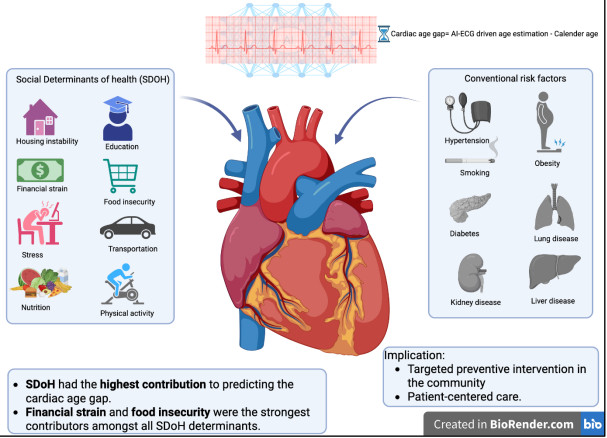
The cross-sectional study, investigating SDoH status with interaction to comorbidities and demographic risk factors in cardiac aging and mortality, included over 280,000 adult patients who sought care at Mayo Clinic between 2018 and 2023. Researchers assessed SDoH using a questionnaire that collects information across nine domains (stress, physical activity, social connection, housing instability, financial strain, food insecurity, transportation needs, nutrition, and education). They estimated cardiac age using an AI-enabled electrocardiogram (AI-ECG) algorithm and used structural equation modeling to map the connections between SDoH, conventional risk factors, and cardiac age gap.

Cardiac age gap
A higher cardiac age gap means the heart is biologically older than the individual, indicating increased risk for future cardiovascular disease. Despite previous efforts, accurate measurement of biological aging has been limited. This study highlights the use of innovative tools, such as the AI-ECG as a novel, noninvasive technique that provides valuable information regarding cardiac aging independently of chronological age. Detection of biological aging on routine ECG may point to the presence of non-traditional cardiovascular risk factors.
The authors point out that because the AI-ECG algorithm was validated internally at Mayo Clinic, and most survey respondents identify as non-Hispanic White, the study’s results may not apply precisely to other specific populations and racial or ethnic groups.
Key findings of the study are as follows:
- The interplay of SDoH was the most influential determinant of cardiac aging when compared with traditional clinical risk factors.
- Among all SDoH, financial strain and food insecurity were the most impactful in the overall population and sex-stratified analysis.
- SDoH such as financial strain, housing, and physical inactivity are robust predictors of increased mortality risk, matching or even surpassing certain conventional mortality risk factors.
Dr. Lerman concludes, “Our study highlights the critical role of SDoH in cardiac aging and mortality. Identifying the most important risk factors for cardiac aging allows for targeted preventive intervention in the community and empowers physicians to engage in patient-centered care, addressing the social context that contributes to heart disease.”
Disclaimer
Artificial Intelligence Disclosure & Legal Disclaimer
AI Content Policy.
To provide our readers with timely and comprehensive coverage, South Florida Reporter uses artificial intelligence (AI) to assist in producing certain articles and visual content.
Articles: AI may be used to assist in research, structural drafting, or data analysis. All AI-assisted text is reviewed and edited by our team to ensure accuracy and adherence to our editorial standards.
Images: Any imagery generated or significantly altered by AI is clearly marked with a disclaimer or watermark to distinguish it from traditional photography or editorial illustrations.
General Disclaimer
The information contained in South Florida Reporter is for general information purposes only.
South Florida Reporter assumes no responsibility for errors or omissions in the contents of the Service. In no event shall South Florida Reporter be liable for any special, direct, indirect, consequential, or incidental damages or any damages whatsoever, whether in an action of contract, negligence or other tort, arising out of or in connection with the use of the Service or the contents of the Service.
The Company reserves the right to make additions, deletions, or modifications to the contents of the Service at any time without prior notice. The Company does not warrant that the Service is free of viruses or other harmful components.









 are the most influential determinants of cardiac aging.)