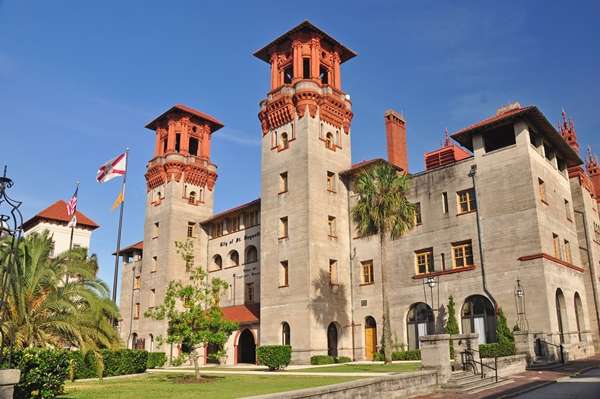
St. Augustine is famous because it is the oldest city in America and the history is still evident throughout the city.

proudly displays the statue
of Pedro Menéndez de Avilés.
America’s oldest city was established when the King of Spain sent Don Pedro Menendez de Aviles to colonize Florida in 1565. Little did they know that for the next 250 years the British, French, and Spanish would fight for control of the region (and most of Florida).

While there is no dispute about the fact Aviles founded St. Augustine in 1565, there is a dispute about who first landed in the area. Many historians believe Ponce de Leon first landed near St. Augustine in 1513.
We do know that St. Augustine residents must believe de Leon was the first explorer. There are statues and streets named after them throughout the town.
We also know that Ponce de Leon first named “La Florida” some three hundred years before the new country of the United States purchased the Spanish possession.
The Spanish, under Aviles, did establish the oldest continuously occupied settlement in the country. Older history books give the settlers at Jamestown the credit for the oldest settlement, but that did not occur until 1608.
Historical Facts and Attractions
History can be found throughout the city. Understanding the history helps understand what makes the attractions so significant.

The Fort at St. Augustine
Under Spanish rule, the fortification of St. Augustine was as important as finding food. Defending the colony from disease, the French and appeasing the Native Americans was key to survival.
The Fort Castillo de San Marcos (formerly Fort St. Mark) stands at the entrance to the city of St. Augustine. The fort was started in 1572 and refortified many times as the ongoing conflicts with the French and British battered it.
The Fort was a marvel in fortification at the time of its building. Castillo de San Marcos was constructed of coquina, a mass of bounded shells. It stands today as the oldest masonry fort in the United States.
Disclaimer
Artificial Intelligence Disclosure & Legal Disclaimer
AI Content Policy.
To provide our readers with timely and comprehensive coverage, South Florida Reporter uses artificial intelligence (AI) to assist in producing certain articles and visual content.
Articles: AI may be used to assist in research, structural drafting, or data analysis. All AI-assisted text is reviewed and edited by our team to ensure accuracy and adherence to our editorial standards.
Images: Any imagery generated or significantly altered by AI is clearly marked with a disclaimer or watermark to distinguish it from traditional photography or editorial illustrations.
General Disclaimer
The information contained in South Florida Reporter is for general information purposes only.
South Florida Reporter assumes no responsibility for errors or omissions in the contents of the Service. In no event shall South Florida Reporter be liable for any special, direct, indirect, consequential, or incidental damages or any damages whatsoever, whether in an action of contract, negligence or other tort, arising out of or in connection with the use of the Service or the contents of the Service.
The Company reserves the right to make additions, deletions, or modifications to the contents of the Service at any time without prior notice. The Company does not warrant that the Service is free of viruses or other harmful components.