By: Editor:
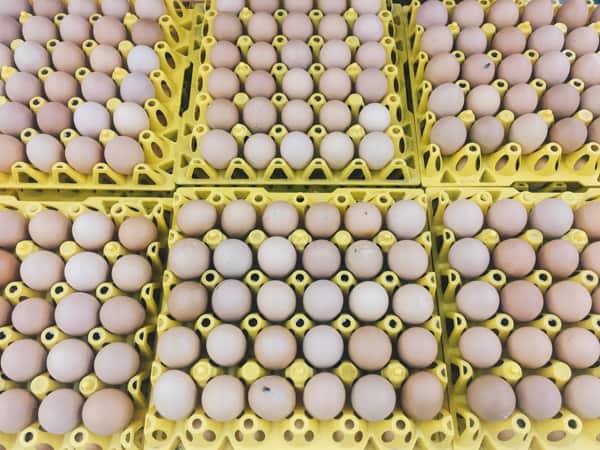
If you’ve been grocery shopping recently, you may have noticed a lot of bare shelves in the egg section. And if you’ve managed to snag a carton, you probably spotted something even more shocking: the price.
The cost of eggs is nearing a record high after spiking the past two months. Forecasts suggest it’s not getting cheaper anytime soon, either.
According to the latest U.S. government data, a dozen eggs cost $4.16 on average in December, marking an annual increase of about 37%. By contrast, grocery prices in general rose 1.8% over that same period of time.

And eggs are only expected to get more expensive as the year goes on. The department projects egg prices will jump another 20% by the end of 2025.
The cost of groceries, and specifically eggs and bacon, sparked an exchange during Vice President JD Vance’s first interview since taking office on CBS’s Face the Nation on Sunday. Host Margaret Brennan pressed Vance on when grocery prices — a major issue Vance and President Donald Trump campaigned on last fall — are going to actually decrease.
“Prices are going to come down, but it’s going to take a little bit of time,” Vance said, adding that Trump’s recent executive orders to supercharge U.S. energy production will “lower prices at the pump and at the grocery store.”
What’s causing egg prices to spike?
But right now, the soaring cost of eggs has little to do with energy prices.
In the U.S., egg prices tend to rise at the start of every year, in part, due to the increased demand during the winter and holiday months when people tend to bake more. But what we’re experiencing now is far from normal seasonal fluctuations.
The main culprit? The U.S. is still reeling from a catastrophic bird flu outbreak. The strain, known as H5N1, hit the U.S. in the early days of the COVID-19 pandemic and has lingered since, infecting more than 145 million poultry since January 2022, according to the Centers for Disease Control and Prevention.
The rippling effects of the virus have wreaked havoc on the U.S.’s egg supply, sending prices to record highs. That’s because when it comes to farming, if a bird tests positive for the virus, the farmer has to kill the entire flock as a precaution. Given how long this wave of bird flu has lingered, some farmers have reportedly had to kill their flocks several times.
During the last bird flu outbreak of 2015, about 50 million poultry were killed as a result, the USDA says, and that triggered an egg price bump, jumping from about $2 to $3 a dozen in the course of a few months. By spring of 2016, though, prices had already fallen below pre-outbreak levels. The cost of a dozen eggs mostly stayed below $2 until the current outbreak — when general inflation trends were supercharged by the bird flu.
Data suggests the current bird flu outbreak is several times worse than the one in 2015 — and the spread of the virus does not appear to be slowing down. According to a Money analysis of CDC data, more than 30 million chickens reared for egg production have been killed due to the bird flu outbreak since November.
The mass cullings lately are sparking egg shortages across several states and pushing some grocers to limit how many cartons shoppers can buy.
Disclaimer
Artificial Intelligence Disclosure & Legal Disclaimer
AI Content Policy.
To provide our readers with timely and comprehensive coverage, South Florida Reporter uses artificial intelligence (AI) to assist in producing certain articles and visual content.
Articles: AI may be used to assist in research, structural drafting, or data analysis. All AI-assisted text is reviewed and edited by our team to ensure accuracy and adherence to our editorial standards.
Images: Any imagery generated or significantly altered by AI is clearly marked with a disclaimer or watermark to distinguish it from traditional photography or editorial illustrations.
General Disclaimer
The information contained in South Florida Reporter is for general information purposes only.
South Florida Reporter assumes no responsibility for errors or omissions in the contents of the Service. In no event shall South Florida Reporter be liable for any special, direct, indirect, consequential, or incidental damages or any damages whatsoever, whether in an action of contract, negligence or other tort, arising out of or in connection with the use of the Service or the contents of the Service.
The Company reserves the right to make additions, deletions, or modifications to the contents of the Service at any time without prior notice. The Company does not warrant that the Service is free of viruses or other harmful components.