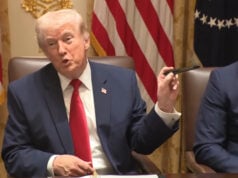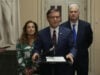
WASHINGTON — In a high-stakes gathering at the White House East Room on March 6, 2026, President Donald J. Trump convened a “College Sports Roundtable” featuring a who’s who of the athletic world. Flanked by legendary coaches Nick Saban and Urban Meyer, as well as the commissioners of the “Power Four” conferences, the President issued a stern warning: without immediate federal intervention, the “special American institution” of college athletics is on the brink of extinction.
A System Under Strain
The meeting comes at a pivotal moment. Following the landmark House v. NCAA settlement in 2025, which paved the way for schools to share up to 22% of their athletic revenue directly with players, many athletic departments are facing a fiscal crisis. President Trump described the current environment of Name, Image, and Likeness (NIL) as “out of control,” lamenting that the escalating costs of football and men’s basketball are “wiping out” smaller, non-revenue sports.
“We have to save college sports,” Trump told the gathering of over 35 sports leaders. “The amount of money being spent and lost by otherwise very successful schools is astounding. Even the rich colleges are going to go bust if we don’t bring order to this madness.”
The President’s comments underscored a growing sentiment among administrators that the “Wild West” era of NIL—marked by third-party “collectives” and bidding wars for transfers—is unsustainable. Trump pointed to the loss of “Olympic training grounds,” noting that sports like fencing, wrestling, and swimming are often the first to be cut when football budgets balloon to satisfy donor-driven pay-for-play schemes.

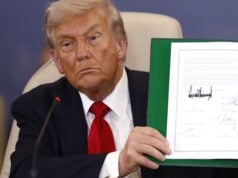
The roundtable served as a status report on the administration’s aggressive policy rollout. In July 2025, President Trump signed the “Saving College Sports” Executive Order, a sweeping directive aimed at reshaping the collegiate landscape. Key pillars of the policy include:
- Protecting Non-Revenue Sports: The order mandates that wealthy programs (generating over $125 million) must increase scholarship opportunities for non-revenue sports to offset the shift toward revenue sharing.
- Prohibiting “Pay-for-Play”: While supporting legitimate “fair market value” endorsements, the administration is seeking to eliminate de facto salaries disguised as NIL deals.
- Clarifying Student-Athlete Status: The Order directs the Department of Labor to ensure that college athletes are not classified as professional employees, a move intended to prevent collective bargaining and further tax burdens on universities.
Legislative Gridlock on Capitol Hill
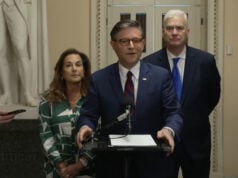
Despite the executive push, the President and his allies acknowledge that permanent stability requires a “National NIL Fix” from Congress. House Speaker Mike Johnson, who attended the summit, signaled that the SCORE Act (Student Compensation and Opportunity Through Rights and Endorsements) remains a top priority.
The bill has faced a rocky path, stalled by an unlikely coalition of conservative “freedom” caucuses—who view the bill as corporate welfare for the NCAA—and progressive Democrats who argue it strips athletes of their labor rights.
“We want to accomplish the necessary ends, and we think we’re very close,” Speaker Johnson told the room. The goal of the legislation is to provide the NCAA with a limited antitrust exemption, allowing the newly formed College Sports Commission to enforce a single set of national rules, effectively preempting the current “patchwork” of conflicting state laws.
Voices from the Field
Former Alabama coach Nick Saban, a vocal critic of the current transfer portal system, spoke during the session about the loss of “parity.” Saban expressed concern that a handful of “oligarch” programs are now able to effectively buy the best players from less-wealthy programs every offseason.
“We need a system that protects the kids but also protects the game,” Saban said. “Right now, we have 25-year-olds playing six or seven seasons because of eligibility loopholes. We need a return to the educational and developmental model.”
However, the meeting was not without its critics. Advocacy groups such as Athletes.org released a statement condemning the roundtable for its lack of representation from current student-athletes. “We deserve more than decisions handed down to us without our input,” the group stated. “If there is a real conversation about fixing college sports, it will start with us at the table.”
Looking Ahead: 2026 and Beyond
As the 2026-2027 athletic season approaches, the Trump administration has signaled it will use “all available regulatory and enforcement mechanisms,” including federal funding oversight, to ensure universities comply with the new scholarship mandates for women’s and Olympic sports.
The White House also announced the restoration of the Presidential Fitness Test and a revitalized President’s Council on Sports, Fitness & Nutrition, framing college athletics as the pinnacle of a broader national push for physical excellence and leadership.
Sources and References
- The White House (2025). Executive Order: Saving College Sports. whitehouse.gov/presidential-actions/2025/07/saving-college-sports/
- GV Wire (2026). Trump: Soaring College Football Costs Are Hitting Sports, Congress Must Act. gvwire.com/2026/03/06/trump-soaring-college-football-costs-are-hitting-sports-congress-must-act/
- CBS Sports (2026). President Donald Trump to host White House roundtable on future of college athletics. cbssports.com/college-football/news/president-donald-trump-white-house-meeting-college-athletics/
- JD Supra (2025). With Executive Order, President Trump Aims To Reshape College Sports. jdsupra.com/legalnews/with-executive-order-president-trump-1149015/
- The American Prospect (2026). How Congress Refused to Save the NCAA From Itself. prospect.org/2026/02/09/feb-2026-magazine-sports-ncaa-college-football-score-act/
- Sports Business Journal (2025). President Donald Trump calls state of college sports ‘very serious problem’. sportsbusinessjournal.com/Articles/2025/11/11/trump-calls-state-of-college-sports-very-serious-problem/
Disclaimer
Artificial Intelligence Disclosure & Legal Disclaimer
AI Content Policy.
To provide our readers with timely and comprehensive coverage, South Florida Reporter uses artificial intelligence (AI) to assist in producing certain articles and visual content.
Articles: AI may be used to assist in research, structural drafting, or data analysis. All AI-assisted text is reviewed and edited by our team to ensure accuracy and adherence to our editorial standards.
Images: Any imagery generated or significantly altered by AI is clearly marked with a disclaimer or watermark to distinguish it from traditional photography or editorial illustrations.
General Disclaimer
The information contained in South Florida Reporter is for general information purposes only.
South Florida Reporter assumes no responsibility for errors or omissions in the contents of the Service. In no event shall South Florida Reporter be liable for any special, direct, indirect, consequential, or incidental damages or any damages whatsoever, whether in an action of contract, negligence or other tort, arising out of or in connection with the use of the Service or the contents of the Service.
The Company reserves the right to make additions, deletions, or modifications to the contents of the Service at any time without prior notice. The Company does not warrant that the Service is free of viruses or other harmful components.