WASHINGTON — In a move that has sent shockwaves through the halls of European power and ignited a firestorm of diplomatic protest, the White House confirmed Tuesday that President Donald Trump is actively exploring a “range of options” to bring Greenland under U.S. control—explicitly refusing to rule out the use of military force to achieve the objective.
The escalation follows a weekend of high-stakes American military activity, including the controversial capture of Venezuelan President Nicolás Maduro. Emboldened by that operation, the President turned his focus north, telling reporters aboard Air Force One on Sunday that the U.S. needs Greenland “very badly” due to its strategic importance and the presence of Russian and Chinese vessels in the region.
“Military is Always an Option”
White House Press Secretary Karoline Leavitt clarified the administration’s stance in a formal statement on Tuesday. “President Trump has made it well known that acquiring Greenland is a national security priority of the United States, and it’s vital to deter our adversaries in the Arctic region,” Leavitt said. She added that while the administration is weighing multiple avenues, “utilizing the U.S. military is always an option at the commander-in-chief’s disposal.”
The rhetoric was echoed by White House Deputy Chief of Staff Stephen Miller, who told CNN on Monday that Greenland “should be part of the United States” and suggested that Denmark’s historical claim to the territory is essentially obsolete. Miller further asserted that “no one will fight the United States militarily” over the island’s future, a remark critics have characterized as blatant intimidation of a NATO ally.

A Fracture in the Alliance
The response from Europe was immediate and unified. Leaders from Denmark, Great Britain, France, Germany, Italy, Poland, and Spain issued a joint statement on Tuesday, declaring that “Greenland belongs to its people” and emphasizing that only Denmark and Greenland can decide the territory’s future.
Danish Prime Minister Mette Frederiksen, who has long dismissed Trump’s interest in the island as “absurd,” issued her most dire warning to date. She stated that any U.S. military move against a NATO ally would represent the “end” of the North Atlantic Treaty Organization and the post-WWII security architecture. “If the United States chooses to attack another NATO country militarily, everything stops,” Frederiksen told reporters.
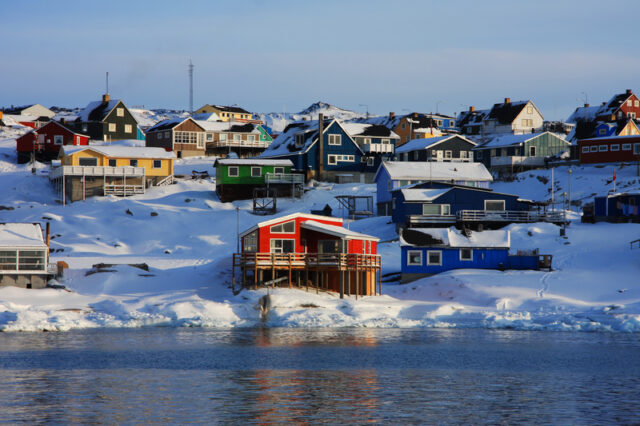
The Trump administration’s renewed interest in the 836,000-square-mile island is fueled by two primary factors: national defense and mineral wealth. Strategically situated between North America and Russia, Greenland is home to the Pituffik Space Base (formerly Thule Air Base), a critical hub for U.S. missile warning and space surveillance.
Furthermore, as the climate crisis thins Arctic ice, the island’s untapped deposits of rare earth minerals, lithium, and graphite have become increasingly attractive. Administration officials argue that securing these resources is vital for decoupling the U.S. supply chain from China.
Domestic Resistance
Despite the administration’s push, the prospect of a military seizure remains deeply unpopular at home. A recent poll indicated that only 7% of Americans support a military takeover of Greenland. On Capitol Hill, Senator Ruben Gallego (D-AZ) introduced a bill on Tuesday to “prohibit the use of funds for military force or other hostilities against Greenland,” accusing the President of treating international borders like real estate deals.
While Secretary of State Marco Rubio reportedly told lawmakers in a private briefing that the administration would still prefer a “purchase” agreement, the White House’s refusal to take military action off the table has left the international community on edge. With the President hinting at a major announcement in “about two months,” the future of the Arctic—and the NATO alliance itself—appears increasingly uncertain.
News Sources and Links
- The Guardian: White House says using US military is ‘always an option’ for acquiring Greenland
- Fox News: White House says ‘range of options,’ including US military, on table as Trump renews push to acquire Greenland
- CBS News: White House discussing “range of options” for acquiring Greenland, including U.S. military takeover by force
- The Hindu: Trump discussing how to acquire Greenland; U.S. military always an option, White House says
- PBS News: European leaders push back on Trump’s comments about U.S. taking over Greenland
- European Newsroom: Sharp statements after the US demand for Greenland
Disclaimer
The information contained in South Florida Reporter is for general information purposes only.
The South Florida Reporter assumes no responsibility for errors or omissions in the contents of the Service.
In no event shall the South Florida Reporter be liable for any special, direct, indirect, consequential, or incidental damages or any damages whatsoever, whether in an action of contract, negligence or other tort, arising out of or in connection with the use of the Service or the contents of the Service.
The Company reserves the right to make additions, deletions, or modifications to the contents of the Service at any time without prior notice.
The Company does not warrant that the Service is free of viruses or other harmful components