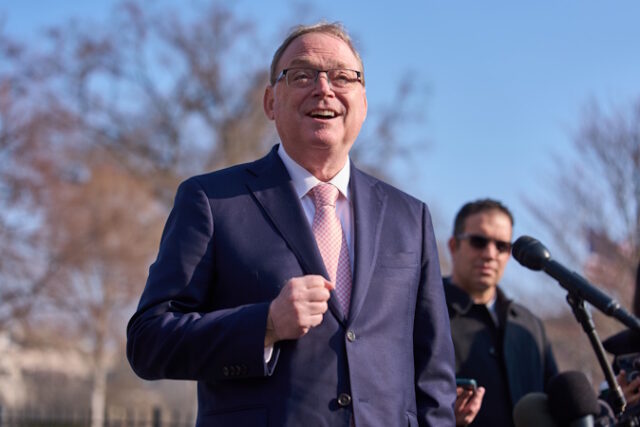
In a sharp escalation of the friction between the executive branch and independent economic institutions, White House National Economic Council (NEC) Director Kevin Hassett called for disciplinary action against Federal Reserve researchers on Wednesday. Hassett’s comments targeted economists at the Federal Reserve Bank of New York who recently published a study concluding that the burden of the administration’s tariff policies falls almost entirely on American businesses and consumers rather than foreign exporters.
The public rebuke has sent ripples through the economic community, raising concerns about the politicization of data and the erosion of the central bank’s traditional independence.
The Catalyst: The New York Fed’s Tariff Report
The controversy centers on a report released on February 12, 2025, via the New York Fed’s Liberty Street Economics blog. The study analyzed the “Liberation Day” tariffs and subsequent trade levies implemented throughout 2025. According to the researchers, the average U.S. import tariff rate surged from 2.6% to 13% over the course of the year.
The study’s most explosive finding was its analysis of “tariff incidence”—the technical term for who actually pays the tax. The New York Fed found that:

- 94% of the cost was borne domestically in the first eight months of 2025.
- By November 2025, that figure dropped only slightly to 86% as supply chains began to adjust.
- Foreign exporters lowered their prices by only a negligible amount, meaning they did not “absorb” the tax as the White House has frequently claimed.
Hassett’s “Blistering” Response
Appearing on CNBC’s Squawk Box on February 18, 2026, Hassett did not mince words. He characterized the research as “the worst paper I’ve ever seen in the history of the Federal Reserve system” and labeled it an “embarrassment.”
“The people associated with this paper should presumably be disciplined,” Hassett told the anchors. He argued that the study was “highly partisan” and claimed the methodology “wouldn’t be accepted in a first-semester econ class.” Hassett’s primary criticism was that the Fed researchers focused too narrowly on the prices of imported goods while ignoring broader macroeconomic benefits, such as onshoring production, wage growth, and the strengthening of the domestic industrial base.
Hassett defended the administration’s trade agenda by pointing to real wage growth—which he claimed rose by an average of $1,400 last year—and arguing that the tariffs were a net positive for American workers. “Consumers couldn’t have been made better off by the tariffs if this New York Fed analysis was correct,” he stated.
A Departure from “Free Market” Roots?
Critics and observers have noted that Hassett’s current stance marks a significant shift from his historical views. In 2003, while at the American Enterprise Institute, Hassett co-wrote that “liberalized trade… is a key ingredient in the recipe for prosperity.” As recently as 2018, he acknowledged that “if you put tariffs on things, then you get less economic growth,” famously referring to tariffs as “taxes.”
The demand for “discipline” marks a new chapter in the administration’s relationship with the Fed. While President Trump has frequently criticized Fed Chair Jerome Powell over interest rates, Hassett’s call to punish specific researchers for their findings is viewed by many as a direct threat to the central bank’s intellectual autonomy.
Broader Economic Consensus
The New York Fed is not alone in its conclusions. Several other independent institutions have published data that align with the “90% burden” figure:
- The Congressional Budget Office (CBO): Found that foreign exporters absorb only about 5% of tariff costs, with 95% falling on U.S. firms.
- The Tax Foundation: Estimated that tariffs cost the average American household approximately $1,000 in 2025.
- Harvard and University of Chicago: Researchers there found high “pass-through” rates to U.S. import prices.
Reactions from the Economic Community
The suggestion that government-affiliated economists should face professional consequences for peer-reviewed findings has met with swift condemnation from many in the field. Claudia Sahm, a former Fed economist, described the comments as “deeply disturbing,” suggesting that such rhetoric could lead to “self-censorship” among government researchers who fear for their jobs if their data contradicts political narratives.
Conversely, supporters of the administration argue that the New York Fed is part of a “deep state” economic establishment that is ideologically opposed to the President’s protectionist policies. They suggest the Fed’s focus on short-term price increases ignores the long-term national security and employment benefits of reshoring manufacturing.
What’s Next?
The Federal Reserve Bank of New York has declined to comment on Hassett’s specific demand for discipline. However, the clash underscores a deepening rift as the 2026 midterm elections approach. With the public still wary of inflation, the debate over whether tariffs are a “tax on the consumer” or a “tool for the worker” is likely to remain at the forefront of the national discourse.
Whether Hassett’s call for “discipline” will result in actual personnel changes remains to be seen. Given the Federal Reserve’s statutory independence, the White House does not have direct authority to fire regional Fed researchers. However, the political pressure is undeniable, and the nomination of Kevin Warsh to replace Jerome Powell later this year suggests the administration is looking for a Fed leadership more aligned with its “Tariff First” philosophy.
Sources and Links
- Fox Business: Kevin Hassett says Fed economists should be ‘disciplined’ over tariff study
- The Washington Post: White House economic adviser says Fed researchers should be punished
- Associated Press (AP): WH adviser Hassett urges ‘discipline’ for Fed economists over tariff study
- Quartz: A White House advisor wants economists ‘disciplined’ for tariff study
- Benzinga: ‘Worst Paper I’ve Ever Seen’: Kevin Hassett Goes Nuclear On NY Fed Paper On Tariffs
- Federal Reserve Bank of New York (Liberty Street Economics): The Impact of 2025 Tariffs on Import Prices (Generic link for context of the study mentioned)
Disclaimer
Artificial Intelligence Disclosure & Legal Disclaimer
AI Content Policy.
To provide our readers with timely and comprehensive coverage, South Florida Reporter uses artificial intelligence (AI) to assist in producing certain articles and visual content.
Articles: AI may be used to assist in research, structural drafting, or data analysis. All AI-assisted text is reviewed and edited by our team to ensure accuracy and adherence to our editorial standards.
Images: Any imagery generated or significantly altered by AI is clearly marked with a disclaimer or watermark to distinguish it from traditional photography or editorial illustrations.
General Disclaimer
The information contained in South Florida Reporter is for general information purposes only.
South Florida Reporter assumes no responsibility for errors or omissions in the contents of the Service. In no event shall South Florida Reporter be liable for any special, direct, indirect, consequential, or incidental damages or any damages whatsoever, whether in an action of contract, negligence or other tort, arising out of or in connection with the use of the Service or the contents of the Service.
The Company reserves the right to make additions, deletions, or modifications to the contents of the Service at any time without prior notice. The Company does not warrant that the Service is free of viruses or other harmful components.