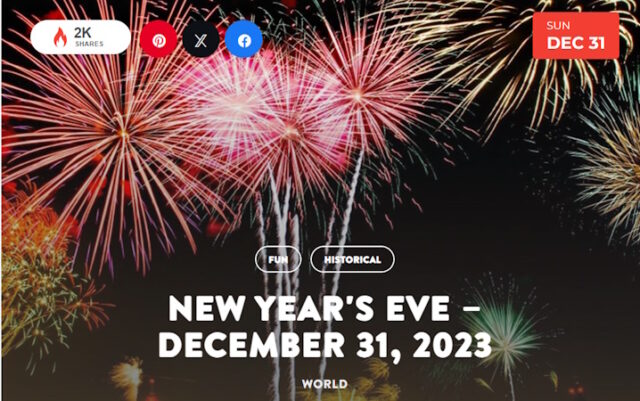
Every year on December 31st, people around the world celebrate New Year’s Eve, the last day of the year. It’s a day to say “goodbye” to the old and “hello” to the new.
- 320 BCE – 620 BCE – The first New Year’s celebrations were thought to be held in ancient Mesopotamia. Because of the calendar at the time, these celebrations took place in March. Ringing in the New Year consisted of an 11-day festival.
- 600 BC – Baby New Year has been a symbol of the holiday since around 600 B.C., starting in ancient Greece when an infant was paraded around in a basket in celebration of Dionysus, the god of fertility (and wine). The baby represents a rebirth that occurs at the start of each new year.
- 1582 – You can thank a pope for making our new year start on January 1. The Gregorian calendar was introduced in October of 1582 by Pope Gregory XIII as a revised version of the Julian calendar. It took almost 350 years for the world to get on board. Turkey didn’t make the switch until 1927.
- 1788 – The guy credited with Auld Lang Syne didn’t fully write it. Robert Burns took a Scottish folk song called “Old Long Syne” and put his own spin on it in 1788, which is the version we all know today. Auld lang syne means “times long past.”
- 1833 – Long before it was used on New Year’s Eve, a ball on top of England’s Royal Observatory in Greenwich was dropped at 1 p.m. every day (starting in 1833) to help ship captains coordinate their navigation equipment. Similar balls were set up in coastal areas around the world.
- 1904 – The annual tradition of gathering in Times Square for New Year’s started as a party to celebrate the opening of the New York Times building in 1904. Over 200,000 people attended.
- 1907 – Though the parties raged on, there wasn’t a ball drop until 1907. Fireworks were previously used to welcome the new year, but they were banned because burning embers were falling on the crowd. A ball being lowered on a flagpole was a safer bet.
- 1942 – the only year when Times Square remained dark on New Year’s Eve.
- 1975 – Dick Clark first hosted New Year’s Rockin’ Eve until 2004 when he suffers a stroke.
- 2000 – A song that takes 1000 years to play launched on January 1, 2000. Composer Jem Finer wrote the piece called “Longplayer,” which can be heard at London’s Trinity Buoy Wharf (or over this live stream). It’s being performed by singing bowls and is set to start all over again immediately after it finishes in 2999.
- 2005 – Dick Clark returns to co-host New Year’s Rockin’ Eve with Ryan Seacrest.
- 2009 – The annual Times Square New Year’s Eve event is officially changed to Dick Clark’s New Year’s Rockin’ Eve with Ryan Seacrest.
- Also known as Old Year’s Day or Saint Sylvester’s Day, New Year’s Eve is one of the most exciting holidays of the year.
- New Year’s is also a time to forgive past mistakes and form new habits. Many people make New Year’s resolutions. Although, only 8% of people actually accomplish them. Instead of making resolutions that you’re not going to keep anyway, it’s better to set three or four goals.
- In Spain and other Spanish-speaking countries, it is a tradition to eat 12 grapes during the countdown to midnight, symbolizing hopes for the new year. Around the world, eating anything in the form of a circle or ring symbolizes coming full circle and is considered good luck.
- When the calendar switched from the lunar year to the solar year, the New Year began in January. This occurred in 46. B.C., when an astronomer convinced Julius Caesar to follow the solar year
- The month January is named after the god Janus, who has two faces — one looking forward to the future and one looking back to the past.
- $1.1 Billion – Estimated cost of New Year’s air travel, with at least 6.7 million people expected to pay an average of $165 for a round-trip ticket. (2019)
- 45% of Americans plan to celebrate New Year’s Eve with family, and only 15% will attend public events or parties.
- $1,160 — the average price for dinner and entertainment for two in New York City on this night.
- 360+ Million – Glasses of sparkling wine are drunk each New Year’s Eve.
- 17.1% of emergency room visits on New Year’s Eve are drug/alcohol-related (most of any holiday).
- 49,900 – People get hurt in car crashes each New Year’s Eve Holiday.
- 0.094% – Average BAC on New Year’s Eve, making it the most drunken night of the year.
- 80% of New Year’s resolutions fail by February, with 22% of Americans admitting that their 2019 resolutions were the same as their 2018 goals.
- According to WalletHub, 12 percent of people fall asleep before the clock strikes midnight
- The Ball is a geodesic sphere, 12 feet in diameter, and weighs 11,875 pounds.
- 2,000 pounds of confetti are also dropped in Times Square. Confetti may not be a new concept, but in 2015 “wishfetti” became a part of the tradition. People write their wishes for the new year and submit them to the Wish Wall in Times Square (or online) and those wishes are turned into the confetti that falls over the crowd at midnight.
- 102.1 million — the number of people who travel to reach their New Year’s Eve destinations.
- The Pacific island nations of Tonga, Samoa, and Kiribati are the first to ring in the New Year. New Zealand is next, followed by Australia, Japan, and South Korea.
- The very last places on our planet where the New Year arrives are in two places: U.S. island territories Baker Island and Howland Island. Both are unoccupied National Wildlife Refuges. The last place where you can celebrate the arrival of a New Year is in another U.S. territory, American Samoa, which is occupied.
- Kissing at midnight comes from old English and German folklore, saying the first person you come across in the new year could set the tone for the next year.
- If you live in Italy, wearing red underwear is considered lucky. Wearing red underwear on New Year’s will supposedly bring good fortune in the coming year. It’s also considered the color of fertility so for those hoping to conceive, it’s considered double lucky.
- New Year’s Eve ranks fourth on Americans’ list of favorite holidays, with 41% of the population calling it their favorite. Predictably, 78% of Americans love Christmas. Thanksgiving and July 4th came in second and third, respectively.
- According to Google, Louisville, Kentucky, was the most hungover city in America on January 1, 2019.
- Until 2006, the Space Shuttle never flew on New Year’s day or eve because its computers couldn’t handle a year rollover. – Source
- The tradition of kissing someone at midnight is likely rooted in German and English folklore. The belief was that the first person you encountered at the start of the new year determined your fortunes in the year ahead. Over time, people decided to be proactive about it, making sure they kissed someone they knew and liked at the start of the year.
Sources:

Disclaimer
Artificial Intelligence Disclosure & Legal Disclaimer
AI Content Policy.
To provide our readers with timely and comprehensive coverage, South Florida Reporter uses artificial intelligence (AI) to assist in producing certain articles and visual content.
Articles: AI may be used to assist in research, structural drafting, or data analysis. All AI-assisted text is reviewed and edited by our team to ensure accuracy and adherence to our editorial standards.
Images: Any imagery generated or significantly altered by AI is clearly marked with a disclaimer or watermark to distinguish it from traditional photography or editorial illustrations.
General Disclaimer
The information contained in South Florida Reporter is for general information purposes only.
South Florida Reporter assumes no responsibility for errors or omissions in the contents of the Service. In no event shall South Florida Reporter be liable for any special, direct, indirect, consequential, or incidental damages or any damages whatsoever, whether in an action of contract, negligence or other tort, arising out of or in connection with the use of the Service or the contents of the Service.
The Company reserves the right to make additions, deletions, or modifications to the contents of the Service at any time without prior notice. The Company does not warrant that the Service is free of viruses or other harmful components.