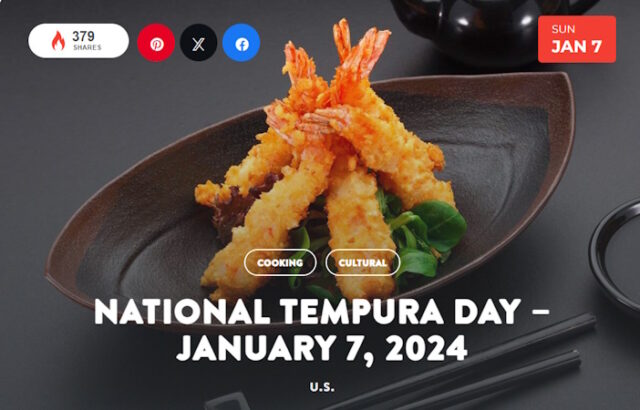
On January 7, enjoy a Japanese dish made up of either seafood or vegetables that are battered and deep-fried. Make sure the batter is the right kind for National Tempura Day!
- 1549 – Portuguese Jesuit missionaries introduced the recipe for tempura to Japan during the sixteenth century (around 1549). It is believed that Portuguese Jesuit Tokugawa Isyasu, founder and first shogun of the Tokugawa shogunate of Japan, loved tempura.
- 1600s – Portuguese missionaries originally introduced the deep-fried food method of cooking now associated with tempura in the Japanese city, Nagasaki, in the 1600s.
- 1671 – The first publication of the modern tempura recipe in a book titled “Cook Menu.”
- 1688 – Since the Genroku era (September 1688 – March 1704) tempura was originally a very popular food that was eaten at street vendors called ‘yatai’.
- 1800 – The style of frying introduced by the Portuguese evolves to fit the Japanese cuisine.
- 2000 – Modern chefs have unique ideas on tempura, and they don’t only use fish or vegetables. Almost anything goes into tempura these days.
- Today, chefs all over the world include tempura dishes on their menus using a wide variety of different batters and ingredients including nontraditional broccoli, zucchini and asparagus as well as dry fruits.
- Some meats, usually chicken and cheeses, particularly mozzarella are known to be served tempura-style in some American restaurants.
- For sushi lovers, a more recent variation of tempura sushi has the entire pieces of sushi being dipped in batter and tempura-fried.
- Remarkably, the name ‘tempura’ stems from the Latin word ‘ad tempora cuaresme,’ meaning “in the time of Lent.” The event was mistaken for the dish’s name, and tempura came to stay.
- Outside Japan (as well as recently in Japan), there are many nontraditional and fusion uses of tempura. Chefs over the world include tempura dishes on their menus, and a wide variety of different batters and ingredients are used, including the nontraditional broccoli, zucchini, asparagus and chuchu.
- More unusual ingredients may include nori slices, dry fruit such as banana, and ice cream. American restaurants are known to serve tempura in the form of various meats, particularly chicken, and cheeses, usually mozzarella.
- Tempura is either eaten with dipping sauce, salted without sauce, or used to assemble other dishes. Tempura is commonly served with grated daikon and eaten hot immediately after frying.
- Vegetable oil or canola oil are most common; however, tempura was traditionally cooked using sesame oil.
- The most popular seafood tempura is probably ebi (shrimp).
- To help the batter stick even better, you can sprinkle the item to be fried with a little bit of kosher salt before dredging it.
- Classic tempura batter consists of only three simple ingredients: cake flour, eggs, and cold water (sometimes with added ice, or sparkling water instead).
- Contrary to popular belief, tempura does not contain panko (Japanese-style breadcrumbs).
- More recently, tempura has branched out to experimental sweets such as tempura ice cream, tempura chocolate, and even tempura gummies!
- Restaurants that specialize in the preparation and sales of tempura in Japan are called tempura-ya.
- Many take-out restaurants sell tempura as part of a lunch box meal.
Sources:

Disclaimer
Artificial Intelligence Disclosure & Legal Disclaimer
AI Content Policy.
To provide our readers with timely and comprehensive coverage, South Florida Reporter uses artificial intelligence (AI) to assist in producing certain articles and visual content.
Articles: AI may be used to assist in research, structural drafting, or data analysis. All AI-assisted text is reviewed and edited by our team to ensure accuracy and adherence to our editorial standards.
Images: Any imagery generated or significantly altered by AI is clearly marked with a disclaimer or watermark to distinguish it from traditional photography or editorial illustrations.
General Disclaimer
The information contained in South Florida Reporter is for general information purposes only.
South Florida Reporter assumes no responsibility for errors or omissions in the contents of the Service. In no event shall South Florida Reporter be liable for any special, direct, indirect, consequential, or incidental damages or any damages whatsoever, whether in an action of contract, negligence or other tort, arising out of or in connection with the use of the Service or the contents of the Service.
The Company reserves the right to make additions, deletions, or modifications to the contents of the Service at any time without prior notice. The Company does not warrant that the Service is free of viruses or other harmful components.