A translator stood between Meganne Money and the Korean production team.
Words flew back and forth.
Thirty minutes evaporated before anyone realized they had been describing two completely different shapes.
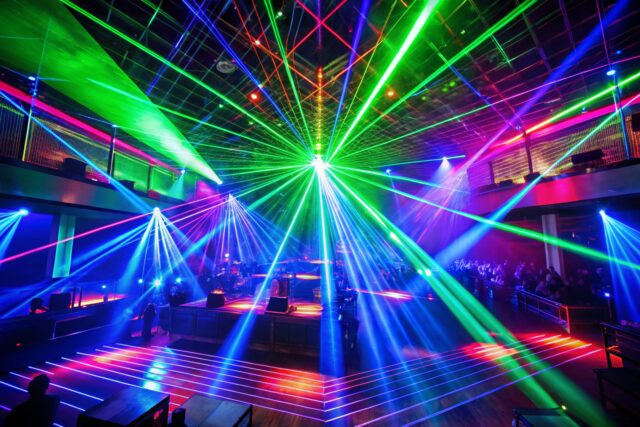
The team wanted a laser tunnel. Money programmed one wrapping around the entire audience. Blank stares. What they actually meant was a cone rising above the crowd.

International touring hides complexities that domestic productions never encounter. Technical precision collides with linguistic ambiguity, and the simplest color request can derail an entire programming session.
When Colors Refuse to Translate
Certain languages use identical words for colors that English speakers treat as entirely distinct. Meganne Money encountered exactly that problem during her K-pop work.
“The words for blue and green are essentially interchangeable in Korean,” she explains. “We found ourselves in extensive back-and-forth exchanges, and even then, the results I was producing weren’t necessarily capturing what they were trying to communicate.”
Imagine programming an elaborate laser sequence. The creative director asks for blue. You deliver blue. Disappointment. You try a different shade. Still wrong. Hours vanish into color swatches and frustrated gestures before someone realizes they meant teal, or cyan, or something landing in murky territory between what English calls blue and what English calls green.
A translator helped bridge the gap, but linguistic conversion only stretches so far. “There’s only so much he can accomplish when he doesn’t know precisely what they envision and can’t simply extract it from their minds,” Money notes.
Technical vocabulary compounds the difficulty. Laser terminology barely exists in standardized English, let alone across language barriers, where even basic color names carry different boundaries.
Geometry Gets Lost Somewhere Between Languages
The tunnel incident captures something more fundamental than vocabulary mismatch. Spatial concepts carry cultural assumptions that rarely survive translation intact.
Money assumed the tunnel meant what it means in American concert parlance: a cylindrical laser formation encircling the audience, beams radiating outward to create an immersive corridor of light. The Korean team pictured something entirely different. A conical formation rising above the crowd. A geometric party hat of laser beams tapering toward a point in the sky.
Both descriptions technically involve enclosed space. Both use light to define boundaries. Neither team was wrong about what a tunnel could mean. They operated from incompatible mental models, and thirty minutes of professional translation couldn’t close that gap.
The Invisible Labor Behind Flawless Shows
Audiences watch K-pop performances and see flawless synchronization. Lasers hit their marks. Colors pulse in perfect harmony with choreography. Everything appears effortless, inevitable, as though the technology simply knows what to do.
Behind that illusion sits someone like Meganne Money, who spent an entire afternoon learning that her client’s request for a tunnel was actually a cone. The sweat behind the spectacle rarely makes headlines. Thirty-minute shape debates won’t appear in any concert review.
“It was a particularly difficult run because of the language barrier,” Money admits about her K-pop experience. Every instruction became a potential misunderstanding. Every confirmation required additional confirmation. The margin for error shrank while communication difficulty expanded.
Meganne Money emerged with hard-won wisdom about the limits of language and the necessity of patience. Some lessons only arrive after standing in a room full of talented professionals, all wanting the same spectacular result, none quite able to articulate what that result should look like.
The cone tunnel, incidentally, looked spectacular.
Frequently Asked Questions
Who is Meganne Money?
Meganne Money is the founder of Laser DesignWorks, where she specializes in laser FX programming, operation, and technical production for live entertainment. Her work has supported tours and performances for artists such as Missy Elliott, Post Malone, Miley Cyrus, Shania Twain, Steve Aoki, 21 Savage, Dream Theater, Joji, Jai Wolf, Busta Rhymes, Cage The Elephant, Ciara, and Zeds Dead.
What is K-pop?
K-pop, short for Korean popular music, is a genre originating from South Korea that emerged in the 1990s and blends pop, hip-hop, R&B, and electronic music. K-pop productions are known for their high visual standards, with live performances and music videos featuring precisely choreographed dance moves performed with sharp exactness. Major acts like BTS and Blackpink have brought the genre to global audiences, making K-pop one of South Korea’s most significant cultural exports.
Disclaimer
Artificial Intelligence Disclosure & Legal Disclaimer
AI Content Policy.
To provide our readers with timely and comprehensive coverage, South Florida Reporter uses artificial intelligence (AI) to assist in producing certain articles and visual content.
Articles: AI may be used to assist in research, structural drafting, or data analysis. All AI-assisted text is reviewed and edited by our team to ensure accuracy and adherence to our editorial standards.
Images: Any imagery generated or significantly altered by AI is clearly marked with a disclaimer or watermark to distinguish it from traditional photography or editorial illustrations.
General Disclaimer
The information contained in South Florida Reporter is for general information purposes only.
South Florida Reporter assumes no responsibility for errors or omissions in the contents of the Service. In no event shall South Florida Reporter be liable for any special, direct, indirect, consequential, or incidental damages or any damages whatsoever, whether in an action of contract, negligence or other tort, arising out of or in connection with the use of the Service or the contents of the Service.
The Company reserves the right to make additions, deletions, or modifications to the contents of the Service at any time without prior notice. The Company does not warrant that the Service is free of viruses or other harmful components.