TEHRAN / WASHINGTON — In a mission described by military officials as one of the most perilous and technically complex extractions in the history of U.S. special operations, American commandos successfully rescued a missing U.S. Air Force Airman from the rugged, snow-dusted peaks of western Iran early Sunday morning. The rescue marks the conclusion of a high-stakes, 48-hour drama that threatened to escalate an already volatile five-week-old conflict between the United States and the Islamic Republic into an even more direct and bloody confrontation.
The Airman, identified by President Donald Trump as a highly respected Colonel and Weapons Systems Officer (WSO), had been evading Iranian search parties since Friday afternoon, when his F-15E Strike Eagle was brought down by Iranian air defenses during a combat sortie. The pilot of the aircraft was recovered within hours of the crash, but the Colonel remained behind enemy lines, sparking a massive, multi-service search-and-rescue (SAR) effort that involved hundreds of personnel and dozens of aircraft.
The President’s Announcement
The news of the successful extraction was first shared by President Donald Trump via a series of celebratory posts on Truth Social shortly after midnight on Easter Sunday.

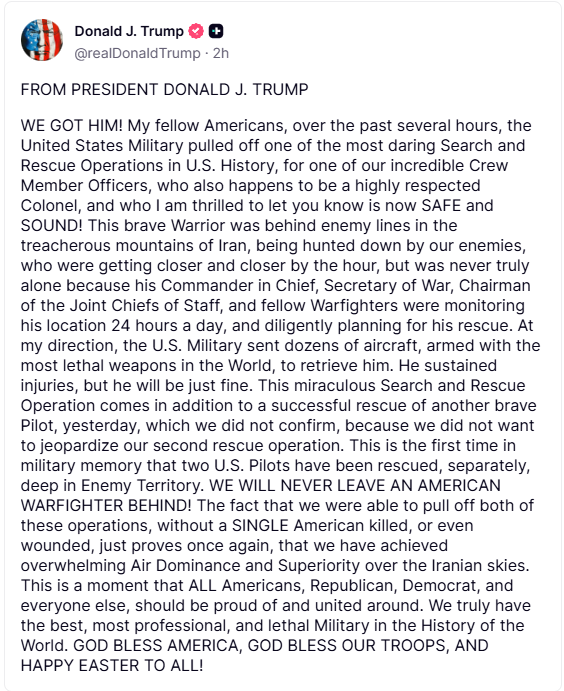
“WE GOT HIM!” the President exclaimed, using his characteristic bold style. “My fellow Americans, over the past several hours, the United States Military pulled off one of the most daring Search and Rescue Operations in U.S. History, for one of our incredible Crew Member Officers, who also happens to be a highly respected Colonel, and who I am thrilled to let you know is now SAFE and SOUND.”
The President went on to describe the conditions the Airman faced during his two days in the wilderness. “This brave Warrior was behind enemy lines in the treacherous mountains of Iran, being hunted down by our enemies, who were getting closer and closer by the hour,” Trump wrote. “But he was never truly alone because his Commander in Chief, Secretary of War Pete Hegseth, Chairman of the Joint Chiefs of Staff Dan Caine, and fellow Warfighters were monitoring his location 24 hours a day, and diligently planning for his return.”
Trump confirmed that while the Airman sustained injuries during the ejection or evasion process, his condition was stable. “He sustained injuries, but he will be just fine,” the President assured the public.
Forty-Eight Hours in the Shadows
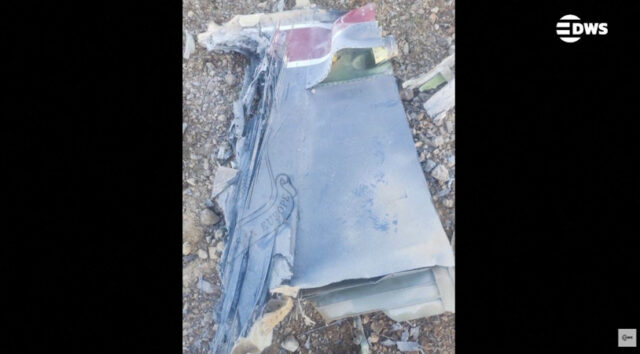
The ordeal began on Friday, April 3, 2026, when the U.S. Air Force F-15E Strike Eagle, operating as part of a coalition strike package against Iranian military infrastructure, was struck by a surface-to-air missile. Both the pilot and the Colonel successfully ejected from the crippled jet, but they became separated in the high winds and jagged terrain of the Zagros Mountains.
While the pilot was located and extracted by a rapid-response SAR team within hours—under heavy fire that damaged at least one A-10 Thunderbolt II and two rescue helicopters—the Colonel disappeared into the “radar-blind” canyons of the mountain range.
For the next 48 hours, the Colonel engaged in a textbook display of Survival, Evasion, Resistance, and Escape (SERE) tactics. Armed with little more than a sidearm, a survival kit, and a handheld radio, he moved only at night, hiding in caves and thick brush during the daylight hours to avoid Iranian military patrols and local militias. Sources indicate that the Iranian Revolutionary Guard Corps (IRGC) had mobilized hundreds of troops to find the downed “trophy,” even going as far as to offer cash rewards to local villagers for information on his whereabouts.
U.S. intelligence officials monitored the situation through a combination of satellite imagery, signals intelligence, and high-altitude drones. At several points, MQ-9 Reaper drones were forced to engage groups of “military-aged males” who approached within three kilometers of the Colonel’s position, providing a lethal “shield” of air support to keep the search parties at bay.
The Midnight Extraction
The final rescue operation, launched under the cover of a moonless night, was a “maximum-effort” mission. According to Pentagon sources, the operation involved a specialized commando unit—likely the Air Force’s Pararescuemen (PJs) — supported by Army Rangers or Navy SEALs, and a fleet of aircraft that included CV-22 Ospreys, MH-47 Chinook helicopters, and F-35 Lightning II fighters for air cover.
The mission was not without incident. As the rescue aircraft entered Iranian airspace, they were met with sporadic ground fire. In a separate but related engagement during the 48-hour window, a U.S. A-10 Thunderbolt II was hit by Iranian fire, forcing the pilot to limp the aircraft into Kuwaiti airspace before ejecting safely.
On the ground in the mountains, the extraction team reportedly engaged in a “heavy firefight” with an Iranian patrol that had closed in on the Colonel’s location. U.S. attack aircraft provided close air support, dropping precision-guided munitions to suppress the Iranian positions while the commandos moved the injured Airman to the extraction bird.
“At my direction, the U.S. Military sent dozens of aircraft, armed with the most lethal weapons in the world, to retrieve him,” Trump stated. He also used the success to underscore his administration’s military posture. “The fact that we were able to pull off both of these operations, without a SINGLE American killed, or even wounded, just proves once again, that we have achieved overwhelming Air Dominance and Superiority over the Iranian skies.”
A Moment of Unity on Easter Sunday
The timing of the rescue, coinciding with Easter Sunday, was not lost on the President or the American public. In his message, Trump called for a moment of national pride.
“This is a moment that ALL Americans, Republican, Democrat, and everyone else, should be proud of and united around,” Trump wrote. “We truly have the best, most professional, and lethal Military in the History of the World. GOD BLESS AMERICA, GOD BLESS OUR TROOPS, AND HAPPY EASTER TO ALL!”
The rescue comes at a critical juncture in the five-week-old war, which began in early March 2026. The conflict, sparked by escalating tensions between Israel and Iran and subsequent U.S. intervention, has seen some of the most intense aerial combat of the 21st century. The shootdown of the F-15E and the subsequent rescue represent the most “perilous moment” for U.S. forces in the war thus far, as it was the first instance of American personnel being downed deep inside hostile Iranian territory.
Technical and Strategic Implications
The loss of an F-15E and the near-loss of its crew have raised questions about the sophistication of Iranian air defenses. While the Trump administration has maintained that the U.S. has “overwhelming air dominance,” military analysts suggest that the IRGC may still possess potent mobile SAM (surface-to-air missile) batteries capable of challenging fourth-generation aircraft like the Strike Eagle.
However, the success of the rescue mission also demonstrates the immense reach and capability of the U.S. Joint Personnel Recovery Center (JPRC). To extract a high-ranking officer from the heart of a hostile nation while under fire is a feat of logistics and bravery that few nations could replicate.
“This is the first time in military memory that two U.S. Pilots have been rescued, separately, deep in Enemy Territory,” Trump noted in his statement. “WE WILL NEVER LEAVE AN AMERICAN WARFIGHTER BEHIND!”
As of Sunday morning, the rescued Colonel has been flown to a U.S. military hospital in Kuwait for evaluation and treatment of his injuries. Officials have not yet released his name, pending notification of his full family and a debriefing on the intelligence he may have gathered while on the ground.
Sources and Links:
- Air & Space Forces Magazine: F-15E Aviator Missing in Iran Rescued by US Forces
- The Washington Post: U.S. rescues missing crew member in Iran after fighter jet shot down
- The Jerusalem Post: US successfully rescues second airman deep behind enemy lines in Iran, Trump confirms
- Washington Examiner: Second pilot from downed F-15 jet rescued in Iran, Trump says
- India Today: He was behind enemy lines: The stunning extraction of downed US pilot from Iran
- Times of Israel: Trump confirms rescue of downed airmen in Iran, says one injured
- Gephardt Daily: Second U.S. airman downed in Iran ‘safe and sound’ after rescue operation
- The Nightly: US-Iran war update: Missing US airman found after rescue plane crashed
- Axios: (Referenced via The Jerusalem Post and Gephardt Daily regarding specialized commando unit details).
Disclaimer
Artificial Intelligence Disclosure & Legal Disclaimer
AI Content Policy.
To provide our readers with timely and comprehensive coverage, South Florida Reporter uses artificial intelligence (AI) to assist in producing certain articles and visual content.
Articles: AI may be used to assist in research, structural drafting, or data analysis. All AI-assisted text is reviewed and edited by our team to ensure accuracy and adherence to our editorial standards.
Images: Any imagery generated or significantly altered by AI is clearly marked with a disclaimer or watermark to distinguish it from traditional photography or editorial illustrations.
General Disclaimer
The information contained in South Florida Reporter is for general information purposes only.
South Florida Reporter assumes no responsibility for errors or omissions in the contents of the Service. In no event shall South Florida Reporter be liable for any special, direct, indirect, consequential, or incidental damages or any damages whatsoever, whether in an action of contract, negligence or other tort, arising out of or in connection with the use of the Service or the contents of the Service.
The Company reserves the right to make additions, deletions, or modifications to the contents of the Service at any time without prior notice. The Company does not warrant that the Service is free of viruses or other harmful components.