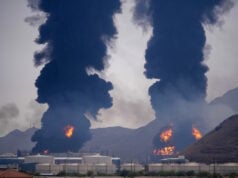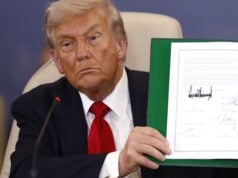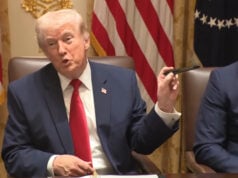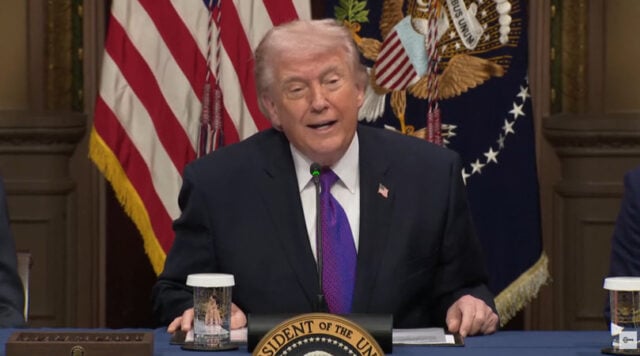
WASHINGTON, D.C. — In the sun-drenched East Room of the White House on Wednesday, March 4, 2026, the traditional decorum of a policy roundtable was starkly punctured by the echoes of a distant conflict. President Donald J. Trump, flanked by the titans of the American technology sector, convened the Ratepayer Reduction Summit—a meeting ostensibly designed to address the skyrocketing electricity bills of the American public. However, the President wasted no time in connecting the domestic struggle for affordable power to the thunder of Tomahawk missiles and the collapse of the Iranian regime’s naval capabilities.
“We are here to protect the American ratepayer, the forgotten man and woman who is being crushed by energy costs,” Trump began, his voice resonant with the familiar cadence of a campaign rally. “But we cannot have energy security at home if we allow the world’s number one sponsor of terror to threaten the global supply and the very stability of our future. We didn’t start this war with Iran, but let me tell you—under this administration, we are finishing it. And we’re finishing it fast.”
The remarks, delivered during the opening ten minutes of the summit, provided the most detailed look yet at the President’s strategic mindset five days into Operation Midnight Hammer, the massive joint U.S.-Israeli military campaign that has fundamentally reshaped the Middle East in less than a week.

The Convergence of AI and Warfare
The summit brought together the leaders of Meta, Amazon, Microsoft, Alphabet, OpenAI, and xAI. The primary agenda was the “Ratepayer Protection Pledge,” a White House initiative compelling tech giants to fund and build their own “behind-the-meter” power plants to support the insatiable energy demands of Artificial Intelligence (AI) data centers. For months, residential electricity prices have surged by as much as 30% in some regions, a spike the Trump administration blames on the “AI gold rush” and the previous administration’s “green energy fantasies.”
“You look at what’s happening in the Strait of Hormuz. You look at the threats to the tankers,” Trump said, leaning forward. “The Iranian regime thought they could hold the world hostage. They thought they could build a nuclear weapon while we looked the other way. They were wrong. Their navy is virtually gone. Their air defenses? Obliterated. We have taken out their missile sites with a precision that nobody—not even the people in this room with all your fancy AI—could have imagined ten years ago.”
The President’s rhetoric at the summit mirrored the aggressive posture adopted by Defense Secretary Pete Hegseth and Secretary of State Marco Rubio in recent days. Trump reiterated that the military’s objectives were singular and uncompromising: the total destruction of Iran’s nuclear infrastructure, its ballistic missile program, and its naval capacity.
According to White House officials, the strikes have already resulted in the death of the Iranian Supreme Leader, Ali Khamenei, and several high-ranking members of the Islamic Revolutionary Guard Corps (IRGC). While the Pentagon has confirmed the loss of four American service members in Kuwait due to retaliatory strikes, Trump struck a tone of somber victory, claiming that the “vicious group of hard, terrible people” running Iran was being replaced by a vacuum that the Iranian people must now fill.
Perhaps the most striking portion of Trump’s opening remarks was his suggestion that the war would follow what he termed the “Venezuela template.” He explicitly called on the Iranian security forces to defect and “peacefully merge with the Iranian patriots.”
“We’ve seen this before. We saw it with Maduro. We see it whenever a dictator loses the will of the people,” Trump said. “The Iranian people are great people. They have a wonderful culture. But they’ve been held back by a radical, wicked dictatorship. Now is their time. We are doing the heavy lifting from the air, but the ground belongs to the people of Iran. I’m telling the IRGC right now: lay down your weapons and you get immunity. Keep fighting for a dead regime, and you face certain death.”
This rhetoric has alarmed some foreign policy veterans who fear the administration is underestimating the potential for a protracted civil war or a regional power vacuum. However, Trump dismissed these concerns at the summit, asserting that General Dan Caine, Chairman of the Joint Chiefs of Staff, had assured him the operation would be “something easily won” and would last no more than “four to five weeks.”
Protecting the American Pocketbook
Returning to the theme of the summit, Trump linked the military success directly to the “Ratepayer Protection Pledge.” He argued that by eliminating the Iranian threat, the U.S. was stabilizing global energy markets, which would eventually lead to lower costs for the American consumer.
“When we have peace through strength, the price of oil goes down. When the price of oil goes down, the cost of everything goes down,” Trump explained. “But we also need you,” he said, gesturing to the tech CEOs, “to stop sucking the life out of our domestic power grid. You’re making billions with AI. That’s great. We want you to win the AI race against China. But you’re going to build your own plants. You’re going to use our coal, our gas, and our nuclear. And you’re going to pay for it yourself so the mother in Pennsylvania or the retiree in Florida doesn’t see their bill double because you need more data centers.”
The pledge, which includes signatures from Amazon, Meta, and OpenAI, commits these companies to “behind-the-meter” generation. This means companies will bypass the traditional utility regulatory process by building dedicated small modular reactors (SMRs) or natural gas turbines directly on-site at their massive data complexes. Critics, including the advocacy group 350.org, have labeled the pledge a “theatrical stunt” that encourages fossil fuel expansion, but the CEOs present seemed to acknowledge the political reality of a second Trump term.
The President’s remarks have already sent shockwaves through international markets and the halls of Congress. While Republican allies like Senator Josh Hawley praised the President for “putting American families first,” Democrats in the Senate have introduced the GRID Act and a war powers resolution in a desperate attempt to curb the President’s military and regulatory authority.
“The President is fighting two wars at once—one in the Middle East and one against the American utility bill,” said a senior administration official who requested anonymity. “To him, they are the same fight. It’s about American sovereignty, American energy, and the removal of anyone, foreign or domestic, who stands in the way of that.”
As the summit moved into its closed-door session, the images broadcast to the world were of a President in total command, bridging the gap between Silicon Valley’s digital future and the kinetic reality of 21st-century warfare. For the “forgotten man” Trump frequently invokes, the promise of a “Ratepayer Reduction” is now inextricably tied to the outcome of the smoke-filled skies over Tehran.
Sources and References
- The White House. (2026, March 4). Live News: President Trump Participates in a Roundtable on Ratepayer Protection Pledge. Retrieved from https://www.whitehouse.gov/live/
- Public Radio Guam (NPR). (2026, March 2). Trump defends Iran strikes, offers objectives for military operation. Retrieved from https://www.islapublic.org/2026-03-02/hegseth-we-didnt-start-this-war-but-under-president-trump-were-finishing-it
- Argus Media. (2026, February 24). Trump upbeat on economy despite tariff setback: State of the Union 2026. Retrieved from https://www.argusmedia.com/ja/news-and-insights/latest-market-news/2792674-trump-upbeat-on-economy-despite-tariff-setback
- MNI Political Risk Analysis. (2026, March 4). US Daily Brief: Ratepayer Protection Pledge and Middle East Conflict Day Five. Retrieved from https://media.marketnews.com/MNIPOLRISKUS_Daily040326_aa97410cfb.pdf
- House of Commons Library. (2026, March 2). Research Briefing: US-Israel strikes on Iran: February/March 2026. Retrieved from https://commonslibrary.parliament.uk/research-briefings/cbp-10521/
- PBS NewsHour. (2026, February 28). Read Trump’s full statement on Iran attacks. Retrieved from https://www.pbs.org/newshour/world/read-trumps-full-statement-on-iran-attack
- Wikipedia. (2026, March 4). 2025–2026 Iran–United States negotiations. Retrieved from https://en.wikipedia.org/wiki/2025%E2%80%932026_Iran%E2%80%93United_States_negotiations
- Council on Foreign Relations (CFR). (2026, March 3). The U.S. Campaign in Iran Ignores the Lessons of the Iraq War. Retrieved from https://www.cfr.org/articles/trumps-iran-campaign-ignores-the-lessons-of-the-iraq-war
- EnergyConnects. (2026, March 4). Soaring Power Prices Have US Politicians Searching for Solutions. Retrieved from https://www.energyconnects.com/news/utilities/2026/march/soaring-power-prices-have-us-politicians-searching-for-solutions/
- Legal Planet. (2026, February 25). Trump’s Ratepayer Protection Pledge: Analysis of Electricity Prices. Retrieved from https://legal-planet.org/2026/02/25/trumps-ratepayer-protection-pledge-more-bs-on-electricity-prices/
- Broadband Breakfast. (2026, February 25). Trump Announces Data Center ‘Rate Payer Protection Pledge’ at SOTU. Retrieved from https://broadbandbreakfast.com/trump-announces-data-center-rate-payer-protection-pledge-at-sotu/
Disclaimer
Artificial Intelligence Disclosure & Legal Disclaimer
AI Content Policy.
To provide our readers with timely and comprehensive coverage, South Florida Reporter uses artificial intelligence (AI) to assist in producing certain articles and visual content.
Articles: AI may be used to assist in research, structural drafting, or data analysis. All AI-assisted text is reviewed and edited by our team to ensure accuracy and adherence to our editorial standards.
Images: Any imagery generated or significantly altered by AI is clearly marked with a disclaimer or watermark to distinguish it from traditional photography or editorial illustrations.
General Disclaimer
The information contained in South Florida Reporter is for general information purposes only.
South Florida Reporter assumes no responsibility for errors or omissions in the contents of the Service. In no event shall South Florida Reporter be liable for any special, direct, indirect, consequential, or incidental damages or any damages whatsoever, whether in an action of contract, negligence or other tort, arising out of or in connection with the use of the Service or the contents of the Service.
The Company reserves the right to make additions, deletions, or modifications to the contents of the Service at any time without prior notice. The Company does not warrant that the Service is free of viruses or other harmful components.