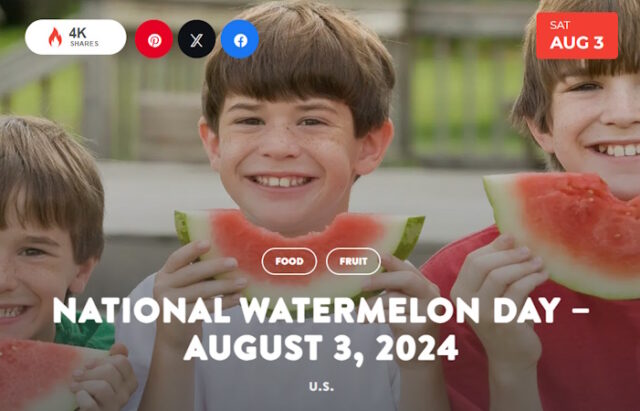
National Watermelon Day on August 3rd recognizes the refreshing summertime treat enjoyed at picnics and fairs! And since watermelon is 92% water, it is very satisfying in the summer heat.
- 1615 – According to “The Dictionary of American Food and Drink” by John Mariani, the word ‘watermelon’ first appeared in the English dictionary in 1615.
- 1634 – The watermelon has long inspired artists, such as Giuseppe Recco’s “Still-Life with Fruit and Flowers.”
- 1796 – The first cookbook published in the United States in 1796, American Cookery by Amelia Simmons, contains a recipe for watermelon rind pickles.
- 1840s – The sweetest watermelon is the Bradford watermelon. It was created by Nathaniel Napoleon Bradford of South Carolina in the 1840s. It was unusually sweet but the skin was too soft for transportation, making it commercially nonviable.
- 1893 – In his novel “The Tragedy of Pudd’nhead Wilson,” Mark Twain describes the watermelon as “what the angels eat.”
- 1939 – Seedless watermelons are developed by treating the unpollinated flowers of watermelons with an acid.
- 2007 – the year when the Oklahoma State Senate made watermelon its official state vegetable.
- 2013 – Oct. 4th The Guinness World Record for the heaviest watermelon ever is grown by Tennessee-based Chris Kent.
- Watermelon is one of the lowest fruits in terms of calories, yet it is one of the best in terms of the nutrients that it delivers. It provides three percent of the RDI (Recommended Daily Intake) in terms of vitamins B6, B5, and B1.
- It also offers four percent of your RDI of magnesium, as well as five percent of your RDI of potassium, 18 percent of your RDI of vitamin A, and 21 percent of your RDI of Vitamin C.
- It has also been proven that watermelon is beneficial when it comes to your hair and your skin. This is because of the vitamins C and A that are included in watermelons.
- Vitamin C helps to create collagen, which is the protein that keeps your hair strong and your skin supple.
- Vitamin A is also critical in terms of healthy skin, as it assists with repairing skin cells and creating them. Your skin can look flaky and dry if you do not have enough Vitamin A.
- By weight, watermelon is the most-consumed melon in the U.S., followed by cantaloupe and honeydew.
- The first recorded watermelon harvest occurred nearly 5,000 years ago in Egypt.
- Watermelon’s official name is Citrullus Lanatus of the botanical family Curcurbitaceae. It is a cousin to cucumbers, pumpkins and squash.
- Seedless watermelons aren’t genetically modified. They’re actually a hybrid watermelon. Seedless watermelons were first created over 50 years ago.
- Over 300 types of watermelons are grown in the U.S., although only about 50 varieties are grown for grocery stores.
- Watermelons usually have red flesh, but some watermelons have white, yellow, orange, or even green flesh.
- China grows more watermelon than any other country.
- In China, guests offer watermelons as gifts to a hostess.
- The U.S. ranks seventh in the world for watermelon production. Top watermelon-growing states include California, Arizona, Texas, Florida and Georgia.
- Watermelon is the official vegetable of Oklahoma.
- The novelty of a cubed watermelon began in Japan where they would grow them in glass boxes to hold their shape
- Although many people prefer not to, all of the watermelon, including the rind can be eaten
- Watermelon juice may relieve muscle tension
- Watermelon is known as a natural Viagra due to its citrulline content
- In some cases, watermelon can reduce inflammation in the body
- In ancient Egypt, watermelons were placed in burial tombs to nourish the soul after they had passed
- In many Mediterranean countries including Israel and Egypt, watermelon is often served with feta cheese.
- Watermelon contains more lycopene than raw tomatoes which is famously known as a cancer-fighting substance.
- So, the commercial production of the variety ended by the 1920s, and it almost died out. Still, the Bradford family decided to keep the variety alive in their backyard for several generations. The great-great-great-grandson – Nat Bradford has once again started producing it commercially.
- A watermelon was once thrown at Greek orator Demosthenes during a speech. Placing the watermelon on his head, he thanked the thrower for providing him with a helmet to wear as he fought Philip of Macedonia.
- Americans eat more watermelon than any other type of melon
- More than 1200 kinds of watermelon exist around the world.
- It’s traditional to eat watermelon with salt. The salt helps bring out the sweet flavor of the fruit’s flesh.
- In Egypt and Israel, people take this a step further, eating watermelon not with salt, but with salted feta cheese. In addition to bringing out the watermelon’s flavor, the cheese adds its own unique flavor as well.
- 92% – the percentage of a watermelon that is water.
- 1,200 – the estimated number of varieties of watermelon available.
- 85% – the percentage of watermelons sold today that are seedless.
- 350.5 – the weight in pounds of the world’s heaviest watermelon grown in 2013.
- $100 – the starting price of square watermelons.
- 85–100 – the number of days it takes for most watermelons to mature.
- 300 – the number of types of watermelons grown in the U.S.
- 9–10 – the sweetness measurement of most watermelons on the Brix scale.
- 75 feet – the record distance for spitting watermelon seeds held by Jason Schayot.
Sources:

Disclaimer
Artificial Intelligence Disclosure & Legal Disclaimer
AI Content Policy.
To provide our readers with timely and comprehensive coverage, South Florida Reporter uses artificial intelligence (AI) to assist in producing certain articles and visual content.
Articles: AI may be used to assist in research, structural drafting, or data analysis. All AI-assisted text is reviewed and edited by our team to ensure accuracy and adherence to our editorial standards.
Images: Any imagery generated or significantly altered by AI is clearly marked with a disclaimer or watermark to distinguish it from traditional photography or editorial illustrations.
General Disclaimer
The information contained in South Florida Reporter is for general information purposes only.
South Florida Reporter assumes no responsibility for errors or omissions in the contents of the Service. In no event shall South Florida Reporter be liable for any special, direct, indirect, consequential, or incidental damages or any damages whatsoever, whether in an action of contract, negligence or other tort, arising out of or in connection with the use of the Service or the contents of the Service.
The Company reserves the right to make additions, deletions, or modifications to the contents of the Service at any time without prior notice. The Company does not warrant that the Service is free of viruses or other harmful components.