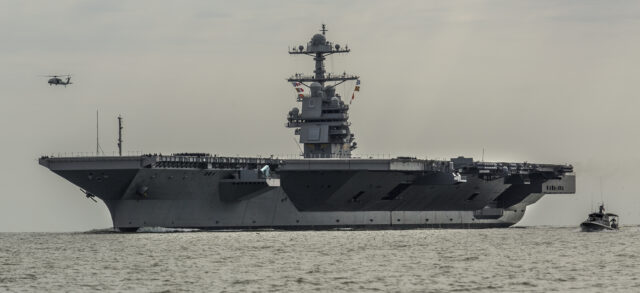
The United States has repositioned its newest aircraft carrier, the USS Gerald R. Ford, accompanied by three warships, into the region of U.S. Southern Command’s jurisdiction—marking a significant escalation in naval presence near Latin America. In response, Venezuela’s defence minister, Vladimir Padrino López, announced that the country will activate its full military arsenal, mobilizing militia, ground, naval, aerial and missile forces, with nearly 200,000 soldiers on alert.
U.S. officials say the deployment is intended to strengthen capabilities aimed at disrupting drug‑trafficking networks and transnational criminal organizations. Yet analysts interpret the carrier’s arrival as more than just a counternarcotics manoeuvre. Given the strategic heft of a carrier strike group—formerly reserved for high‑stakes global missions—the move is being read as a potential signal of U.S. willingness to escalate against Venezuela.
This development comes amid rising speculation over whether the U.S., under Trump’s administration, may pursue regime‑change goals against Venezuelan President Nicolás Maduro. Although officials reassured Congress that no active preparations for a direct strike are underway, concerns persist that the window for action is narrowing—“the shot clock has started,” as one expert put it.
For Venezuela, the mobilisation underscores a defensive posture steeped in brinkmanship. The country is preparing “massive deployment of ground, aerial, naval, riverine and missile forces” with full militia involvement. Meanwhile, Congress remains wary of the expanded U.S. military footprint in the region, with some lawmakers warning that the administration’s actions may risk executive overreach absent proper war‑powers oversight.

As the carrier advances into the Caribbean and Atlantic corridors long used by drug‑smuggling networks, the broader message is clear: a region once on the periphery of major U.S. naval operations is now part of the chessboard. The stakes include not only counternarcotics efforts, but also the balance of power in Latin America at a time of heightened geopolitical tension.
Sources:
Disclaimer
Artificial Intelligence Disclosure & Legal Disclaimer
AI Content Policy.
To provide our readers with timely and comprehensive coverage, South Florida Reporter uses artificial intelligence (AI) to assist in producing certain articles and visual content.
Articles: AI may be used to assist in research, structural drafting, or data analysis. All AI-assisted text is reviewed and edited by our team to ensure accuracy and adherence to our editorial standards.
Images: Any imagery generated or significantly altered by AI is clearly marked with a disclaimer or watermark to distinguish it from traditional photography or editorial illustrations.
General Disclaimer
The information contained in South Florida Reporter is for general information purposes only.
South Florida Reporter assumes no responsibility for errors or omissions in the contents of the Service. In no event shall South Florida Reporter be liable for any special, direct, indirect, consequential, or incidental damages or any damages whatsoever, whether in an action of contract, negligence or other tort, arising out of or in connection with the use of the Service or the contents of the Service.
The Company reserves the right to make additions, deletions, or modifications to the contents of the Service at any time without prior notice. The Company does not warrant that the Service is free of viruses or other harmful components.