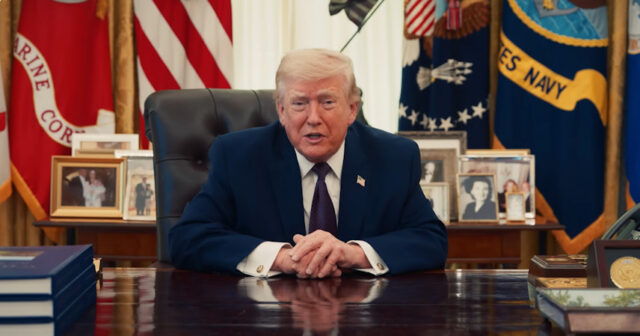
WASHINGTON, D.C. — The White House confirmed late Tuesday that President Donald Trump will deliver a primetime address to the nation on Wednesday at 9:00 p.m. ET. The speech, to be delivered from the Oval Office, comes at a pivotal moment as the ongoing conflict with Iran enters a more volatile phase, and the administration faces growing pressure over a domestic economy rattled by geopolitical instability.
Click the picture to go to LIVE feed
A High-Stakes Update on the “Iran War”
Sources close to the National Security Council suggest the President intends to provide a “comprehensive operational update” on U.S. military activities in the Persian Gulf and Western Iran. While the administration has characterized recent actions as “precision-based deterrence,” the scale of the engagement has expanded significantly over the last fortnight.
The Wednesday address is expected to outline the next steps in what the President has termed a “campaign for ultimate regional security.” However, the tone from the West Wing has been described as somber yet defiant. The President is reportedly preparing to declassify specific intelligence regarding Iranian tactical movements that necessitated recent U.S. airstrikes, seeking to solidify public support for a conflict that many had hoped would remain contained.
Diplomatic Tensions: The Fight for Basing Rights
Perhaps the most contentious element of the President’s upcoming speech will be his directed criticism of international partners. For weeks, the Trump administration has been locked in a quiet but fierce diplomatic struggle with several key nations in the Middle East and Europe.

Internal memos leaked to the press indicate a deep-seated frustration within the Oval Office regarding “basing rights.” Several nations, citing fears of Iranian retaliation or domestic political backlash, have reportedly denied U.S. combat aircraft the use of their runways for offensive sorties.
President Trump has not hidden his irritation. In a series of social media posts and brief comments to reporters on the South Lawn earlier today, he signaled that his patience with “non-contributing allies” has reached a breaking point.
“We are defending the world, and we are defending their interests, yet they won’t even let our planes land or take off from their bases,” the President remarked. “It’s the same old story. America does the work, and they provide the excuses. That’s going to change, and it’s going to change very fast.”
Diplomatic analysts suggest that the President may use the Wednesday address to issue a formal ultimatum to specific regional partners. The refusal of these nations to allow U.S. assets to operate from their soil has forced the Pentagon to rely more heavily on carrier-based operations and long-range bombers stationed in more distant territories, significantly increasing the logistical cost and complexity of the mission.
Markets in Turmoil: The Economic “See-Saw”
While the drums of war beat louder, Wall Street is feeling the reverberations. The financial markets have been locked in a dizzying “see-saw” pattern for the past five trading sessions. Investors have struggled to find a foothold as every update from the front lines triggers sharp swings in the major indices.
The Dow Jones Industrial Average has seen intraday swings of nearly 800 points, as “risk-off” sentiment battles with bargain hunters. Technology stocks, particularly those with heavy reliance on global supply chains that could be disrupted by a wider Middle Eastern conflict, have led the downward slides. Conversely, defense contractors and traditional energy companies have seen brief, explosive rallies, contributing to the market’s overall volatility.
“The market hates uncertainty, and right now, we have nothing but uncertainty,” said Marcus Thorne, a senior market analyst at Bloomberg. “The see-sawing we’re seeing is a direct reflection of a ‘wait-and-see’ approach. Everyone is holding their breath for Wednesday night to see if we are looking at a localized conflict or a full-scale regional war.”
The $4 Gallon: Pain at the Pump
Nowhere is the conflict being felt more acutely by the average American than at the gas station. National averages for a gallon of regular unleaded have officially crossed the $4.00 mark, with some metropolitan areas in California and the Northeast reporting prices as high as $5.25.
The surge is a direct consequence of the instability in the Strait of Hormuz, a critical chokepoint for global oil transit. Crude oil futures have spiked, and despite the administration’s efforts to release more from the Strategic Petroleum Reserve, the psychological impact of the war is driving prices higher.
For President Trump, whose political brand is tied closely to economic prosperity and “the forgotten man,” these prices represent a significant domestic hurdle. He is expected to address these concerns directly on Wednesday night, likely framing the energy crisis as another reason why the U.S. must “finish the job” in Iran quickly to restore global stability.
National Response and What to Expect
Congressional response to the upcoming address is predictably split. Republican leaders have largely rallied behind the President, urging for “strength and clarity” in the face of Iranian aggression. Meanwhile, several prominent Democrats have called for a reassessment of the administration’s “maximum pressure” tactics, arguing that the lack of international basing support is proof that the U.S. is “going it alone” in a dangerous theater.
When the President takes the podium at 9:00 p.m. tomorrow, the world will be watching for three specific signals:
- Military Intent: Does he announce a troop surge or a shift in tactical goals?
- Diplomatic Retribution: Does he name the nations that have denied basing rights and announce consequences?
- Economic Assurance: What concrete steps will he take to stabilize the markets and lower the price of gas?
As the sun sets on Washington tonight, the tension is palpable. The “Iran war” is no longer a distant geopolitical concern—it is a reality being felt in the American wallet and seen on every trading floor. Wednesday night’s address may well be the most consequential moment of the Trump presidency since his return to office.
Sources Used and Links
- Associated Press (AP): Trump schedules Oval Office address on Iran conflict
- Reuters: Global markets seesaw as Middle East tensions escalate
- Bloomberg: Energy markets react to $4 gas and rising oil futures
- The Wall Street Journal: U.S. struggles with basing rights in Middle East theater
- AAA Gas Prices: National average for regular unleaded hits $4.00 threshold
- Fox News: President Trump expresses frustration with allies over military support
- The New York Times: The logistical challenges of a carrier-reliant Iran strategy
Disclaimer
Artificial Intelligence Disclosure & Legal Disclaimer
AI Content Policy.
To provide our readers with timely and comprehensive coverage, South Florida Reporter uses artificial intelligence (AI) to assist in producing certain articles and visual content.
Articles: AI may be used to assist in research, structural drafting, or data analysis. All AI-assisted text is reviewed and edited by our team to ensure accuracy and adherence to our editorial standards.
Images: Any imagery generated or significantly altered by AI is clearly marked with a disclaimer or watermark to distinguish it from traditional photography or editorial illustrations.
General Disclaimer
The information contained in South Florida Reporter is for general information purposes only.
South Florida Reporter assumes no responsibility for errors or omissions in the contents of the Service. In no event shall South Florida Reporter be liable for any special, direct, indirect, consequential, or incidental damages or any damages whatsoever, whether in an action of contract, negligence or other tort, arising out of or in connection with the use of the Service or the contents of the Service.
The Company reserves the right to make additions, deletions, or modifications to the contents of the Service at any time without prior notice. The Company does not warrant that the Service is free of viruses or other harmful components.