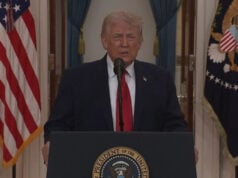
DAVOS, Switzerland — President Donald J. Trump has touched down in the snow-capped peaks of Switzerland for the 2026 World Economic Forum (WEF), leading the largest American delegation in the event’s 56-year history. Accompanied by a “heavy-hitting” Cabinet—including Secretary of State Marco Rubio, Treasury Secretary Scott Bessent, and Commerce Secretary Howard Lutnick—Trump’s arrival has effectively shifted the gravity of the summit from its traditional focus on global cooperation to a high-stakes arena for “America First” deal-making.
This visit marks Trump’s third in-person appearance at the forum as President, following his landmark trips in 2018 and 2020. While the 2025 summit saw him deliver a punchy address via video link just days after his second inauguration, the 2026 return is a physical projection of power. The theme of this year’s forum, “A Spirit of Dialogue,” is being put to an immediate and grueling test as Trump brings a suitcase full of trade ultimatums and a controversial new geopolitical architecture.
The Greenland Ultimatum: A New Wave of Tariffs
The primary source of tension in the halls of the Congress Center is the President’s latest trade offensive. Just 48 hours before his arrival, Trump stunned European allies by announcing a tiered tariff structure aimed at forcing a deal for the purchase of Greenland.
According to the administration’s latest “Truths,” the U.S. will impose a 10% tariff on imports from Denmark, Norway, Sweden, France, Germany, the United Kingdom, the Netherlands, and Finland starting February 1, 2026. This levy is scheduled to skyrocket to 25% on June 1 if a “Total Purchase” agreement for the Arctic island is not reached.

- Impact on Allies: EU ambassadors held emergency sessions Sunday, labeling the moves “economic coercion.”
- The Rationale: Trump argues that U.S. control of Greenland is a matter of national security to counter Russian and Chinese expansion in the Arctic.
- Market Volatility: Global markets have already reacted with a flight to safe-haven assets like gold and silver, while European wine producers and manufacturers express “deep concern” over the potential disruption of the transatlantic trade corridor.
Signing the “Board of Peace
Beyond trade, Trump’s most ambitious project is the Board of Peace (BoP). A formal signing ceremony for the Board’s charter is scheduled for Thursday morning in Davos, where heads of state have been invited to officially join the U.S.-led intergovernmental organization.
The Billion-Dollar Seat
The Board of Peace is not a standard diplomatic committee. According to leaked charter documents and administration officials, the BoP operates on a unique “commercial trusteeship” model:
- Permanent Membership: Requires a $1 billion contribution to a fund earmarked for the reconstruction of Gaza and global stability.
- Rotating Membership: Nations that do not pay the fee may serve a three-year term by invitation but lack permanent voting status.
- The Mandate: Initially authorized by UN Security Council Resolution 2803 to oversee the demilitarization and reconstruction of Gaza, the Board’s new charter suggests a much broader mandate—effectively positioning it as a U.S.-controlled alternative to the UN Security Council for resolving global conflicts.
History and Evolution of the Board
The Board has its roots in the “Trump Declaration for Enduring Peace and Prosperity,” signed in October 2025 alongside leaders from Egypt, Qatar, and Türkiye. What began as a 20-point plan to end the Gaza conflict has evolved into a global body chaired by Trump himself.
While supporters like Argentina’s Javier Milei and Hungary’s Viktor Orbán have already pledged their participation, calling it a “bold new approach,” traditional powers like France and the European Union remain skeptical. Critics argue the Board represents a “vanity project” that sidelines Palestinian voices and replaces international law with transactional diplomacy.
Looking Back: Davos 2018 and 2020
Trump’s relationship with Davos has always been one of “adversarial attendance.”
- In 2018, he was the first sitting U.S. president to attend in nearly two decades, telling the “globalist” crowd that “America First does not mean America alone,” while still championing protectionist policies.
- In 2020, he used the stage to decry “prophets of doom” regarding climate change, just as the world was on the brink of the COVID-19 pandemic.
Now, in 2026, he returns not just as a participant but as a disruptor who has spent the last year dismantling the “old world order” Davos once represented. With WEF founder Klaus Schwab stepping down in 2025, the forum feels less like a consensus-building retreat and more like a stage for the President’s personal brand of “might-is-right” diplomacy.
News Sources and References
- The Guardian: Davos 2026: The last-chance saloon to save the old world order?
- The Times of India: WEF Davos 2026: Donald Trump to attend summit with largest-ever US delegation
- PBS NewsHour: $1 billion contribution secures permanent seat on Trump’s ‘Board of Peace’
- CBS News: Trump says he will impose 10% tariffs on countries that send military forces to Greenland
- The Times of Israel: Signing ceremony for Trump’s Board of Peace set for Thursday in Davos
- WhiteHouse.gov: The Trump Declaration for Enduring Peace and Prosperity (Oct 2025)
Disclaimer
Artificial Intelligence Disclosure & Legal Disclaimer
AI Content Policy.
To provide our readers with timely and comprehensive coverage, South Florida Reporter uses artificial intelligence (AI) to assist in producing certain articles and visual content.
Articles: AI may be used to assist in research, structural drafting, or data analysis. All AI-assisted text is reviewed and edited by our team to ensure accuracy and adherence to our editorial standards.
Images: Any imagery generated or significantly altered by AI is clearly marked with a disclaimer or watermark to distinguish it from traditional photography or editorial illustrations.
General Disclaimer
The information contained in South Florida Reporter is for general information purposes only.
South Florida Reporter assumes no responsibility for errors or omissions in the contents of the Service. In no event shall South Florida Reporter be liable for any special, direct, indirect, consequential, or incidental damages or any damages whatsoever, whether in an action of contract, negligence or other tort, arising out of or in connection with the use of the Service or the contents of the Service.
The Company reserves the right to make additions, deletions, or modifications to the contents of the Service at any time without prior notice. The Company does not warrant that the Service is free of viruses or other harmful components.