WASHINGTON, D.C. — Amidst the pastel-colored festivities and the rolling of wooden eggs on the South Lawn, the 2026 White House Easter Egg Roll took an unexpected geopolitical turn this Monday. President Donald J. Trump, appearing before a crowd of thousands of families and journalists, pivoted from lighthearted holiday banter to a stern warning regarding the escalating “Iran situation,” doubling down on a controversial strategy to seize and secure Iranian petroleum assets—a move that has already sparked a sharp divide between the administration and a weary American public.
The South Lawn Proclamation
The day began with the traditional blowing of the silver whistle, signaling the start of the egg-rolling races for children. However, during an informal “gaggle” with reporters near the main stage, the President was asked about the recent maritime tensions in the Strait of Hormuz.

“We have the greatest military in the world, but we’ve been played for fools for decades,” Trump stated, adjusting his signature red tie while a costumed Easter Bunny stood several yards away. “Iran is a mess. They are a bad actor. But they have something we need, and something they don’t deserve if they’re going to keep threatening our ships. I’ve always said it—with Iraq, we should have kept the oil. We didn’t. We won’t make that mistake again. If we have to go in, we’re keeping the oil. We’re taking it, and we’re keeping it. It pays for the costs of the mission, and it helps the American consumer.”
The President’s comments, while echoing rhetoric from his first term and his 2024 campaign, come at a moment of heightened sensitivity. With global oil prices fluctuating near $95 per barrel and the Iranian government recently ramping up its enrichment capabilities, the suggestion of a resource-driven military intervention has sent shockwaves through diplomatic circles.
The “Keep the Oil” Doctrine: A Strategic Pivot
The President’s “Keep the Oil” philosophy is rooted in a mercantilist view of foreign policy that views military expenditure as an investment that should yield tangible returns. White House advisors, speaking on the condition of anonymity, suggest that the administration is drafting a framework titled the “Resource Recovery Initiative.”
Under this purported plan, any military response to Iranian aggression would not focus on “regime change” or “nation-building”—concepts Trump has frequently derided as “stupid” and “wasteful”—but rather on the physical control of the Khuzestan province, where the vast majority of Iran’s oil reserves are located.
“The President is looking at this as a businessman,” said one senior administration official. “He sees a country that is hostile to US interests and sitting on a trillion dollars of black gold. His view is: why should American taxpayers foot the bill for security in the Middle East if we aren’t getting paid? Control the wells, control the flow, and you control the behavior of the regime.”
A Nation Divided: The Public Rejection
Despite the President’s confident delivery on the South Lawn, the American public appears increasingly allergic to the idea of another Middle Eastern conflict, regardless of the potential economic spoils. A Gallup poll released just this morning shows a staggering shift in national sentiment.
| Demographic Group | Oppose Military Action in Iran | Support “Keeping the Oil” Strategy |
| All US Adults | 68% | 22% |
| Gen Z (18-29) | 81% | 9% |
| Millennials | 74% | 14% |
| Gen X | 62% | 28% |
| Boomers+ | 55% | 35% |
The data suggests that while the President’s base remains somewhat loyal to his “America First” energy independence goals, the broader electorate is haunted by the legacies of the Iraq and Afghanistan wars. The prospect of “taking the oil” is viewed by many not as a savvy business move, but as a violation of international law that would likely mire the United States in a multi-decade insurgency.
“Americans are tired,” says Dr. Elena Vance, a senior fellow at the Center for New National Security. “They hear ‘keep the oil’ and they don’t see lower gas prices; they see flag-draped coffins and a national debt that continues to spiral. There is a fundamental disconnect between the President’s 19th-century resource-grab strategy and a 21st-century public that wants to pivot away from fossil fuel wars entirely.”
International Legal Fallout and Market Volatility
Legal experts were quick to point out that “keeping the oil” of a sovereign nation would likely constitute a war crime under the Hague and Geneva Conventions, specifically regarding the pillaging of occupied territory.
“The Fourth Geneva Convention is very clear on this,” noted Professor Marcus Thorne of Georgetown Law. “A belligerent power can use the resources of an occupied territory for the immediate needs of the occupation, but it cannot seize them for the benefit of its own national economy. To do so would invite universal condemnation and potentially trigger a global embargo against American energy exports.”
Market reaction to the President’s Easter Monday comments was swift. Crude oil futures (WTI) jumped 3.4% within an hour of the remarks, as traders factored in the increased risk of a hot war in the Persian Gulf. Analysts at Bloomberg Energy warned that any attempt to seize Iranian infrastructure would likely result in the Iranian military sabotaging their own wells—an “environmental and economic scorched-earth policy” that could send oil prices soaring past $150 per barrel.
Congressional Blowback
On Capitol Hill, the reaction was divided along increasingly fractured partisan lines, with even some of the President’s usual allies expressing caution.
“We need to be very careful,” said Senator John Thune (R-SD) in a brief interview. “While we must project strength against Iran, our focus should be on sanctions and diplomatic pressure. The American people have a very low appetite for a ground war, especially one centered on resource extraction.”
Democratic leaders were more pointed. Speaker of the House Hakeem Jeffries issued a statement shortly after the President’s remarks: “The President is treating the US Military like a private mercenary force. We are not a colonial power. We do not invade countries to loot their natural resources. The House will not authorize a single penny for a war of plunder.”
The Scene on the Ground
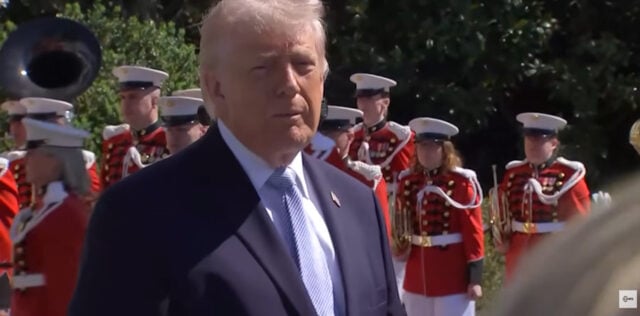
Back at the White House, the dissonance between the President’s words and the setting was palpable. As Trump spoke of seizing oil fields and “hitting Iran harder than they’ve ever been hit,” the “Commanders Own” Marine Drum and Bugle Corps played upbeat patriotic tunes in the background. Families from all 50 states, many of whom had won their tickets through a lottery, seemed more focused on the festivities than the brewing international crisis.
“I came here to see my daughter roll an egg, not to hear about a third world war,” said Michael Hennessey, a father of three from Ohio. “I like the President’s toughness, but I think most of us just want things to stay peaceful. We’ve had enough war for one lifetime.”
Iran’s Response
Tehran wasted little time in responding to the Easter Monday comments. A spokesperson for the Iranian Foreign Ministry called the President’s remarks “the delusional ramblings of a fading empire,” asserting that Iran would defend its sovereignty with “crushing force.”
Regional experts suggest that Trump’s rhetoric may actually be strengthening the hardliners within the Iranian Revolutionary Guard Corps (IRGC), who use such threats to justify further crackdowns on domestic dissent and to accelerate their nuclear program as a deterrent against what they perceive as American “resource imperialism.”
Conclusion: The Road Ahead
As the sun sets on the 2026 Easter Egg Roll, the festive atmosphere has been replaced by a heavy sense of uncertainty. President Trump remains undeterred, insisting that his “Keep the Oil” stance is the only way to ensure that American military intervention provides a “return on investment.”
However, with the public’s staunch opposition and the potential for unprecedented legal and economic blowback, the administration faces a steep uphill battle. The coming weeks will likely see a showdown in Congress over War Powers, as the President continues to test the boundaries of “America First” in an increasingly volatile Middle East.
For now, the wooden eggs have been rolled and the South Lawn is being cleared. But the words spoken by the President today have ensured that the conversation surrounding Iran has shifted from “if” to “how,” and at what cost to the American conscience.
Sources Used and Links:
- White House Press Office: Official Transcript of the 2026 Easter Egg Roll Remarks. https://www.whitehouse.gov/briefing-room/
- Gallup News: “Public Sentiment on Middle Eastern Intervention and Resource Acquisition.” https://news.gallup.com/poll/politics.aspx
- The Associated Press: “Trump Proposes ‘Resource Recovery’ Strategy During White House Event.” https://apnews.com/hub/politics
- Reuters: “Global Oil Markets React to US Presidential Remarks on Iran.” https://www.reuters.com/business/energy/
- Bloomberg Energy: “The Economic Risk of Resource-Based Conflict in the Persian Gulf.” https://www.bloomberg.com/energy
- International Committee of the Red Cross (ICRC): “Rules of War: Protection of Property in Occupied Territory.” https://www.icrc.org/en/war-and-law
- Al Jazeera English: “Tehran Responds to Trump’s ‘Keep the Oil’ Comments.” https://www.aljazeera.com/where/iran/
Disclaimer
Artificial Intelligence Disclosure & Legal Disclaimer
AI Content Policy.
To provide our readers with timely and comprehensive coverage, South Florida Reporter uses artificial intelligence (AI) to assist in producing certain articles and visual content.
Articles: AI may be used to assist in research, structural drafting, or data analysis. All AI-assisted text is reviewed and edited by our team to ensure accuracy and adherence to our editorial standards.
Images: Any imagery generated or significantly altered by AI is clearly marked with a disclaimer or watermark to distinguish it from traditional photography or editorial illustrations.
General Disclaimer
The information contained in South Florida Reporter is for general information purposes only.
South Florida Reporter assumes no responsibility for errors or omissions in the contents of the Service. In no event shall South Florida Reporter be liable for any special, direct, indirect, consequential, or incidental damages or any damages whatsoever, whether in an action of contract, negligence or other tort, arising out of or in connection with the use of the Service or the contents of the Service.
The Company reserves the right to make additions, deletions, or modifications to the contents of the Service at any time without prior notice. The Company does not warrant that the Service is free of viruses or other harmful components.